
Can the bend of a banana give us insight into cancer? What does the shape of a rice grain have to do with infertility? The proteins that give plants their shape and structure are also involved in human disease. A team led by researchers at the University of California, Davis, has mapped out the structure of a key player, augmin, in exhaustive detail.
"This work shows how plants and animals are similar," said Jawdat Al-Bassam, associate professor of molecular and cellular biology at UC Davis. "It could help answer some fundamental questions not just about plants, but also humans."
Augmin is a protein complex that binds to microtubules, the cell's internal skeleton, aiding in the formation of branched microtubules and playing a key role in cell division.
Augmin defects can cause infertility in humans. In addition, "some augmin subunits are highly expressed in human cancer cells," said Bo Liu, a professor of plant biology who collaborated with Al-Bassam on the new study. Understanding its structure could yield both new medical treatments and new strategies for breeding higher-quality rice and cotton crops.
A surprise in plants
Inside the cells of every plant and animal is a shape-shifting skeleton.
This morphing skeleton can cause cells to expand, stretch, or bend - sculpting the overall shapes of bulging strawberries, curving cucumbers, and the long skinny nerve cells that connect our brains and feet.
When a cell divides, its protein skeleton grows long arms that reach out and grasp the DNA-containing chromosomes. The arms then shorten - pulling the chromosomes apart - ensuring that each daughter cell receives a complete set of genes.
A cell's skeleton assembles from tiny protein blocks called tubulin. The tubulin snaps together, creating hollow rods called microtubules. These microtubules form the arms of a bigger structure, called the spindle, which delicately separates the chromosomes when a cell divides.
In 2007, scientists found that animal cells could not form a functioning spindle if they lacked the augmin protein complex. Without it, the microtubules could not branch, spindle arms were weak and flimsy, and the cells often died during division.
"Most people did not think augmin was also in plants," Liu said. But, in 2011, he and his students discovered a set of eight augmin genes in Arabidopsis thaliana, a plant in the mustard family often used in genetic research. Those plant genes encode a protein complex whose overall structure is very similar to human augmin.
Cellular scaffolds, cotton and rice
Liu discovered that plant augmin doesn't just assist cell division, as it does in animals, it also regulates the shapes of plant cells.
As a plant cell grows, a scaffold of microtubules expands within it. That scaffold positions enzymes at the growing edges of the cell, allowing them to expand the rigid cellulose wall that surrounds a plant cell.
When Liu reduced a cell's production of augmin, its scaffold became flimsy and disorganized. "Microtubules guide the growth of cells," he said.
This microtubule scaffold is critical for plant survival; oryzalin, an herbicide frequently used on farms, kills plants by interfering with it.
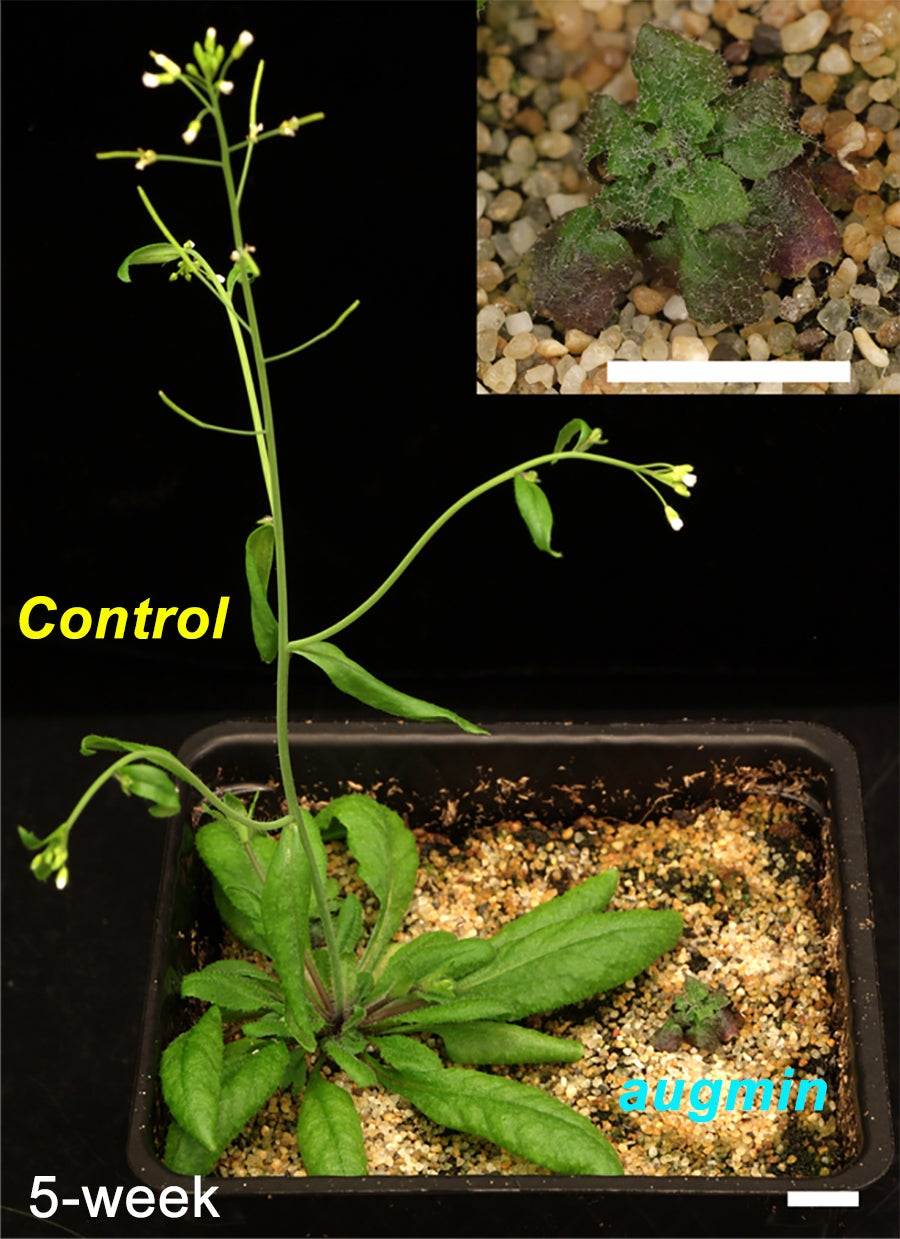
The scaffolding also shapes important traits in crop plants. The juice in oranges is contained in gigantic cells whose dramatic ballooning is driven by a microtubule skeleton that expands inside each cell. Long-grained rice owes its shape to the microtubule scaffolds that cause individual cells to elongate. It's also important in cotton, whose fiber cells begin the size of a red blood cell and then extend, driven by telescoping microtubules.
"It's pretty dramatic," Liu said. "They lengthen by thousands of times."
Even as Liu pieced together the function of plant augmin, he knew almost nothing about how it physically initiates branches in microtubules. So, he collaborated with Al-Bassam, who worked upstairs in the same building, and who specializes in protein structures.
A molecular pitchfork
Md Ashaduzzaman, a postdoctoral fellow in Al-Bassam's lab, cooled plant augmin proteins to -196°C and took thousands of electron microscope images - an approach called CryoEM. He and Al-Bassam spent months assembling the data into a single structure.
Their job was akin to someone who had never seen the Eiffel Tower, mapping its overall structure by piecing together thousands of up-close photos.
They finally succeeded in unveiling the mystery structure.
"Augmin turns out to look like a pitchfork," said Al-Bassam. He and Ashaduzzaman worked out how the pieces come together to form the complete augmin complex. They identified the critical structures that it uses attach to microtubules and form branches.
Seeing the nuanced differences between the plant and animal versions of augmin could improve our understanding of how it works on both sides.
In humans, altered levels of augmin protein are associated with a worse prognosis in certain cancers of the liver, brain and other organs. Understanding how augmin functions - or malfunctions - could illuminate new ways to treat these cancers. It could also help identify the unknown causes of infertility in some people.
Meanwhile, understanding how augmin functions in plants could help scientists breed new varieties of important California crops, such plums and strawberries.
For Al-Bassam, it's a fulfilling outcome.
"This was a very long endeavor," he said. "It was a real labor of love that required a lot of people working together."
The work was supported in part by grants from the National Institutes of Health and National Science Foundation.
Their Augmin research utilized advanced scientific facilities at UC Davis, including the Biological Electron Microscopy Campus Core.
Additional authors of the new paper include: Aryan Taheri and Fei Guo, UC Davis; Yuqi Tang and Stephen D. Fried, Johns Hopkins University; and Shubham Mittal and Faruck Morcos, University of Texas at Dallas.


