
Researchers theorize that having a positive aging role model might be enough to change one's own thinking: 'If they look good with gray hair, I might too'
Women who view TikTok videos of others comfortable with their gray hair and laugh lines start to feel more positive about their own aging the more they watch, a new UConn study has found, potentially influencing a woman's ability to age well later in life.
For almost as long as time, or at least as long as television, film, and print media have been around, women have been held to a different beauty standard than men, penalized if they don't have smooth skin and perfectly highlighted hair well into old age, says Amanda Cooper, an assistant professor of interpersonal communication at UConn.
"Anti-aging messages, particularly around beauty care, have been prominent for a long time," she says. "Historically, an older man has been labeled 'a silver fox,' but a woman who gets gray hair has been called an 'old lady.' There's been this double standard in aging for a long time, and now it's amplified for younger women in addition to older women."
Cooper says she and her co-authors, UConn graduate student Lexi McNamara and Heather Gahler from the University of Wisconsin, were dismayed when they first started to notice on social media that women in their 20s were using anti-aging products and promoting dermatological procedures to erase signs of aging on their young faces.
Plastic surgery used to be something relegated to mostly mid-life, Cooper says, now a growing number of teenagers are looking at minimal creases in disgust.
"I don't want to blame everything on social media, but my guess is they're hearing the anti-aging messages that used to be targeted to older women thanks to our constant media intake. I don't know if we can fully prove that, but I think that's what the change is. Younger women seem to be more conscious of their aging and more concerned about how to make sure they're going to age the right way or appear not to age at all."
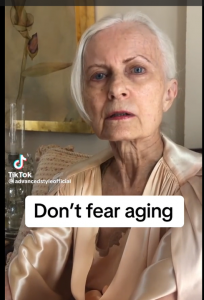
Several years ago, Cooper says she read an article about and started exploring the positive aging movement on TikTok, featuring mostly middle-aged and older women posting videos about the good parts of aging.
Hashtags like #GrayHairDontCare bring up videos of radiant women talking about how much they love their gray locks, she says. Other similar searches produce videos about how crow's feet are merely proof of a life filled with joy and laughter.
The team started to wonder whether watching these videos would have any effect. Their study – "Examining the Effects of Viewing Positive Aging TikTok Videos on Aging Outcomes and Attitudes Among Young, Middle-Aged, and Older Women," which was published last month in the journal Communication Research – sought to put the question to the test.
Shifting the Dial
Groups of women identified as younger, middle-aged, and older watched videos of women either touting the positives of aging or talking about travel. They then were asked questions soliciting their feelings on aging: What are your concerns about aging? Do you feel negative or positive emotions about it? How confident are you in your ability to age well?
"We found that women who watched those positive aging reels increased their positive emotions about aging. They felt more upbeat about aging and also felt more confident in their ability to age well as compared to the control group that watched travel videos," Cooper says. "It means that watching these videos of older woman talking positively about aging can at least somewhat shift the dial on how women are feeling about their own ability to age."
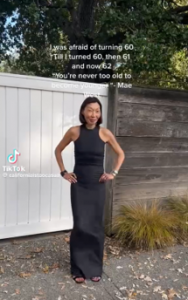
The team theorizes that merely having a positive aging role model might be enough of an influence to change one's own thinking. Cooper says it might allow a person to feel more comfortable with the idea that if someone else looks good with gray hair, they might too.
While all three age groups of women in the study were affected by the positive aging videos, the middle-aged and older subgroups were more significantly affected, she notes, which might be because aging is more salient in their lives.
"There can be moments of panic around aging, of course, but when women see examples of successful aging or when they hear positive messages it can help them feel more confident," Cooper says.
"Shifting attitudes about aging is important because women reinforce some of the negative messages about aging and penalize each other," she continues. "Our society as a whole does this, but we also do it on a micro level. If we can promote communication environments that are positive, we can empower women to feel better about their aging."
The study also notes the positive aging videos brought about another thought change among those who watched them: Viewers started feeling more positive about older people in general.
Cooper says that was an exciting finding, perhaps with a profound effect of reducing ageism and prejudice against older people.
"We should be creating more content that celebrates the markers of aging and gives permission for women to age, whether that's talking about gray hair or wisdom gained," Cooper says. "My call to content creators would be to create more messages that do this. Let's create more content that features older women and messages about aging as an experience that can be meaningful and triumphant."


