
In the life of a technology company that aims to advance health care, the stage between promise and product can feel less like a runway and more like a tightrope.
The science is encouraging. The founders have left academic labs or hospital posts to turn an idea into a product. But the path forward - through product development, regulatory approval, clinical validation and scaled manufacturing - is long and expensive. And increasingly, traditional sources of funding are wary of stepping in too soon.
At Cornell, a program called Ignite Cornell Research: Lab to Market was designed precisely for that moment.
Managed by Cornell's Center for Technology Licensing (CTL), Ignite gap funding series is nurturing three early stage biomed startups that could better detect illnesses, unlock RNA insights to develop new therapies and improve IVF treatment - among more than a hundred of other projects.
Ignite funding provided critical support to TETmedical in the early stage where funding is difficult to obtain. The startup formed when two professors in the College of Veterinary Medicine - Dr. Alex Travis, professor of reproductive biology and director of Cornell Public Health, and Roy Cohen, research assistant professor at the Baker Institute for Animal Health - developed a way to tether a thousand or more enzymes to a silica nanoparticle producing molecular nanobots that they first used for a blood test that can diagnose a stroke in less than 15 minutes. They named it Tethered Enzyme Technology, or TET. With no current blood test for stroke, they immediately saw the potential to bring it to market for hospital use.
It wasn't as simple as they'd hoped.
"Here were two professors who had invented a blood test for stroke, concussion or anything that kills neurons in the brain," said their co-founder David R. Fischell '75, M.S. '78, Ph.D. '80, a serial med tech entrepreneur and Cornell trustee emeritus. "They had a prestigious National Institutes of Health Pioneer Award, but were unsuccessful in getting anyone interested."
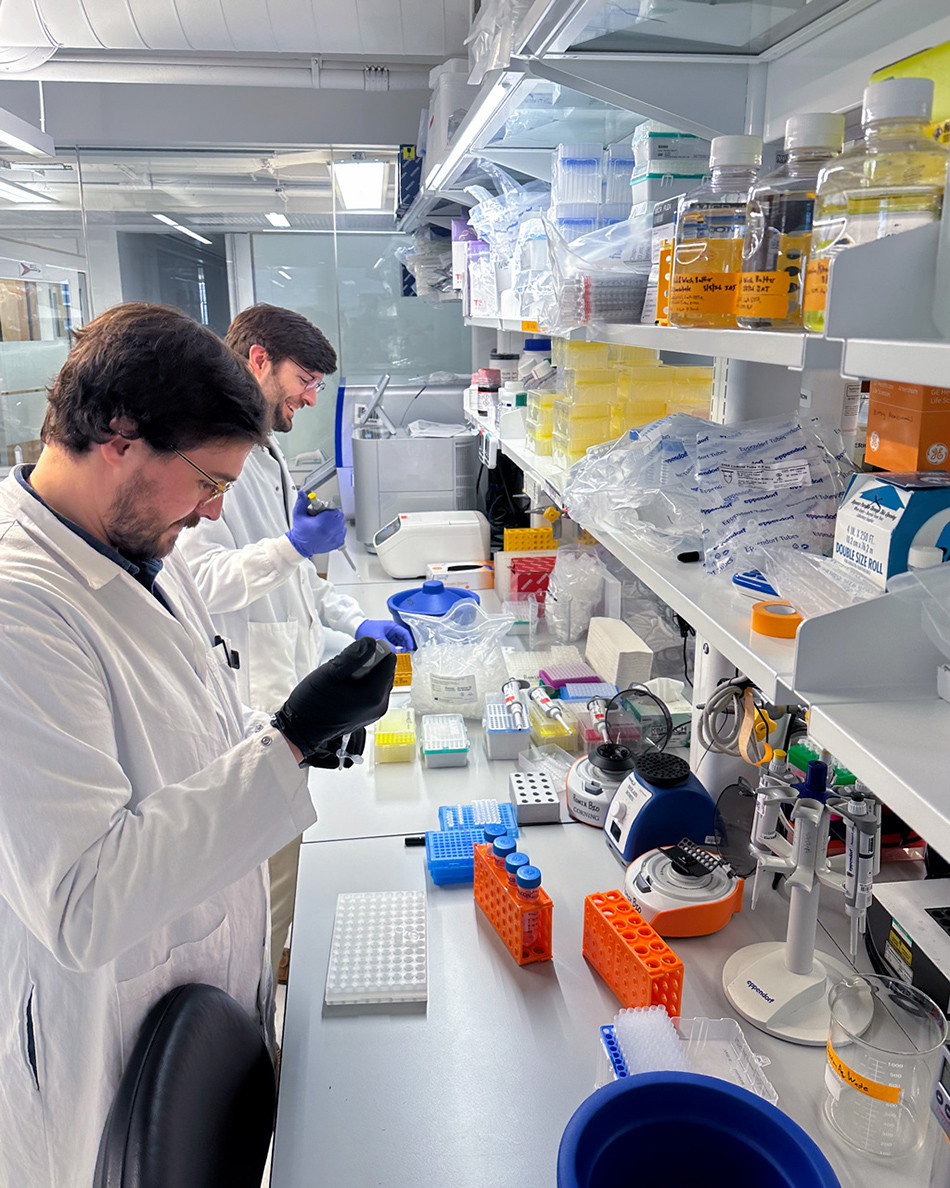
Romix's director of next generation sequencing Julius Judd, foreground, and co-founder and chief technology officer David McKellar work in the lab where they build molecular tools that expand what's possible with non-invasive liquid biopsies.
Ignite's early funding helped TETmedical on its path toward follow-on funding and grants of more than $8 million, allowing TETmedical to develop and test on stroke patients the Neuron Specific Enolase (NSE) Functional Activity Stroke Test (NSE-FAST), its first product.
"Stroke is the No. 1 missed diagnosis causing harm to patients, with an average of 17% of all strokes missed," Fischell said. "With 2 million patients arriving at an ER each year with stroke symptoms, there is a huge unmet need for a fast test to reduce this huge number of missed strokes."
TETmedical's NIH pioneer award technology has also shown potential to detect other conditions including biomarkers for liver function, viruses, cancers and endometriosis, and with a grant from New York state this year, the company is building the next generation of TET that can bring fast sensitive blood testing to the point of use.
"Wouldn't it be nice if you didn't have to go to a lab and could do at-home blood testing?" Fischell said of future applications for the technology.
Making discoveries usable
Since its founding four years ago, 32 Ignite-supported technology startups have secured significant funding for growth, executed 38 licenses and options and attracted $231 million follow-on funding. This comes as venture capital for deep tech startups has dwindled and government funding for technology translation is uncertain.
"It's a reality that universities' technologies usually start at a very early stage," said Alice Li, executive director of CTL. "We're focused on getting those discoveries out of the lab and into real-world use and products sooner - at a moment when the public is asking what value universities deliver."
Ignite's model recognizes that as investors become more selective, early validation is not a luxury but a prerequisite. By offering hands-on commercialization guidance and funding, the program aims to help startups generate the data and momentum they need to survive the so-called "valley of death" between discovery and market.
Platform biotech ventures especially face an uphill climb. They must not only demonstrate technology novelty but also show that their approach can reliably yield biological molecules involved in a disease that might produce a therapeutic effect. That requires extensive laboratory validation, bioinformatics infrastructure and, eventually, partnerships with pharmaceutical companies.
Ignite's portfolio in this area includes Romix Biosciences, which is building a platform to unlock disease insights from RNA biology. The technology identifies and measures RNAs in blood and urine that could lead to new diagnostic and therapeutic approaches. The promise is significant: RNA-based strategies have already reshaped parts of medicine, but much of the complete collection of all RNA transcripts remains underexplored.
Chief executive Conor Loy, Ph.D. '24, studied cell-free RNA in his graduate work.
"These molecules contain a signature that is unique to the disease from which they come. We studied this in many disease settings and found that this type of measurement can be utilized to diagnose disease and event predict if a patient will respond well to treatment," he said.
During Loy's last year at Cornell, he and his thesis advisor, Iwijn De Vlaminck, associate professor of biomedical engineering in Cornell Duffield College of Engineering, decided to turn their discoveries into a company - Romix Biosciences, which is creating a platform for cell-free RNA extraction, analysis and disease profiling.
"The Ignite program allowed us to use the Cornell ecosystem as we explored starting a company, facilitating conversations and opening doors that would have been shut," Loy said. "It provides funding, salary, and benefits for Ignite Fellows to start a company. It also gave us the time to go from research to business model, and it was incredibly valuable to get that time."
Time allows a startup to focus on sharpening its platform, generating key datasets and articulating a commercialization strategy grounded in realistic regulatory and development timelines.
IVSonance is developing technologies aimed at providing fresh tools for embryologists who work on IVF fertility treatments, is another recipient of an Ignite fellowship. Co-founder Amir Mokhtare, Ph.D. '23, worked on new technologies for in vitro fertilization for his doctoral project. The problem, he said, was that engineers, not IVF physicians, were developing new technologies and didn't understand what tech was keenly needed.
A partnership with Weill Cornell Medicine, widely considered one of the best IVF hospitals in the U.S., enabled Mokhtare to road test his ideas.
"We had gone through several technologies, all of them published in journals but almost none of them had the potential to get into a real lab," Mokhtare said. "I'm super fortunate that the Ignite committee saw potential in the solution. They invested in very early prototypes, and in the first year we overcame several technological challenges."
Since then, IVSonance won a National Science Foundation grant and was admitted to Cornell's Praxis Center for Venture Development. Today they are working on a standalone device that helps IVF technicians remove cells from retrieved eggs to assess their maturity and prepare them for fertilization.
"I could see this being the new pipette - one of the most fundamental tools in the lab," said co-founder Nicole Lustgarten, Ph.D. '20. "It wouldn't have made it to prototyping stage if it weren't for Ignite."


