

Scientists have identified targets on the malaria-causing parasite that could be the key to developing a universal vaccine against one of humankind's oldest and deadliest diseases.
The study published today in the journal Nature.
Researchers from Oregon Health & Science University and collaborators across the globe identified telltale fragments of a malaria-causing parasite that could be targeted by a vaccine designed using T cells, a type of white blood cell.
"A T cell-based malaria vaccine has long been considered the field's holy grail," said co-senior author Brandon Wilder, Ph.D., an immunologist and associate professor in OHSU's Vaccine and Gene Therapy Institute.
T cells perform a central function of the body's immune system by identifying and attacking cells infected by viruses, bacteria or, in the case of malaria, parasites. Wilder and co-authors at OHSU identified that the telltale malaria protein fragments are recognized during infection in the liver — a key bottleneck and vulnerability common to all malaria species.
Researchers in Brazil collected and analyzed blood samples from people infected in South America. Through painstaking research, they identified that the fragments of the parasites presented by infected cells to the immune system were shared by parasites from Africa, and they appeared to be presented by an immune component called HLA-E that is nearly identical in every human.
However, for these findings to be the basis of a universal vaccine, they needed to be visible by the immune system in the liver as well as the blood.
"Our contribution is bridging the pathway between observations in humans and a tractable path to building a vaccine," Wilder said.
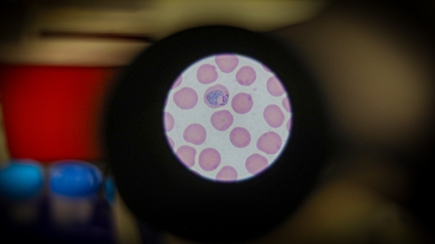
Veterinary surgeons at the Oregon National Primate Research Center developed a minimally invasive biopsy technique for nonhuman primates that enabled OHSU researchers to determine that the immune system recognized these telltale parasite fragments in the liver — the organ where the parasite first establishes itself.
Researchers are currently testing the first human vaccine candidates based on these findings in the animal model.
In contrast to current antibody-based malaria vaccines that require annual boosters, a T cell-based vaccine could persist in the body for years or decades.
"This provides a blueprint for making a T cell-based malaria vaccine that can be effective against the huge diversity of existing parasites," Wilder said. "This publication opens an entirely new era for malaria vaccines previously impossible without these key data."
Mosquitoes transmit the parasite that causes malaria, which affects hundreds of millions of people annually. Malaria is the biggest single cause of childhood death worldwide, killing the equivalent of every child under 5 living in Oregon and Washington every year.
Wilder and OHSU colleagues are working on multiple fronts to eradicate malaria.
Wilder last year received a two-year, $2.4 million award from the Gates Foundation. The award from the Seattle-based foundation will evaluate monoclonal antibody and vaccine candidates to protect against infection by the parasite — Plasmodium falciparum — known to be the most prevalent human malaria parasite in Africa.
The OHSU portion of the research published today was supported by the National Institutes of Health, grant awards R01AI102063-01, U01AI165457 and P51OD011092 to the Oregon National Primate Research Center. The content is solely the responsibility of the authors and does not necessarily represent the official views of the NIH.
All research involving animal subjects at OHSU must be reviewed and approved by the university's Institutional Animal Care and Use Committee (IACUC). The IACUC's priority is to ensure the health and safety of animal research subjects. The IACUC also reviews procedures to ensure the health and safety of the people who work with the animals. No live animal work may be conducted at OHSU without IACUC approval.


