
Can computers use less energy without compromising performance? That's what computer scientists Ben van Werkhoven and Rob van Nieuwpoort from the Leiden Institute of Advanced Computer Science (LIACS) are studying.

'The energy consumption of computers and data centres has grown enormously in recent years,' Van Nieuwpoort begins. 'It's difficult to put an exact figure on it, but data centres in the Netherlands account for around 5 per cent of total energy consumption. That's more than the entire Dutch Railways (NS).'
For a long time, the world of computing was all about speed. For the sake of simplicity, it was assumed that faster also meant more energy-efficient, but this wasn't actually measured. And Van Werkhoven and Van Nieuwpoort discovered that this assumption isn't always correct.
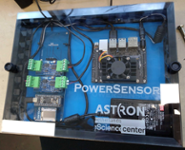
Tinkering with a supercomputer
'So our first step was simply to measure how much electricity a processor actually uses,' says Van Werkhoven. A processor is the component in a computer that performs the calculations. 'Together with ASTRON, the Netherlands Institute for Radio Astronomy, we developed a power sensor. We then did some soldering to install the sensor in the supercomputer. This allows us to accurately read the energy consumption for each small part of a calculation.'
Energy-efficient computing in the Dutch countryside
ASTRON's involvement in this research is no coincidence. They have a great deal of technical expertise, and their LOFAR antennas are located in the fields of Drenthe and other remote areas, where there is not much energy available. The signals are then processed on large-scale supercomputers to produce images. Energy-efficient computing is therefore not just a matter of idealism; in some cases, it is a practical necessity.
Finding the best solution automatically
During the programming process, there are a great many variables to tweak. The researchers wanted to automate this. 'We feed every possible solution back to the sensor to measure energy consumption,' says Van Werkhoven. 'Sometimes, the results were surprising. For example, we often assume that computing with fewer bits is more energy-efficient, but that does not always turn out to be the case.'
'Or we test a small AI model with 10-100 times fewer parameters,' Van Nieuwpoort adds. 'Such a model is less intelligent, but it can learn through a feedback loop. After just a few rounds, you sometimes get better results than with a large model. That saves a lot of energy.'
'It can be done, so we simply have to make this happen together.'
From a single computer to a larger scale
Van Nieuwpoort also looks at larger systems. A single data centre contains tens of thousands of processors, making it considerably more complex. 'We model not only power consumption, but also water consumption and CO₂ emissions,' he explains. In doing so, he looks at both the operational footprint - during use - and the footprint including the production of all components. This enables the researchers to calculate how to run software optimally. 'For example, do you run an application on a single computer or spread across two? This way, you can make an informed choice.'

Methods for saving energy are widely applicable
The researchers hope that others will adopt their methods and therefore publish everything open access. 'But ultimately, we don't know who actually does so,' says Van Werkhoven. 'Every now and then I see interest from people at major chip manufacturers, so hopefully our work will contribute to a more sustainable future for the industry.'
They themselves primarily look at applications within science, ranging from astronomy to aviation safety. 'Every time, you're looking for a trade-off between energy consumption, speed and accuracy,' says Van Nieuwpoort. 'So the first question is: what do you actually need? And that's what you optimise for.' Van Werkhoven adds: 'The great thing is that you always come across interesting challenges for computer science as well. The application and pure computer science reinforce each other.'
Exactly how much the energy consumption can be reduced varies from project to project, but it is clear to the researchers that it can be done: 'We simply have to make this happen together.'


