
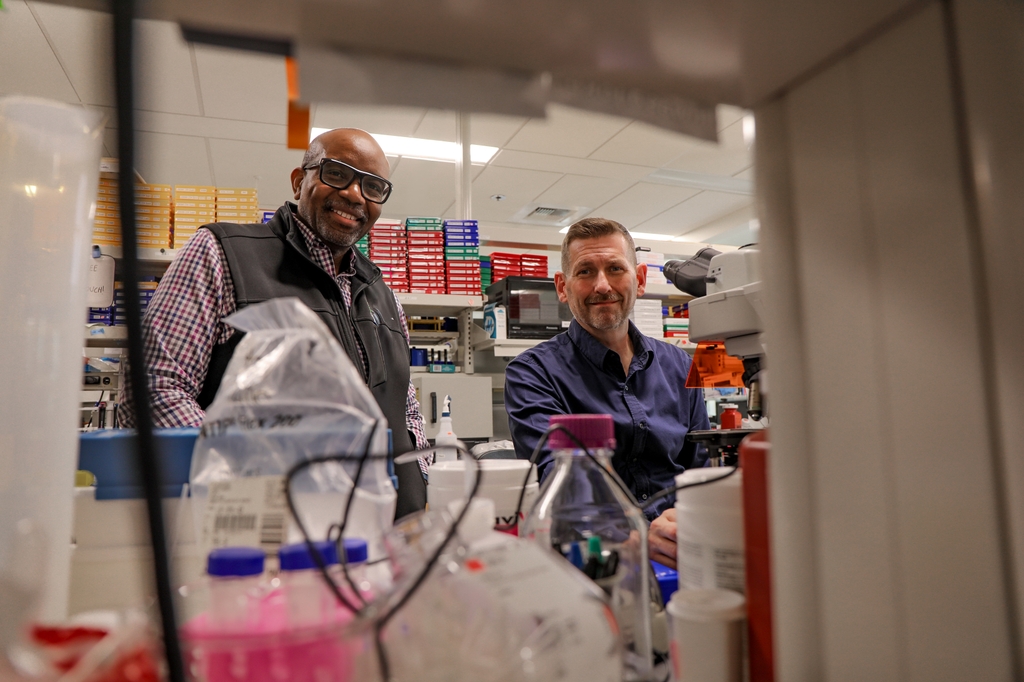
Oregon Health & Science University researchers have secured a $5.8 million, five-year federal award to investigate whether damage to the gastrointestinal tract contributes to neuroinflammation in people living with HIV — raising the potential for new treatments to preserve brain function in people with HIV and older adults.

"Even though antiretroviral drugs are very successful at suppressing the virus, we've seen people living with HIV have neurocognitive disorders similar to what happens when people age," said co-lead investigator Afam Okoye, Ph.D., professor in the OHSU Vaccine & Gene Therapy Institute. "If we can show a dynamic relationship between inflammation in the gut and the brain, this line of research could then lead to new treatments to reduce neuroinflammation."
The award from the National Institute of Mental Health of the National Institutes of Health will enable researchers to align nonhuman primate models with human autopsy tissues to better understand the interplay between inflammation in the gut and brain health among people living with HIV.
Scientists have long associated inflammation in the gastrointestinal tract with impaired cognition in the brain. People with inflammatory bowel disease are at increased risk for Parkinson's and Alzheimer's disease, for example.
This problem disproportionately affects people living with HIV.
Researchers surmise this may be related to the fact that the initial infection of the virus — even when it's subsequently held in check by antiretroviral therapies — causes lasting damage to immune cells in the GI tract. The research team will include pathologists at OHSU and infectious disease specialists at the NIH to better characterize how exactly inflammation in the gut is linked to brain function.
Learn more about OHSU's Oregon National Primate Research Center.
The research also will involve nonhuman primates at OHSU's Oregon National Primate Research Institute.
"Neuroinflammation in people with HIV is very hard to study," said Okoye, who is also part of the Division of Pathobiology and Immunology at the ONPRC. "These are very challenging studies to do, but we have expertise and experience in the nonhuman primate model. It's high risk but also high reward."
Ultimately, it may be possible to develop targeted therapies that tamp down harmful or runaway inflammation while retaining the beneficial effects of a strong immune system.

"Inflammation in and of itself is not bad," said co-lead investigator Jacob Estes, Ph.D., professor and director of the VGTI. "It's part of the immune system's response to mediate infection. Ultimately, this research could lead to precision targets that would limit pathology that harms brain function but doesn't completely shut off the immune system's ability to do the things it needs to do to promote health."
The grant award from the National Institute of Mental Health of the NIH is R01MH146623.
All research involving animal subjects at OHSU must be reviewed and approved by the university's Institutional Animal Care and Use Committee (IACUC). The IACUC's priority is to ensure the health and safety of animal research subjects. The IACUC also reviews procedures to ensure the health and safety of the people who work with the animals. No live animal work may be conducted at OHSU without IACUC approval.


