
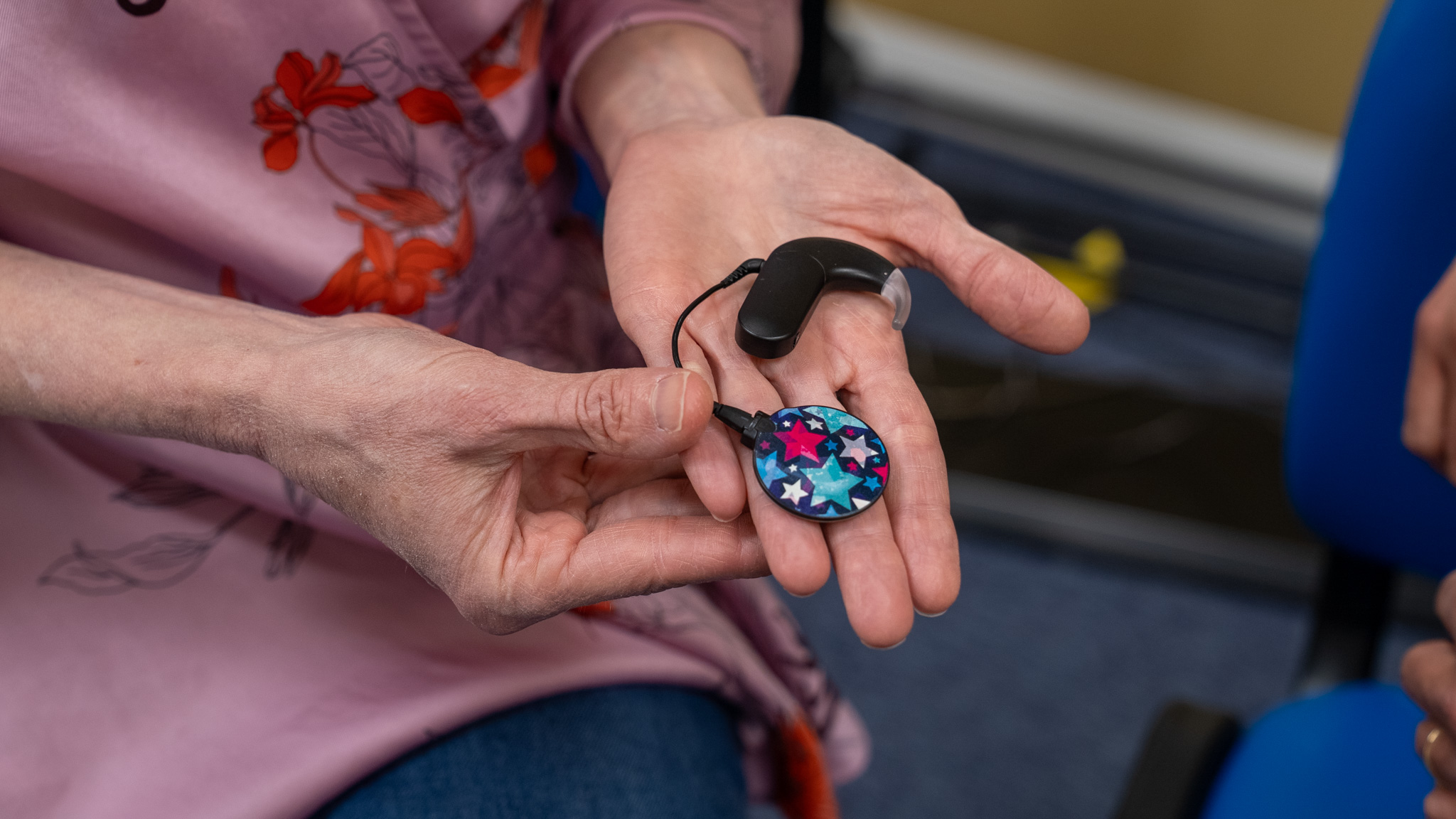
A new cochlear implant trial will give those who are severely and profoundly deaf a say in how they view improvements to help them hear.
Professor Nicci Campbell and Professor Helen Cullington, from the University of Southampton Auditory Implant Service, are co-investigators in the trial, which will provide bilateral (both sides) cochlear implants to some profoundly deaf adults.
Funded by the National Institute for Health and Care Research (NIHR), the LUCIA trial is being co-led from Addenbrooke's Hospital and the University of Cambridge and will include over 250 adult participants at 14 auditory implant centres, who will either receive one (unilateral) or two (bilateral) implants.
Each year more than 1,000 adults in the UK receive cochlear implants to restore their hearing.
Under NHS guidance, children are offered two implants but adults currently only receive a single (unilateral) implant, yet evidence suggests having two could offer significant improvements in prospects and quality of life - and may now be cost effective.
The results will be used to review NHS guidance for the provision of implants to adults.
The trial, which is expected to begin recruiting patients in the autumn, has been designed in collaboration with patients. By involving individuals with lived experience of cochlear implantation, the researchers aim to measure changes that patients consider to be most important. The primary trial outcome will reflect participants' own perceptions of their quality of hearing. The study will also measure common challenges faced by patients, such as listening effort and fatigue, a choice directly based on discussions with patient groups.
Professor Campbell said : "This trial will listen to the voices of those who are severely and profoundly deaf.
"The impact that hearing loss has on everyday life is often misunderstood and underestimated, but around 1.2 million UK adults are missing out on most conversational speech.
"We know that hearing with both ears is better than just using one ear, because it gives us three-dimensional hearing which helps to identify where sounds are coming from, and improves speech understanding, especially in noisy places.
"Adults tell us, and I agree, that they should be given the same hearing opportunities as children.
"Published evidence shows that bilateral implants improve hearing in these ways, however two implants cost more than one and may increase complications."
Participants will be monitored for 12 months after surgery to assess the effects of the implants on wellbeing, ability to hear speech in noise, and quality of life. The study will also evaluate the economic benefits and cost of bilateral implants for the NHS.
While hearing aids help people with mild to moderate hearing loss by making sounds louder, they often provide very little benefit for people with severe or profound hearing loss. Cochlear implants bypass the outer, middle and inner ear and send electrical impulses directly to the hearing nerve which carries signals to the brain.
Participants in the trial will need to have become deaf later in life and cannot already have an implant.
People with cochlear implants will also be involved in delivering the trial. They will be specially trained to participate in interviewing trial participants that will be used to measure the impacts of the trial.
The University of Southampton Auditory Implant Service has a long history of research into two-ear listening and bilateral (both ears) cochlear implants.
Professor Cullington said: "Through research already carried out, including our own here in Southampton, we know that two cochlear implants provide significant benefits, including hearing on both sides, improved sound localisation, better speech understanding in challenging listening environments and improved quality of life.
"Giving bilateral implants to children can have a transformative effect and through this study we can now provide the same opportunities to adults."
Professor Anthony Gordon, Programme Director for the NIHR Health Technology Assessment (HTA) Programme, which funded the trial, said: "We fund innovative trials like the LUCIA study which explore how advances in technology can help make a positive difference to the day-to-day lives of those affected. This study offers real hope to people with severe hearing loss and the chance of a significant improvement in their quality of life."


