
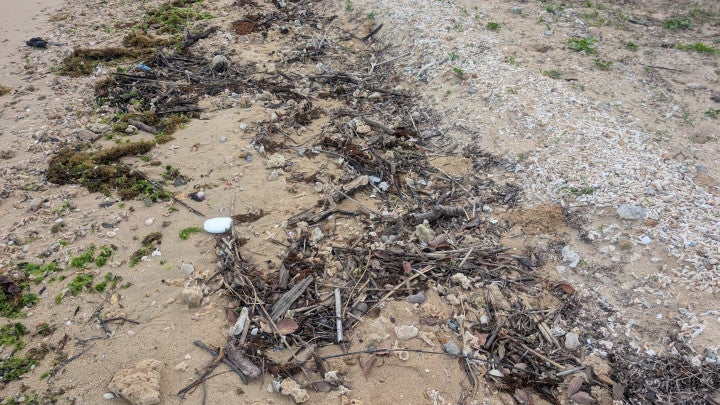
A thin strip of sandy beach, littered with marine debris fills the screen. "Do you see it?" asks Dr Nikolai Iakushev. Invisible to all but the most experienced eyes, a collection of grey speckled eggs are nestled at the high tide line. "That's why it's so easy to step on a Kentish plover nest!" he says.
Iakushev, a Russian-born scientist with a passion for waders (wading bird species), has studied the Kentish plover since 2023. Over the last four years, he's been slowly building data on Kentish plover populations in Okinawa, with the aim of protecting these rare birds.
"Kentish plover populations, and actually most shorebirds, have seen a dramatic decline in population in Japan over recent decades," says Iakushev. "By understanding their behavior, breeding patterns and habitats, I hope we can formulate a strategy to protect these birds."
On the red list
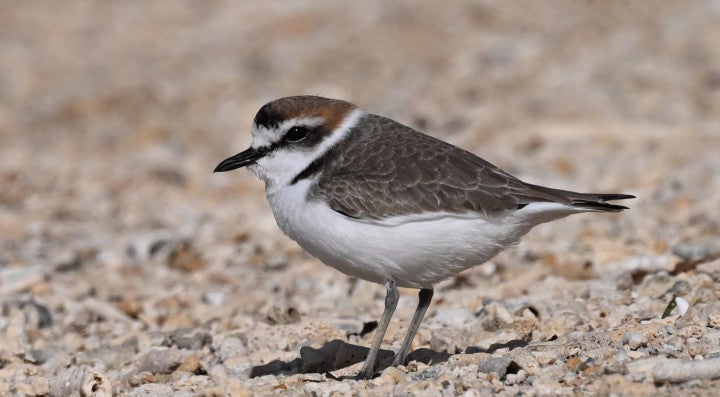
Walk on the beach in Onna, just north of the OIST campus, and there's a good chance you'll spot a Kentish plover. Small, brown-feathered birds that scurry along the shore, Kentish plovers are the only plovers that reside in Okinawa year-round, not migrating like other plovers. While they are thought to be relatively common on the global scale, more locally they've made both the Japanese and Okinawa Red Lists of threatened species, classed as 'vulnerable'.
To understand why these birds are under threat in Japan, Iakushev and his colleagues in the Evolutionary and Synthetic Biology Unit at OIST have spent the past few years establishing a monitoring and tracking program, with the aim of mapping breeding populations across Okinawa's main island.
They first narrow down promising habitats through satellite images, identifying locations with nice strips of sandy or gravel beach for nesting, located near river deltas which can provide food for young fledglings. Then, Iakushev visits these sites with the hope of spotting Kentish plover.
Iakushev smiles, "I must have walked around one hundred beaches in the last year!"
The Kentish plover displays specific, anxious behavior if humans or other interlopers are near its nest. Carefully monitoring from afar, Iakushev gives the adult birds space to return to their nests. Depending on the location, he'll later put up fences or sandbags to protect the nests, reducing their likelihood of being flooded or trampled. He also collaborates with local ornithologists to track the birds, using specially adapted traps to safely contain the plovers and tag them with small plastic rings.


