
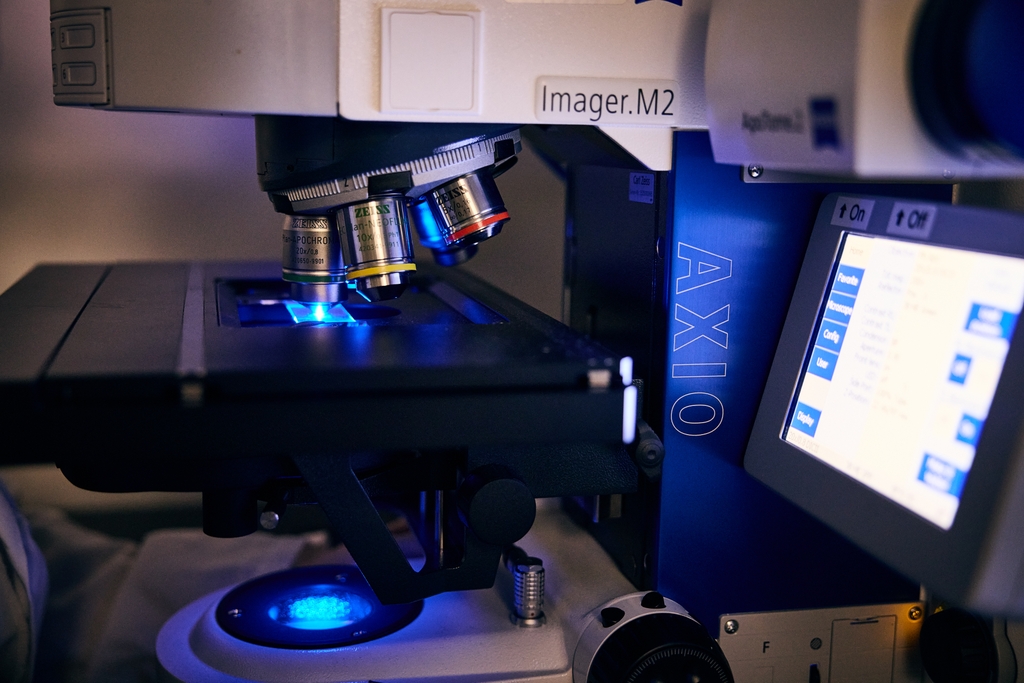
Two Oregon Health & Science University faculty members have been awarded $750,000 grants through the OHSU Faculty Excellence and Innovation Awards, which honor exceptionally creative research with the potential to significantly advance human health.
The OHSU Faculty Excellence and Innovation Awards, distributed over three years, funded by the Silver Family Innovation Fund, supports promising early- and middle-stage research.
The 2026 recipients are Alireza Karimi, Ph.D., assistant professor of ophthalmology in the OHSU Casey Eye Institute, and Elizabeth Moss, Ph.D., assistant professor of anesthesiology and perioperative medicine in the OHSU School of Medicine.
"These scientists are tackling important challenges to human health, from irreversible blindness caused by glaucoma to better understanding mechanisms underlying cognitive decline in neurodegenerative disorders," said Bonnie Nagel, Ph.D., OHSU interim chief research officer and executive vice president. "Their awards honor bold ideas that accelerate discovery and shape the future of research and innovation at OHSU."
OHSU deans, center and institute directors, and department chairs nominated candidates from their respective units, and applications were reviewed by prominent scientists from institutions around the country.
Awardee profiles
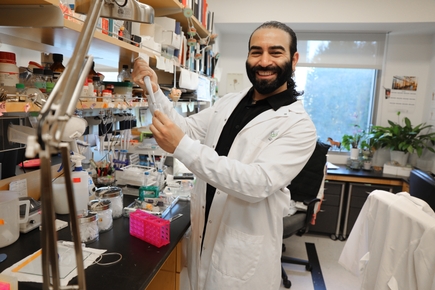
Alireza Karimi, Ph.D.
Assistant professor of ophthalmology and biomedical engineering, OHSU School of Medicine and OHSU Casey Eye Institute
Glaucoma affects more than 80 million people globally and over 3 million in the United States. It is caused by increased pressure inside the eye, which happens when the eye's natural drainage system does not work properly. Today's treatments can lower eye pressure, but they do not fix the underlying problem. As a result, patients often need treatment for life and can still lose vision over time.
Karimi's research is focused on helping the eye regain its natural ability to control pressure on its own. Instead of relying on daily eye drops or repeated surgeries, his goal is to develop a one-time treatment that restores how the eye senses and responds to fluid flow. This approach aims to "reset" the eye's pressure-control system so it can regulate itself, as it does in healthy eyes.
To do this, Karimi combines engineering, computer modeling, biology and genetics in new ways not previously used in glaucoma research. His lab, working with Cristiane Miranda Franca, D.D.S., Ph.D., created a first-of-its-kind "outflow-on-a-chip" — a small lab device that closely mimics the eye's drainage system. Using this model, the team is identifying which pressure-sensing components fail in glaucoma and testing gene-editing and drug-based treatments to repair them.
"Current glaucoma treatments manage pressure but don't fix the underlying problem," Karimi said. "Our goal is to restore the eye's natural ability to regulate pressure, moving beyond lifelong drops and surgeries toward a potentially curative therapy that could preserve sight for millions."
Karimi has helped develop new tools for studying and treating glaucoma: advanced imaging methods; computer models; artificial-intelligence tools that help assess glaucoma risk using medical records; and new ways to deliver gene-editing therapies, in collaboration with other OHSU researchers, safely to the front of the eye. He is also a co-founder of a startup, OutFlowGen, working to develop gene therapies that could preserve vision for patients at OHSU and around the world. In addition, he advises a global eye-care company and leads efforts to improve computer models used to design tiny eye stents.
The Faculty Excellence award will help speed the translation of these discoveries into treatments that could protect vision and improve care for millions of people.
Elizabeth Moss, Ph.D.
Assistant professor of anesthesiology and perioperative medicine, OHSU School of Medicine
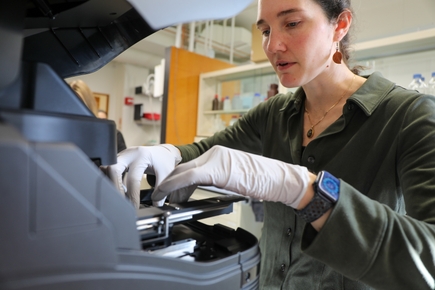
The brain is remarkably good at making sense of unclear or noisy information — such as recognizing a face in dim light or identifying a smell amid many others. This ability is essential for perception, learning and thinking. Unlike computers, which rely on predictable operations, the brain works through flexible, variable activity shaped by context. What may seem like biological "messiness" is likely a strength, allowing the brain to adapt to changing environments and function reliably even when information is incomplete.
Moss studies how the brain processes sensory information to create meaningful experiences. Using the sense of smell in mice as a model, her research examines how individual brain cells process signals, how large groups of cells work together, and how factors like attention reshape these processes. By observing brain activity and behavior together, her team aims to understand how the brain remains flexible and responsive across different situations.
Her research has important implications for human health. Loss of smell is often one of the earliest warning signs of Alzheimer's and Parkinson's diseases, linking sensory changes to declines in memory and thinking. By revealing how healthy brain circuits normally adapt and remain resilient, Moss' work may help explain what goes wrong in these disorders and guide new approaches to early detection or treatment.
"I am excited about the flexibility this award provides over the next few years," Moss said. "It's going to make it possible to bring in people with complementary skills and expertise. It also gives us the freedom to study biological computations across multiple scales simultaneously and follow the science where it leads."
Moss is recognized for her contributions to sensory neuroscience. Her earlier discoveries showed that smells are represented by encoded by patterns of activity across many neurons in the olfactory system, and that the brain briefly retains information about recent odors after a scent is gone in a way that may help the brain remember and distinguish between odors in a complex environment. The new award will allow her team to pursue bold ideas that connect a basic understanding of how the brain represents sensory information to pressing challenges in human health.
Karimi has current funding with National Eye Institute, of the National Institutes of Health, under Award numbers R01EY036011, R01EY037245, R01EY030238, and the OHSU Oregon Clinical & Translational Research Institute's Biomedical Innovation Program.
Moss has current funding with National Institute on Deafness and Other Communication Disorders, of the National Institutes of Health, Award number 5R00DC019505, and Whitehall Foundation and Medical Research Foundation New Investigator grants.
All research involving animal subjects at OHSU must be reviewed and approved by the university's Institutional Animal Care and Use Committee (IACUC). The IACUC's priority is to ensure the health and safety of animal research subjects. The IACUC also reviews procedures to ensure the health and safety of the people who work with the animals. The IACUC conducts a rigorous review of all animal research proposals to ensure they demonstrate scientific value and justify the use of live animals. Top of Form


