
Many people dream of being a marine biologist working on the Great Barrier Reef, but what's it really like?
Three marine biologists share their experiences working in the Long-Term Monitoring Program (LTMP), which turns 40 this year and is one of the world's longest, continuous reef monitoring datasets.
LTMP scientists spend up to 120 days a year at sea, surveying up to five coral reefs a day for 20 consecutive days at a stretch.
Benthic Ecologist Michelle Jonker
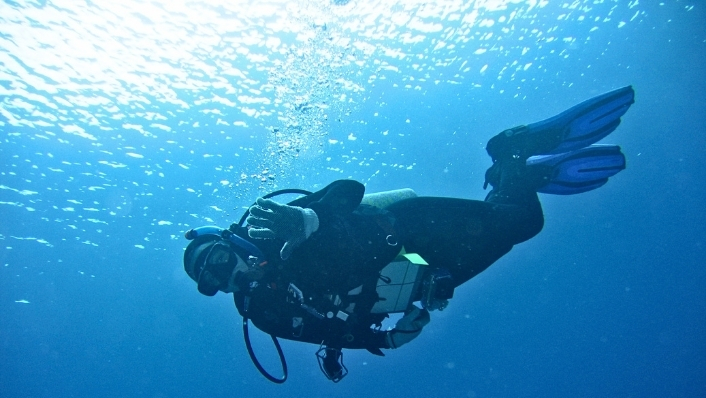
Michelle Jonker has worked with the LTMP for 20 years.
When she tells people she is a benthic ecologist, it's not unusual for them to get confused with oncology and think she is working with cancer patients.
She began her career working as a marine aquarist at The University of Queensland's Centre for Marine Studies after graduating from there.
She also worked on a mangrove and seagrass study in the Port of Brisbane that involved wading waist-deep into the water (trying not to think about the resident bull sharks), and on marine science projects in Papua New Guinea, United Arab Emirates and Minjerribah (Stradbroke Island) and Orpheus Island.
When she began at AIMS in 2006, she only had a few days to get orientated before she was off to Lizard Island, in the northern region of the Reef, on her first LTMP survey.
"It was late September, and quite windy," she said.
"I learned how to do a survey on the back reefs there before getting onto the outer reefs where the swell and conditions were wilder."
One of the survey techniques she learned was manta towing, where the marine biologist, wearing a mask and snorkel, holds onto a manta board and is towed behind a boat. They survey the entire a perimeter of a reef in two-minute blocks, observing and measuring variables such as hard coral cover and coral trout.
Over the years, the list of variables that the scientists are monitoring has expanded to include bleaching and shark counts.
Ms Jonker said they needed to be very focussed and hold simultaneous tallies in their head for two minutes until they can record their data on a special water-proof clipboard attached to the back of the boat.
New staff undertake parallel tows with a more experienced observer to calibrate their data and ensure their methodology is consistent.
"The more you do it, the easier it gets," she said.
During her 20 years, highlights have included surveying reefs with high coral cover in beautiful weather.
"They are etched into my memory, but some of those reefs have since been decimated through COTS outbreaks and bleaching events and they don't look like they did," Ms Jonker said.
And then there are the unexpected marine mammal interactions such as dolphins appearing on the bow just before sunset, seeing giant hammerheads underwater or the encounter with a 6m false killer whale (Pseudorca crassidens).
"We were diving and we could hear loud high-pitched noises," she said.
"It sounded like there were a few dolphins and we were looking around for them. Suddenly a massive 6m long whale shape went past us that at first we thought was a pilot whale.
"And then there are the times when you are swimming through swathes of bait fish. The light is catching them, and it's beautiful.
"Once this was topped off by a rare sighting of pygmy devil rays swimming over the reef!
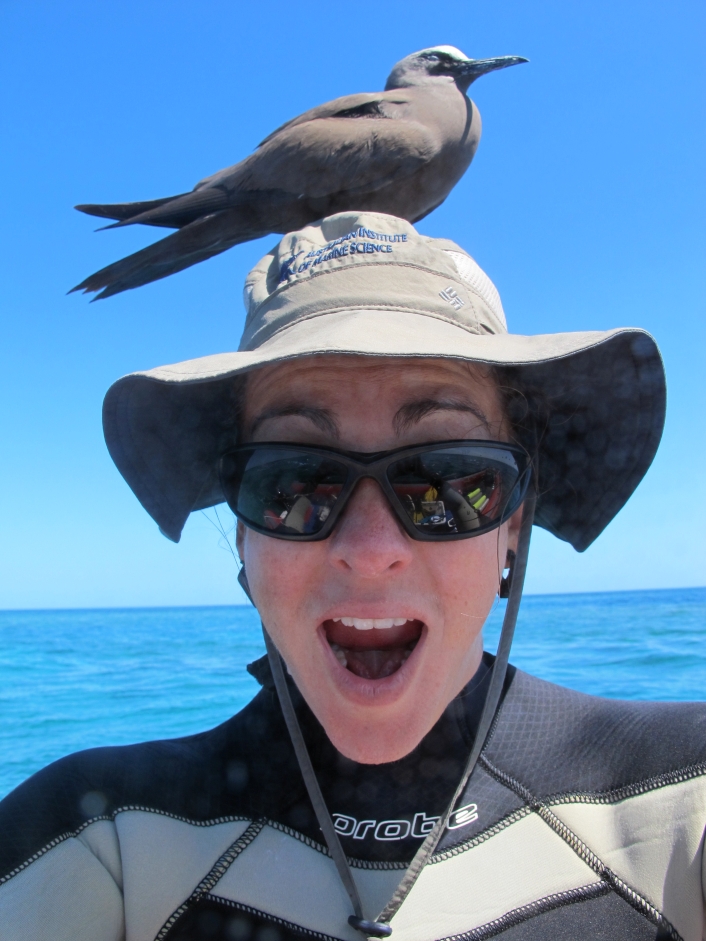
"We also get a lot of seabirds such as noddy terns who like to come and connect.
"Out at sea, there aren't a lot of places for them to stop and perch on. Once one landed on my head and stayed there."
When the conditions are good, the team works hard and fast, knowing they need to take advantage while they can because, more often than not, conditions are challenging.
Back on land, the scientists need to go through the imagery they collected to annotate it, calibrate their data and collate it, ready for writing up the results and publishing papers.
This can be long and tedious work, but it's critical to ensuring the LTMP data remains gold standard.
"My team needs to know all the types of algae, hard and soft corals and be consistent, which takes a lot of training," she said.
"From this we can look at how reefs change over time, for example, if a storm damages the reef, does the coral community change over time and what implications does this have for the fish and other animals that live in that community?"
In recent years, the team has begun using ReefCloud's AI in data analysis and processing.
These days, with two children, Miss Jonker spends about half the season at sea allowing her more time on land for training new staff and data crunching.
When she is at sea, she says satellite technology has made it easier to stay connected with her family and to do other work on days when it's too rough to go into the water.
LTMP Reef Fish Section Lead Daniela Ceccarelli
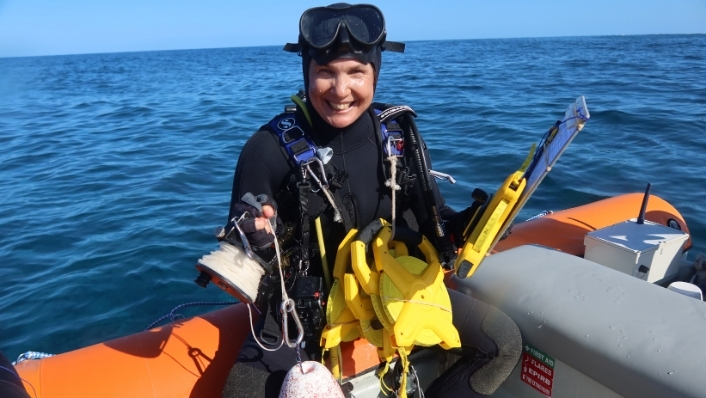
For Dr Daniela Ceccarelli, joining the AIMS LTMP team five years ago meant accomplishing a long-held career aspiration.
"LTMP had a reputation of being not just the pioneers of reef monitoring, but the elite; a very experienced and incredibly competent team. They were legendary," she said.
"I applied to join the LTMP not long out of uni, but it's not an entry-level job and I know now that I wouldn't have been ready to do it back then."
Instead, Dr Ceccarelli worked as a consulting marine biologist for15 years, including participating in and leading coral reef survey teams across the world.
Today Dr Ceccarelli is the LTMP Reef Fish Section Lead.
She's a passionate advocate for LTMP's consistent, repeated, methodical way of collecting information underwater by people who've spent years learning how.
"Those of us in the fish team walk around with 650 Latin names of fish in our heads, ready to go at any time!" she said.
"Being out at sea can be difficult and uncomfortable and long," she said.
"Collecting data again and again in the same places in the same way can be tedious. You could be bored, tired, cold. Your feet may be numb, the weather terrible, or visibility difficult.
"You could be swimming against currents or running out of air, but you endure it because you know that that repetition and consistency is so important and it produces data that are so valuable.
"The method is tried and tested. Over the years, every time there's been changes, there's always been research to back it up."
Not long after Dr Ceccarelli started, the team transitioned from counting a selection of about 245 species of fish, to noting down everything that they can see during the surveys.
"When we are diving along transects, we use a slate with a data sheet on underwater paper and tally the fish as we go," she said.
Remembering the tallies of what she is observing over two minutes while on the manta tow requires full concentration.
"We have methods to make it efficient," she said.
"The data sheet is set up so that you always write them in the same order."
Remembering the tallies of corals, crown-of-thorns starfish, bleaching, trout and sharks over two minutes while on the manta tow requires full concentration.
"I just imagine those numbers in order in my head and as I move along, the numbers might ratchet up or down, you know, if the coral cover changes, or every time I see a trout or a shark," she said.
Dr Ceccarelli is still awed by her encounters with marine animals.
"Every single dive, no matter if it's in the same place, I see something cool," she said.
Possibly the coolest thing was seeing a pugilist octopus at Lizard Island.
"It's rare that octopus will let you close, but this one didn't seem to care I was there," she said.
"It was doing its thing, changing colour, changing texture, digging around and hunting.
"It got to the top of a piece of coral, and its arms were probing in the holes looking for things to eat.
"A small fish was buzzing around it, like a nervous chihuahua. I think the octopus was in its territory and it didn't know what to do.
"Eventually, the octopus got irritated and balled up one of its arms and punched the fish.
"It was the first time I'd seen that. I shook my head and thought: did I just see that? "
Dr Ceccarelli loves the physicality of the field work and the sense of camaraderie and achievement when it's completed.
"Working on the LTMP makes me realise I belong to something bigger than an individual trip or data point," she said.
"When I'm out there, I'm reminded we owe the ocean so much; like the oxygen we breathe, food and livelihoods, the protection of our coastlines, and coral reefs are especially precious.
"I'm still constantly curious about the ocean. It's so vast and so dynamic and there's endless things still to learn."
Longest-serving LTMP team member Ian Miller
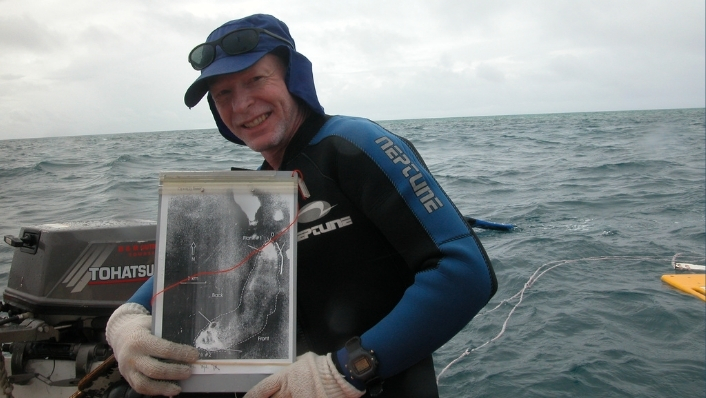
The longest-serving LTMP team member, Ian Miller, started in 1989 on a three-month contract after a brief stint as a volunteer. He stayed 32 years, leaving AIMS in 2021.
He was working at James Cook University at that time as a JCU Marine Biology graduate.
"I was planning to study rainforest honeyeaters for my master's thesis, but after joining AIMS I changed it to measuring the precision and accuracy of the manta tow method," he said.
During his time at AIMS, Mr Miller undertook an estimated 21,0000 manta tows and 3000 dives during his 2400 days in the field.
"I don't think there's anyone on the planet who's seen more coral reef than me," he joked.
He saw first-hand the LTMP develop from providing basic broadscale surveys of crown-of-thorns starfish (COTS) and corals to today's gold standard reef survey producing globally anticipated reports each year.
Mr Miller remembers AIMS hosting then-Prime Minister Bob Hawke on a visit in 1990.
"Impressed with what we had achieved with manta tow surveys, Hawke turned to Peter Moran (AIMS scientist overseeing the program) and asked him how much would be needed to establish a more detailed and ongoing monitoring program," he said.
"'One million dollars' was the off-the-cuff reply.
"That night, in his pre-election campaign speech in Townsville, Mr Hawke announced that if elected, he would give AIMS a million dollars a year to establish a comprehensive monitoring program! This came as a total surprise to us and Canberra…"
The early days were high-spirited but hard.
"The RV Sirius was a 47-foot wooden design, with a single diesel engine," Mr Miller said.
"Six of us were crammed in bunks in the forecastle, a V-shaped room at the front of the boat, about the size of a small kitchen.
"The skylight leaked, so we were always wet. It was extremely uncomfortable and claustrophobic and we'd spend weeks being tossed around in there as we steamed from one reef to another.
"Weird things happened. One night we had a mutton bird fly in, probably thinking it was a nice burrow.
"We had to cook our own meals.
"There was very limited fresh water, so after a while there were no showers.
"There was no GPS, so we did navigation the old school way.
"You had to have your wits about you. The gunnel at back of the Sirius was below your knees. The number one rule was don't fall off the boat.
"At that time AIMS operated two larger steel vessels with much better accommodation and facilities: the RV Harry Messel and the RV Lady Basten.
"Even these had their foibles. The RV Lady Basten had a weird roll that, on a good day, made 90% of us feel sick."
Since those days, the AIMS research vessels have become much more comfortable and are equipped with the latest technology. Staff safety is now the priority of any field work.
Mr Miller said a result of consistent funding meant the program could flourish with the team establishing permanent reef survey sites.
"We spent a lot of time deciding the best way to go about measuring fish populations," he said.
"For instance, we had a target list of around 250 common fish species. We focussed on the most common fish species to better detect changes in abundance over time.
"We also started doing fine scale surveys to record coral mortality from natural predators such as COTS, Drupella (a coral eating sea snail) as well as coral disease.
"We did the first systematic survey of coral and coralline algae disease in the Indo Pacific.
"I coined the term 'white syndrome' which is often the corals' response to disease; it develops characteristic white lesions."
Being a coral reef survey pioneer also led to opportunities to travel the world.
Highlights included going to Florida for training, surveying Ningaloo and Scott Reef in Western Australia, international conferences and teaching reef managers in Pacific Island nations and Torres Strait about coral monitoring.
But the thing that stands out the most for Mr Miller is his LTMP colleagues and the crews on the AIMS research vessels.
"The people I have worked with have been dedicated, and very smart. They love what they do," he said.


