
Secretary of the Air Force Troy E. Meink recognized a National Air and Space Intelligence Center researcher with one of the service's most prestigious science and engineering honors during a visit here.
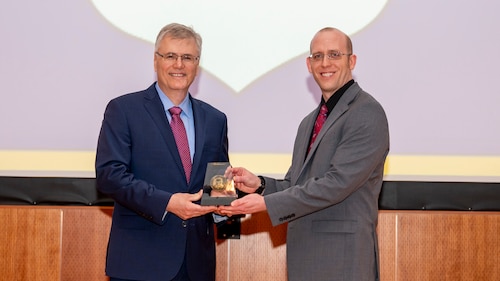
Richard Borth, a Geospatial Intelligence Analysis Squadron researcher, received the 2024 Harold Brown Award for his work developing an artificial intelligence algorithm to detect deployed weapons systems in synthetic aperture radar imagery.
"Mr. Borth's drove the development of an artificial intelligence algorithm that is now having a direct mission effect across the Intelligence Community," Meink said. "This is exactly the kind of innovation the Department of the Air Force needs to maintain our competitive advantage."
The Harold Brown Award is given annually to a scientist or engineer whose research and development achievements significantly enhance the U.S. Air Force's operational effectiveness. The award is named for Harold Brown, a physicist who served as secretary of the Air Force from 1965 to 1969 and was the first scientist to serve as secretary of defense from 1977 to 1981.
Just before presenting the award, Meink reflected on the different ways he encountered, produced and leveraged intelligence throughout his career.
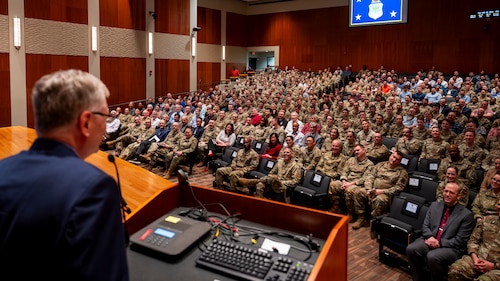
"As a navigator, I relied on the intel, and I trusted it, but I didn't always know where it came from," he said.
As Meink progressed through different positions - including a four-year stint at NASIC's predecessor, the National Air Intelligence Center - he gained an appreciation for the effort and expertise it takes to produce scientific and technical intelligence.
"The work that the team does here at NASIC and the National Space Intelligence Center is critical to our national security," Meink said. "It informs what we acquire and how we operate, not only for our fight tonight, but also for how we fight next week, next year, and even in the next decade."
Borth said the project began with a nearly insurmountable goal set by one of his primary mission partners.
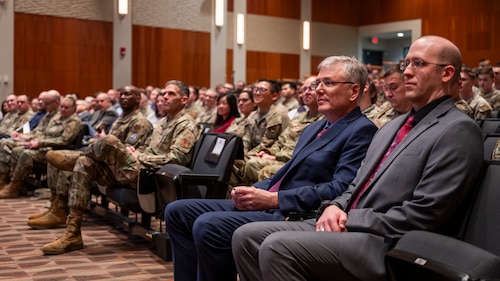
"When I met with U.S. Strategic Command early in the effort, I asked how well it has to perform to get metrics for gauging program success," Borth said. "Their literal response was 100% of the time. I naively echoed '100%?' and they responded, 'Yes, it needs to find the mission target 100% of the time.'"
In this case, Borth couldn't reliably catch a perfect 100%, but as he chased perfection, he caught excellence.
"I will admit, we never made it to 100%, but through much one-on-one work, demonstrations and whole unit evaluations, we proved that though it isn't 100%, there is still mission value," he said.
The project originated shortly after Borth was hired in 2017 when his technical lead identified a need to explore artificial intelligence and machine learning.
"I went around learning about our squadron's missions, and one of our flights proved to be a good candidate to test, and things launched from there," Borth said. "It really came down to recognizing there was a mission need that it could fill, and all the pieces were there to make the research a success."
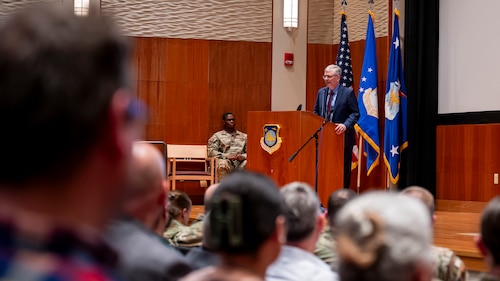
The innovative thinking that was brought forth from the project has been reaffirmed under Col. Kenneth Stremmel, NASIC commander.
"Mr. Borth's work is a powerful example of the culture we are fostering at NASIC," Stremmel said. "Richard saw a challenge, and instead of waiting for a solution, he built one. This is the mindset we want in our organization: empowered experts who take risks and are trusted to deliver. Successes like his don't just benefit one customer; they advance the mission of the entire Center and strengthen our national security."


