
An international team has drilled the longest ever sediment core from under an ice sheet, providing a record stretching back millions of years that will help climate scientists forecast the fate of the ice sheet in our warming world.
The 228-metre core of ancient mud and rock was drilled from under 523m of ice. This game-changing scientific and technological achievement took place more than 700km from the nearest Antarctic stations (New Zealand's Scott Base, and the United States' McMurdo Station), at a deep-field camp at Crary Ice Rise on the edge of the West Antarctic Ice Sheet.
The sediment core holds an archive of past environmental conditions from warmer periods in Earth's history - vital information for climate scientists to determine how much and how fast the ice sheet will melt in the future under our warming climate.
The vast West Antarctic Ice Sheet holds enough ice to raise global sea level by 4-5m if it melts completely.
Satellite observations over recent decades show the ice sheet is losing mass at an accelerating rate, but there is uncertainty around the temperature increase that could trigger rapid loss of ice.
Until now, ice sheet modellers have relied on geological records obtained next to the ice sheet, below floating ice shelves, sea ice and in the open Ross Sea and Southern Ocean.
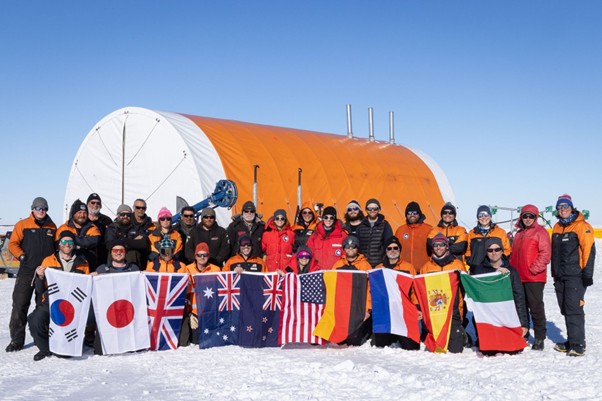
The new sediment core, recovered by the SWAIS2C (Sensitivity of the West Antarctic Ice Sheet to 2°C) project, provides a direct and comprehensive record of how this margin of the ice sheet has behaved during past periods of warmth.
Co-Chief Scientist Huw Horgan (Te Herenga Waka - Victoria University of Wellington, New Zealand and ETH Zurich, Switzerland) said: "This record will give us critical insights about how the West Antarctic Ice Sheet and Ross Ice Shelf is likely to respond to temperatures above 2°C.
"Initial indications are that the layers of sediment in the core span the past 23 million years, including time periods when Earth's global average temperatures were significantly higher than 2°C above pre-industrial."
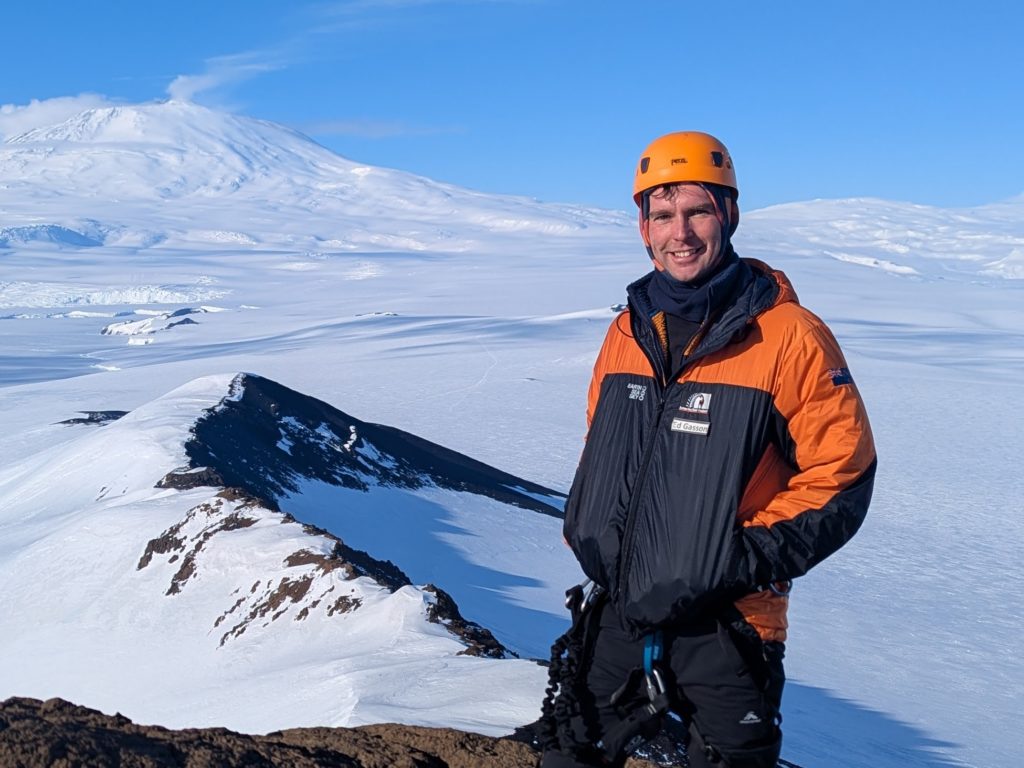
Dr Ed Gasson, Associate Professor at the University of Exeter, and a member of the SWAIS2C Science Team, said: "We have geological records from the edges of the Antarctic continent, but we have never recovered such a deep sediment core from the interior of an ice sheet. It was impressive watching the drill team overcome the technical challenges to retrieve this record.
"This sediment core is important because it tells us directly that this part of the ice sheet, which we think is especially vulnerable to a warming climate, retreated in the geological past leaving behind open seawater. We could see this as soon as the core started coming up.
"This record was incredibly hard won but vital to determining how vulnerable we are to future sea level rise."
Preliminary dating of the sediment carried out in the field was based on identification of tiny fossils of marine organisms found in some of the layers. A wider team of scientists from the 10 countries collaborating in the SWAIS2C project will apply a range of techniques to refine and confirm the age of the records.
Evidence of open ocean where there is now 500-m-thick ice
As the team drilled down through the layers of sediment deep below the ice sheet, pulling up the core in lengths up to 3m long, the researchers examined the sediment for tell-tale indications of the environmental conditions under which it was deposited.
They encountered a wide variety of sediment types from fine-grained muds through to firmer gravels with larger rocks embedded within.
"We saw a lot of variability. Some of the sediment was typical of deposits that occur under an ice sheet like we have at Crary Ice Rise today. But we also saw material that's more typical of an open ocean, an ice shelf floating over ocean, or an ice-shelf margin with icebergs calving off," said Co-Chief Scientist Molly Patterson (Binghamton University, United States).
Open ocean conditions were indicated by the presence of shell fragments and the remains of marine organisms that require light to survive, implying the lack of ice above.
Although it is already thought that there has been open ocean in this region in the past, indicating partial or total retreat of the Ross Ice Shelf, and potential collapse of the West Antarctic Ice Sheet, there is uncertainty about which time periods this occurred in.
Formidable logistical and technical challenges overcome on third attempt
The team of 29 scientists, drillers, engineers and polar specialists living in tents on the snow at Crary Ice Rise knew that success was not guaranteed - SWAIS2C's previous two attempts at drilling had been thwarted by technical challenges.
This was not unexpected - no one has ever drilled geological records this deep under an ice sheet and so far away from any main base of resources.
"To our knowledge, the longest sediment cores previously drilled under an ice sheet are less than 10m. We exceeded our target of 200m, and undertook this 700km from the nearest base - this is Antarctic frontier science," said Patterson.
Professor Tina van de Flierdt, Head of the Department of Earth Science and Engineering at Imperial College London, and Co-Chief Scientist at SWAIS2C, who was part of its previous two expeditions to Antarctica, said: "This is a hugely exciting accomplishment that has involved years of international collaboration, careful design and planning, not to mention physical effort - and we're thrilled to see it finally pay off.
"By helping us understand how the West Antarctic Ice Sheet might behave in rising temperatures, this sediment core will provide the most comprehensive picture yet of our possible future, for one of the most significant consequences of climate change: global sea level rise.
"Our multi-disciplinary team will soon begin work extracting climate data from the core, providing critical information on the vulnerability of the West Antarctic Ice Sheet to catastrophic warming and required adaptation along our coastlines.
"This project has proved to be an inspiring story of resilience, overcoming technical challenges, and not giving up in pursue of answering one of the most pressing questions of our time - how much and how fast will the Antarctic ice melt, and what preparation is needed for future generations."
This groundbreaking work was supported by logistical contributions from two national Antarctic programs.
Antarctica New Zealand provided the traverse capability to tow the custom-designed drilling system and field supplies 1100km across the Ross Ice Shelf. This team then established and operated the remote field camp through a nearly 10-week season.
The National Science Foundation's United States Antarctic Program also provided critical airlift and other logistical support. Weather presented a significant challenge, with the drillers' and scientists' flights into camp delayed by weeks due to freezing fog at the site.
To access the elusive sediment, the team had to first use a hot-water drill to melt a hole through 523m of ice, then lowered more than 1300m of "riser" and "drill string" pipe down the hole.
Once the core was pulled up, the scientists described, photographed and x-rayed the tubes of sediment, and took samples. The team worked in shifts around the clock to make the best use of limited time on site.
Horgan said: "It was a great feeling when that first core came up, but then you start worrying about the next core and the next core after that. So, it's stressful right up until the end. But we're thrilled to have learnt from our previous challenges and to have successfully retrieved this geological record that will help the world prepare for the impacts of climate change."
The core has been transported back to Scott Base and will soon make its way to New Zealand. Samples will then be sent to SWAIS2C scientists around the world for further analysis.


