
When ant pupae are infected by pathogens, they change their body odour. In this way, they warn the colony of the risk of infection - and thus seal their death.
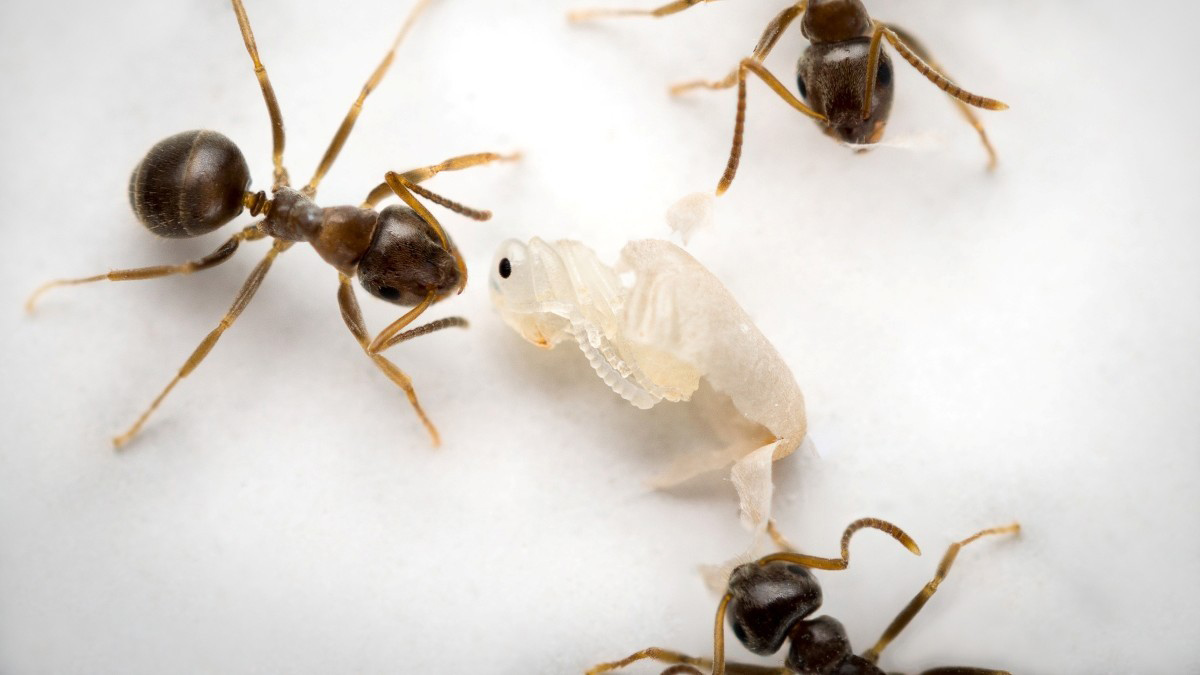
Animals that live in groups and become ill often try to conceal their symptoms so as not to be excluded from social life. The exact opposite is the case with Lasius neglectus: fatally ill ant pupae send an alarm signal to the colony, indicating an incurable infection and thus a risk of infection for the entire colony.
The workers in the colony react immediately. First they unpack the diseased pupae from their cocoons, then they bite small openings in the skin of the sick pupae and apply an antimicrobial poison - formic acid, their self-produced disinfectant.
This treatment immediately kills the pathogens in the pupa. However, the pupa itself does not survive the disinfection process.
Published in Nature Communications
This was discovered by researchers from the Institute of Science and Technology Austria (ISTA) together with chemical ecologist Professor Thomas Schmitt from the University of Würzburg's Biocentre. Their study has been published in the journal Nature Communications.
"What initially appears to be self-sacrifice also indirectly benefits the animal sending the signal, as it protects its relatives. By sending a warning signal, an ant suffering from a fatal infection ensures the health of the entire colony and the production of new daughter colonies. These also carry the genes of the sacrificing, sick ants into the next generation," explains the first author of the study, Erika Dawson, about her completed postdoctoral project in Professor Sylvia Cremer 's Social Immunity research group at ISTA.
Ants develop in four stages. Legless, maggot-like larvae hatch from the eggs. These are fed by workers, moult several times and finally pupate in a protective shell, the cocoon. In the largely immobile pupal stage, the larvae metamorphose into adult ants.
The "Find-me And Eat-me" Signal
Why is there such a complicated early warning system when sick animals could simply withdraw from the colony?
Adult ants that are about to die actually behave like this: "They leave the nest and die outside the colony. Workers that have become infected with fungal spores also show 'social distancing'," explains Sylvia Cremer. However, this is only possible for animals that are mobile. Just like infected cells in a tissue, diseased ant brood is not very mobile and does not have this possibility."
Sick ant pupae, just like infected body cells, are therefore dependent on the help of others to protect the entire colony.
Interestingly, both solve the problem in the same way: They send out a chemical signal that attracts either the body's immune cells or the colony's workers to recognise them as a future source of infection and remove them. In immunology, such cases are referred to as a find-me and eat-me signal.
"It is important that such a signal is both sensitive and specific," says Sylvia Cremer. "This means that all incurably diseased ant pupae should be tracked down, but no healthy pupae or those that can overcome the infection with their own immune system should be unpacked."
So what does a signal that is so precise look like?
Two Components of Body Odour Intensify
Thomas Schmitt, whose research focuses on olfactory communication in social insects, explains: "Workers treat individual pupae very specifically. The odour is therefore not 'in the air' in the nest chamber, but is closely linked to the diseased pupa. It was therefore clear that the odour was not a volatile but a non-volatile odour on the surface of the pupa itself."
The team discovered that two odour components of the natural body odour profile of terminally ill pupae are intensified.
To prove that this altered body odour alone is sufficient to trigger the hygienic behaviour of the workers, the researchers went one step further: they washed the odour signal off diseased pupae, transferred it to healthy brood and observed the reaction of the workers.
The result was clear. The transmitted signal odour alone was sufficient to trigger destructive treatment by the workers.
Alarm Only in Serious Cases
Erika Dawson finds it particularly fascinating that ants do not immediately signal every infection.
"Thanks to their strong immune system, the queen pupae were able to contain the infection themselves and did not send a warning signal to the colony. The worker pupae, on the other hand, were overwhelmed by the infection due to their weaker immune system and then signalled their incurable disease to the colony."
It is precisely this fine-tuning between the individual and colony levels that makes the altruistic disease signalling so efficient.
Publication
Dawson et al. 2025. altruistic disease signalling in ant colonies. Nature Communications, 2 December 2025,
Open Access, DOI: 10.1038/s41467-025-66175-z
https://www.nature.com/articles/s41467-025-66175-z
Project Funding
This study has received funding from the European Research Council (ERC) under the European Union's Horizon 2020 research and innovation programme (grant agreement No 1270 771402; EPIDEMICSonCHIP).


