
As biodigesters go, Cornell's new unit will be small: two 10,000-gallon tanks on a concrete pad that might not be much to look at. But this little system, which will transform food scraps and cow manure into energy, will have an impact far beyond its footprint.
"This is such a great opportunity for research, education and extension," said Lauren Ray, senior extension associate and agricultural sustainability and energy engineer for PRO-DAIRY, in the College of Agriculture and Life Sciences (CALS). "It has this element of practicality, because it really will supply energy to the university, but at the same time it's a platform for learning and even playing, as well as providing hands-on demonstrations for farmers and students."
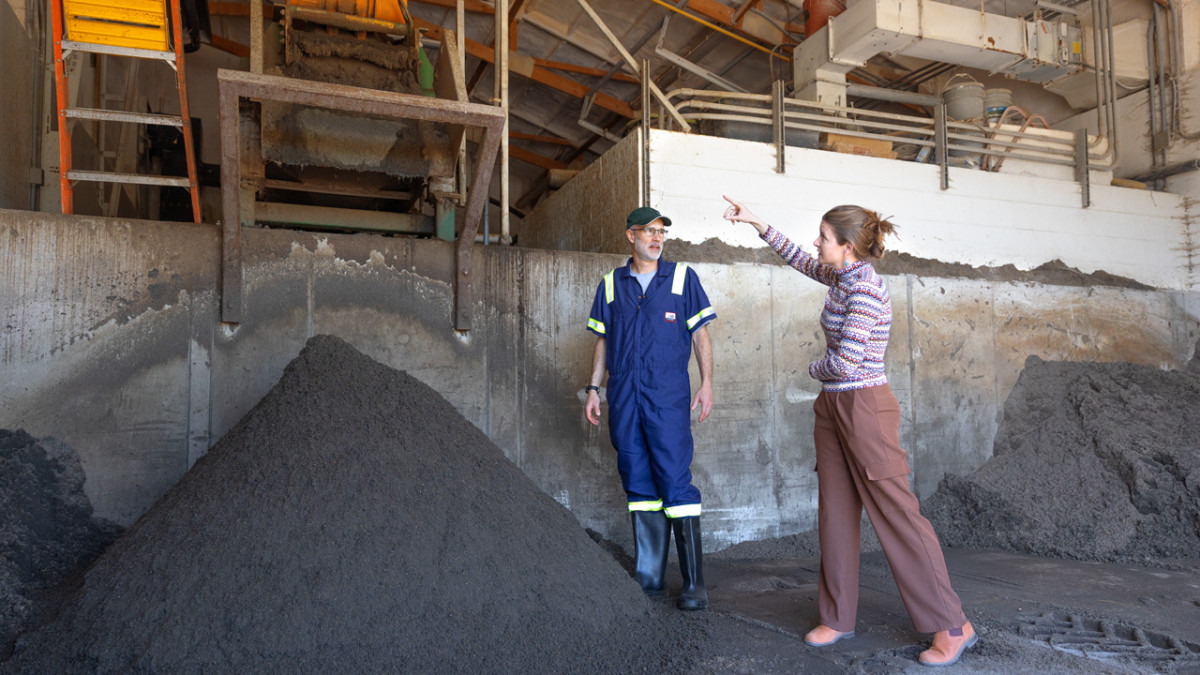
Daryl Nydam (left), professor in the College of Veterinary Medicine, discusses potential uses of the biodigester with Lauren Ray (right), senior extension associate and agricultural sustainability and energy engineer for PRO-DAIRY, at CVM's Teaching Dairy.
The digester is one of the newest additions to Cornell's Living Lab: a long-standing approach that uses campus operations to research and advance sustainability. It will be installed this summer at the Cornell College of Veterinary Medicine's (CVM) Teaching Dairy, where it will take in a portion of manure from the 180-cow herd, as well as food service scraps and byproducts from campus. Microbes in the sealed tanks will anaerobically convert the organic waste into biogas, a combination of methane and carbon dioxide, and nutrient-rich, liquid digestate. The biogas will provide energy to the dairy - offsetting fossil fuel use - and both the gas and digestate will provide raw materials for Cornell researchers who study cutting-edge processes for carbon capture or the conversion of waste streams to biofuels.
"Whatever we do on a laboratory- or bench-scale, to translate it to real-life, you want to validate it in the field," said Jefferson Tester '66, M.S. '67, the Croll Sesquicentennial Fellow and Professor in Cornell Duffield College of Engineering, who studies the conversion of waste to useful products. "It's very hard to do that on a big farm with a huge digester. The best way to get that data is to have an operating experiment like we're going to have on campus."
Funded in part by the New York State Energy Research and Development Authority (NYSERDA), the biodigester will also fill a gap for the state's smaller dairy farms, by providing a proof-of-concept for smaller-scale systems.
"Our living lab extends to partner farms all across New York state," said Daryl Nydam, professor of dairy health and production in the Department of Public and Ecosystem Health (CVM). "For us to have this piece on campus that allows us to interact better with the broader living lab is really important."
'A perfect situation'
Many large dairy farms in New York and beyond have been using and benefiting from anaerobic digesters for decades. At the larger scale - farms with more than 500 cows, for instance - digesters can generate twice as much electricity than a farm uses, and the excess power can be sold and channeled back to the grid. The biogas can even be refined, piped and sold into existing, renewable natural gas lines. That added revenue is in addition to practical and environmental benefits; without a biodigester, manure is generally stored in smelly, exposed pits on the farm, releasing methane, 25 to 30 times more potent than carbon dioxide, into the atmosphere.
But for smaller farms, the economics of installing a digester haven't yet made sense. In 2019, NYSERDA awarded New York City-based nonprofit Energy Vision funds to conduct feasibility studies for smaller-scale systems.
"So the focus became: How can we scale these down so more farms can participate?" Ray said. "Energy Vision was looking for a demonstration site, but it's very hard to do this kind of study on an operating farm. Having it at Cornell and integrated with the Teaching Dairy on campus is really a perfect situation."
Interest and investment in the digester immediately cropped up around campus, prompting cross-campus collaboration and coordination between researchers, staff and extension associates in CALS, CVM, Cornell Duffield Engineering, and the Campus Sustainability Office. Funding and project management came from the Cornell Atkinson Center for Sustainability, which from the outset backed concept work, brought university partners together and aligned stakeholders to help advance the project.
Energy from the biodigester will be used to dry recycled sand from the cows' bedding and to heat domestic hot water at the Teaching Dairy. It will also better prepare veterinary students for their work on farms, Nydam said. "We want to be able to keep up and show our students what's going on out in the world, as well as participate in the research to inform progress," he said.
On the extension side, Ray and others will track the smaller system's performance, tweaking operations to test the economic viability for smaller farms. Adding food scraps is of particular interest, especially since New York state, in 2022, began requiring restaurants, grocery stores and institutions that generate more than 2 tons of food waste per week to donate or recycle it. That law will apply to those generating more than just 1 ton per week beginning in 2027.
"If you look at New York City, the eastern corridor, the amount of food waste is crazy," Ray said. "And there have to be good systems in place to recycle everything into energy and nutrients, which you can do with the digester."
The system on campus will also be publicly accessible for trainings.
"This is a great opportunity to have that hands-on interaction with farmers, developers, design engineers, financiers, all of that," Ray said. "There's a lot of potential."
Research on real systems
The gas produced by anaerobic digesters is nearly equal parts carbon dioxide and methane, but it's captured rather than released. Researchers across campus will investigate how to transform that stored gas, as well as the liquid digestate, in innovative ways.
Tester's group will further work to streamline the conversion of the carbon dioxide to additional methane energy, which could roughly double farmers' profits. Tester is also exploring the use of digestate to produce bio-oil and biochar, and to extract nutrients that can reduce the need for synthetic fertilizer.
Tobias Hanrath, the Croll Professor in Duffield Engineering, will investigate the use of electrical currents to hone and control chemical reactions with the gases. And Phillip Milner, associate professor in the College of Arts and Sciences, will test his method of using sunlight to capture carbon, an approach that could ultimately lead to direct carbon capture from the air and conversion to fuel.
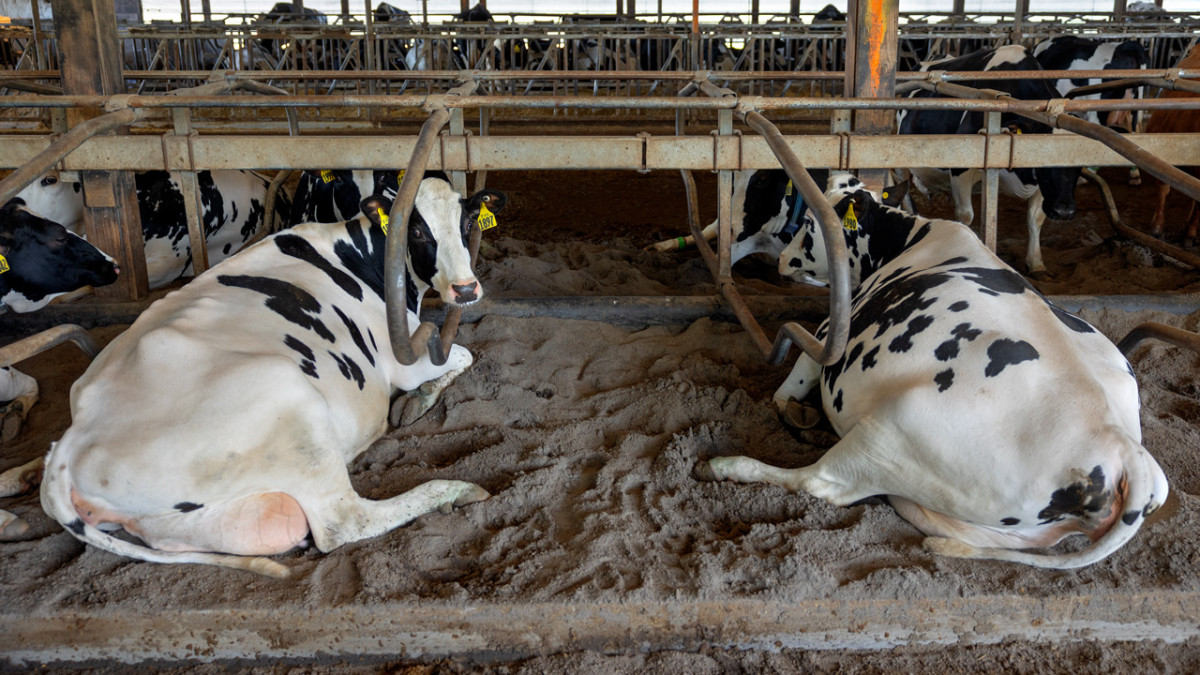
With the energy generated, the biodigester will help dry sand from the cows' bedding for reuse.
"It's all related to this circular bioeconomy, where everything eventually can be reused, where we can get more value from it, but all of that requires data," Tester said.
The biodigester will allow researchers to test their hypotheses from lab research on a real system. And they'll get help from another Living Lab project coming online this summer: the mobile, trailer-mounted CAPTURE lab (Cornell Advanced Platform for Testing, Utilization and Research in CO2 Capture and Conversion). Funded by Cornell Atkinson, the lab will provide composition analyses of the biogas from the digester, as well as gases from other sources like the exhaust stacks of Cornell's Combined Heat and Power Plant.
In particular, Hanrath's group will use the biodigester and the CAPTURE lab to test whether electrical currents could standardize the conversion of the biogas to usable compounds.
"The composition of the gas depends on what you put in, if you put in food waste or cow manure, whatever," said Hanrath, a principal investigator for the CAPTURE lab. "Our value proposition is that you can have a robust technology that can convert the gas, no matter what the composition. You just change the electrical signal, the software, so we can be agile and adaptive."
The size of the system will also allow researchers to easily tweak the composition of waste going into the digester to understand how that impacts the biogas concentrations and subsequent performance.
Tester, who is also principal investigator for Cornell's Earth Source Heat project, said the opportunity to study these questions on real systems - using the Living Lab approach - is what drew him back to Cornell.
"To solve real-world problems, we have to take a multidisciplinary systems view, which is very different than the way a lot of research is done," Tester said. "We're trying to bring all the pieces together, and there's not one path but many. Working with these systems allows us to see that and problem-solve for maximum, real-world impact."


