
By Joey Garcia, University Communications and Marketing
Space isn't known for rich soil or ideal agricultural conditions anywhere in the solar system. Yet amid extreme temperatures and vast distances, multidisciplinary teams at the USF's Aerospace: Science, Technology, Research and Applications Center (ASTRA) are collaborating on sustainable space agriculture projects with potential applications back on Earth.
Much of that work is happening without ever leaving the ground. Researchers across campus are simulating space environments in labs, testing how plants, microbes and biological systems respond to the same stresses they would face on the moon and Mars.
We're building multidisciplinary teams of engineers, plant scientists and health researchers who are contributing to space-related projects and their applications on Earth. It's creating an opportunity for USF to establish itself as a leader in this field.
Stephanie Carey
Associate Professor and Principal Investigator for USF's ASTRA Center
TEAMING UP FOR MANGROVE SPACE BOTANY
A look inside the lab of Associate Professor Christina Richards reveals wild plants adapted to challenging environments, particularly coastal species such as the Spartina alterniflora marsh grass and red mangroves. While the leap from coastal ecosystems to space may seem unlikely, Richards quickly saw the connection when her graduate student, Jessica Bains, expressed interest in space botany.
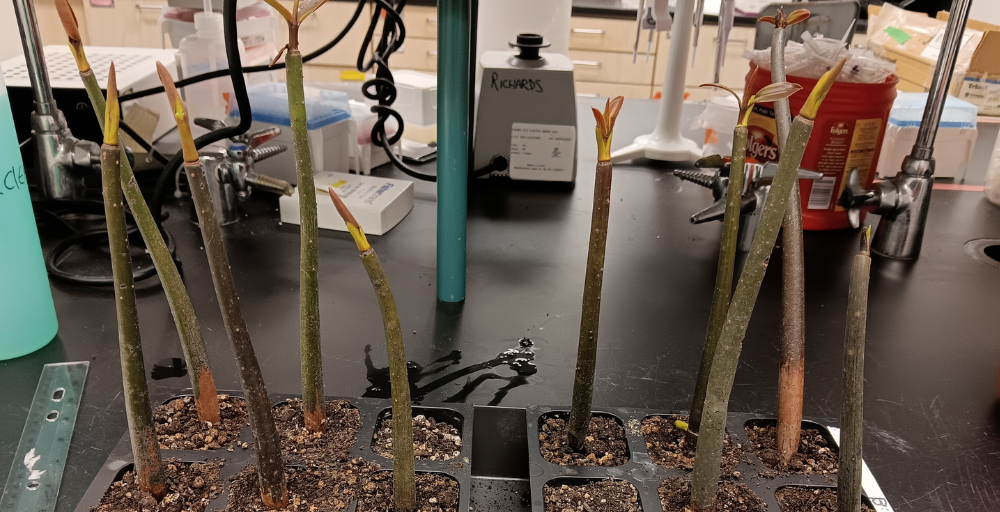
Researchers monitor mangrove growth over time to better understand how resilient coastal plants adapt to challenging environments
"Space agriculture is about understanding how to grow plants in extremely difficult environments," Richards said. "At first, I saw this topic as an opportunity to apply our approaches in genomics to understand how plants regulate those responses under the stresses they face in extra-terrestrial environmental conditions."
In collaboration with other USF integrative biology researchers, the lab studies how red mangroves survive challenging conditions such as pollution, changing water quality and other environmental stresses. Already highly resilient, mangroves offer a model for survival in extreme environments. Researchers are examining how the plants and the microbes living around their roots help them adapt, with plans to collaborate across USF to test mangroves in space environments.
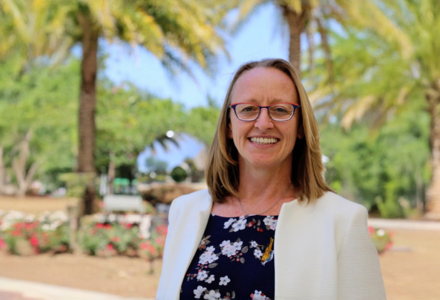
A graduate student's interest in space botany inspired Christine Richards to apply her lab's plant genomics expertise to space agriculture research
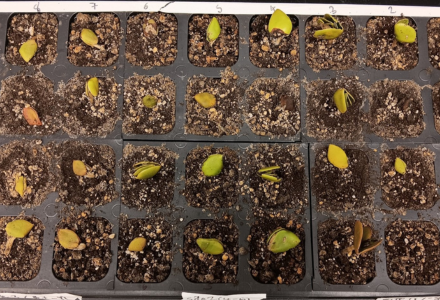
Mangrove seedlings grown as part of USF research examining how coastal plants respond to nutrient-rich conditions and environmental stress
"We want this to be rigorous science, not simply excitement about doing 'space work,'" Richards said. "The goal is to start with strong plant biology grounded in Earth-based systems before expanding to agriculture and true space-growth conditions."
WASTE RECYCLING AND CLOSED-LOOP AGRICULTURE
Sustainability extends beyond Earth. Space exploration is resource-intensive, requiring careful management of limited supplies. In Professor Daniel Yeh's Membrane Biotechnology Lab, researchers have developed an organic processor assembly system that uses anaerobic microorganisms to break down human waste and recover nutrients, producing a rich liquid similar to a water-based plant nutrient solution.
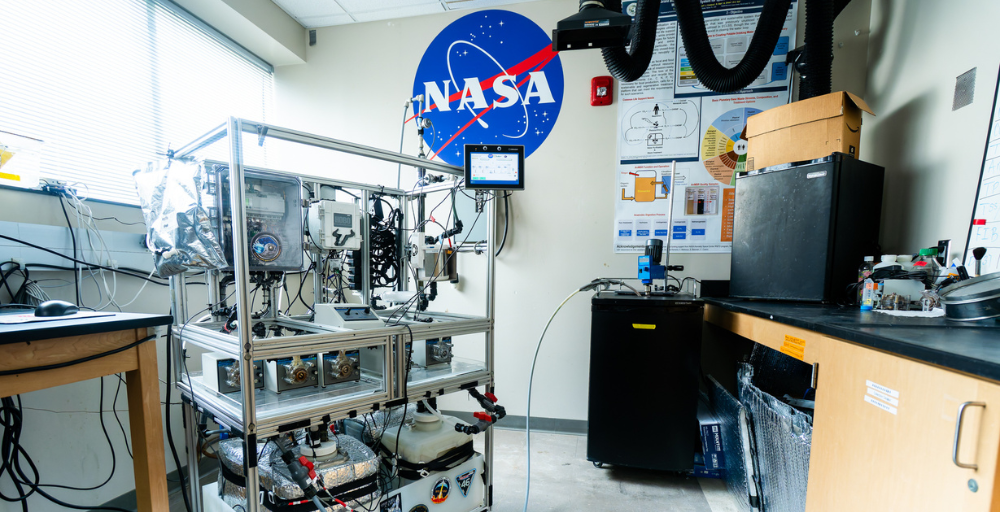
The Yeh Lab uses a nutrient-recovery system designed to recycle waste into resources that could support plant growth during future moon and Mars missions
"Transporting supplies into space is extremely expensive, and every pound of payload matters," said Alexandra Smith, a graduate student in the Yeh lab. "Instead of removing nutrients as waste, we recycle them into plant growth systems that can support astronauts on long-duration missions. This same technology can also be used to face Earth's wastewater challenges."
The lab has successfully grown bok choy without soil using these recycled nutrients.
Beyond space, the technology has important applications on Earth. In regions without centralized wastewater infrastructure, decentralized systems like this could provide sustainable treatment solutions. Yeh has already worked on projects in South Africa where wastewater systems support schools, as well as projects in Hawaii where volcanic rock makes conventional infrastructure difficult to install.
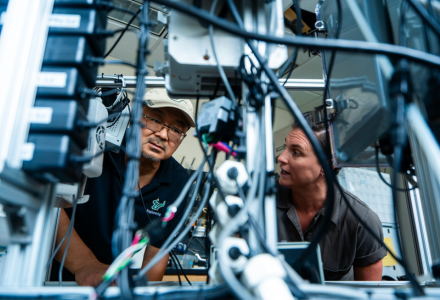
Daniel Yeh and graduate student Alexandra Smith
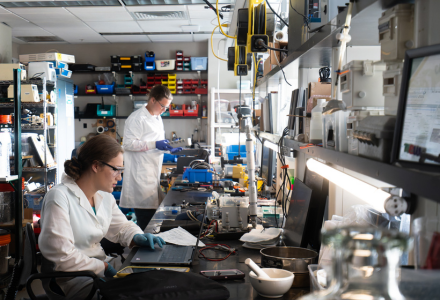
Researchers in the Yeh Lab analyze how nutrients recovered from waste can be reused to support plant growth
"For the past 20 years, our lab has developed off-grid wastewater treatment and resource recovery systems, such as the NEWgenerator, which was successfully deployed in India and South Africa," Yeh said. "Our technology eventually caught the attention of NASA. During the past eight years, we have been collaborating with the Kennedy Space Center to develop various space versions of our membrane bioreactor technology for incorporation into the future moon base."
SATELLITE PLANT GROWTH SYSTEMS
Inside small, box-shaped satellites traveling in low Earth orbit, automated greenhouses are testing how terrestrial plants survive in space. These systems, known as CubeSats, are launched by NASA in collaboration with universities, including USF, and have been led in part by USF Professor Arash Takshi.
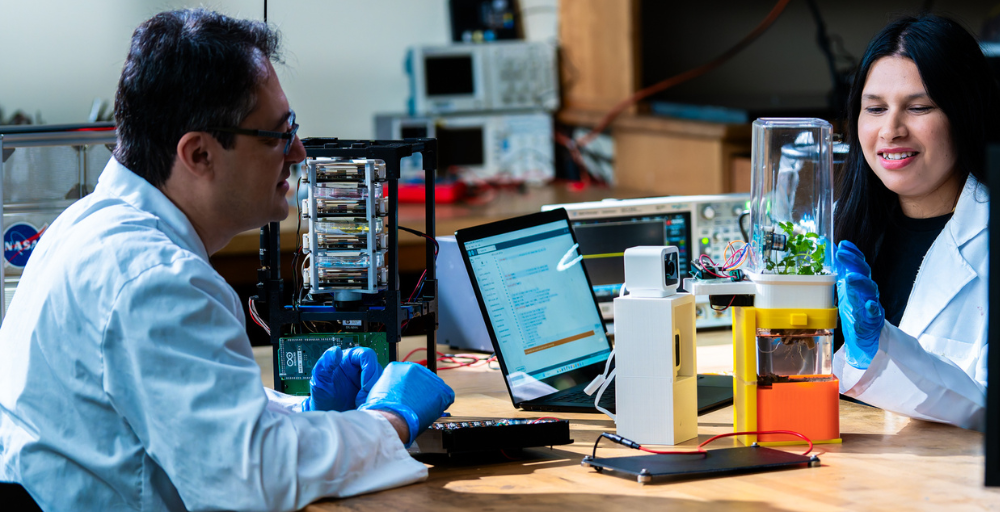
Arash Takshi and graduate research assistant Shubha Dixit examine a prototype plant-growth system designed to study how plants respond to space-like conditions
"NASA wanted additional ways to study plants in space as moon and Mars missions became more serious priorities," Takshi said. "Though challenging, the experiments showed how sensitive plants are to environmental variables. Small changes in gases, humidity, moisture or lighting significantly affected growth."
Takshi built an early prototype in his closet using red romaine lettuce. What began as a simple setup with sensors, cameras and gas-monitoring systems evolved into a sophisticated platform designed to sustain plant growth in space.
The work revealed how many interconnected biological and environmental factors must be managed simultaneously in a confined environment. This complexity encouraged the team to go beyond plant studies and into fungi research since some fungi grow faster and are more resilient to extreme conditions than plants. Certain fungi exhibit unusual radiation-related properties that interest NASA, and researchers are exploring whether they could contribute to food systems or biological support for long-duration missions.
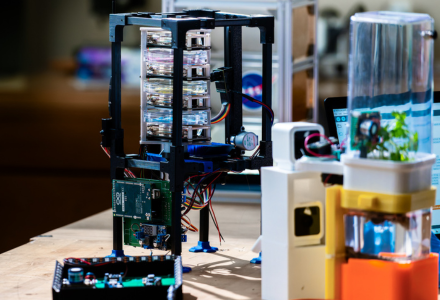
The CubeSat is designed for fungi research (left) and plant-growth (right)
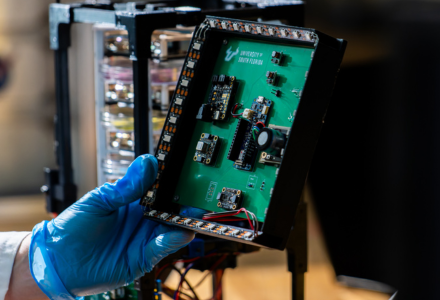
Custom sensor electronics developed at USF help monitor plant health and environmental conditions in space agriculture
"At first, I approached the work entirely from an engineering perspective focused on sensors and electrical systems," Takshi said. "Eventually we realized we had to include other experts at USF, such as Dr. Richards and Dr. Yeh, for their expertise in biology and space."
These collaborations represent just one area of USF's growing involvement in space research, where scientists and engineers are exploring challenges ranging from agriculture and sustainability to human health and advanced technologies for future missions.


