
Key Points
Sunlight can covert glycerol, a low value product of biodiesel production into hydrogen and higher value chemicals
A photocatalyst based on zinc indium sulfide, modified with very small amounts of nickel and cobalt, increased the hydrogen evolution rate and the production of glyceraldehyde and dihydroxyacetone
The research team used X-ray absorption spectroscopy and infrared microspectroscopy at the Australian Synchrotron to observe the catalytic reactions in real time
Australian researchers and international collaborators have demonstrated a solar-driven approach to convert glycerol, a low-value by-product of biodiesel production, into hydrogen and higher-value chemicals. Using advanced techniques at Australian Synchrotron, they revealed how the catalyst changes while it was working.
The study, led by researchers at the University of New South Wales, investigated a process known as photoreforming, in which light energy is used to drive chemical reactions to simultaneously produce hydrogen and transform organic feedstocks into useful products. The research was published in Applied Catalysis B: Environment and Energy.
Glycerol is produced in large quantities by the growing biodiesel industry, with approximately 100 kilograms generated for every tonne of biodiesel. Crude glycerol can be worth as little as US$0.11 per kilogram. Chemicals can be produced from it, such as glyceraldehyde and dihydroxyacetone, which have applications in the chemical and pharmaceutical industries, valued at approximately US$75 and US$150 per kilogram, respectively.
Dr Denny Gunawan from UNSW said the opportunity was to use sunlight not only to produce hydrogen, but also to extract greater value from an existing industrial by-product.
"Rather than using an expensive feedstock simply to produce hydrogen, photoreforming gives us the opportunity to do two useful things at once; generate hydrogen and convert a low-value by-product into more valuable chemicals," said Dr Gunawan.
"The challenge is that glycerol can follow several different reaction pathways. If we understand what controls those pathways, we can start designing catalysts that steer the reaction towards the products we want."
The researchers developed a photocatalyst based on zinc indium sulfide, which was modified with very small amounts of nickel and cobalt.
Under visible light, adding the nickel-cobalt cocatalyst increased the hydrogen evolution rate by approximately ten times compared with the unmodified material. It also changed the chemistry of the reaction, substantially increasing the proportion of glycerol converted through pathways producing glyceraldehyde and dihydroxyacetone.
Tests under simulated sunlight demonstrated the simultaneous production of hydrogen and useful organic products with the catalyst achieving a hydrogen production rate competitive with other reported solar-driven glycerol photoreforming systems.
Watching the catalyst respond to light
To understand why nickel and cobalt changed the reaction, researchers needed to observe the catalyst while it was actually operating.
At the X-ray Absorption Spectroscopy (XAS) Beamline, the researchers used two techniques, in situ XAS and Fixed Energy XAS (FE-XAS), to investigate what happened to the nickel and cobalt sites when the photocatalyst was illuminated. By measuring at selected X-ray energies rather than scanning across the full absorption spectrum, FE-XAS can follow changes in the catalyst much faster than conventional XAS.
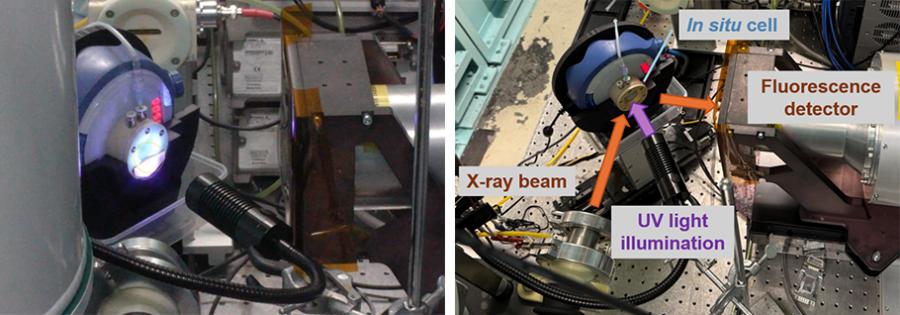
ANSTO Principal Scientist Bernt Johannessen said the ability to follow the catalyst dynamically provided information that could not be obtained simply by examining it before and after the reaction.
"Using these advanced capabilities, we could follow the nickel and cobalt sites as the catalyst responded to illumination and observe changes that occurred in less than one second," said Dr Johannessen.
"When the light was switched on, we could see the chemical states of both metals change as the active catalyst formed. When the light was removed, those changes reversed. Being able to follow that process in real time gave us information that simply looking at the catalyst before and after the reaction could not provide."
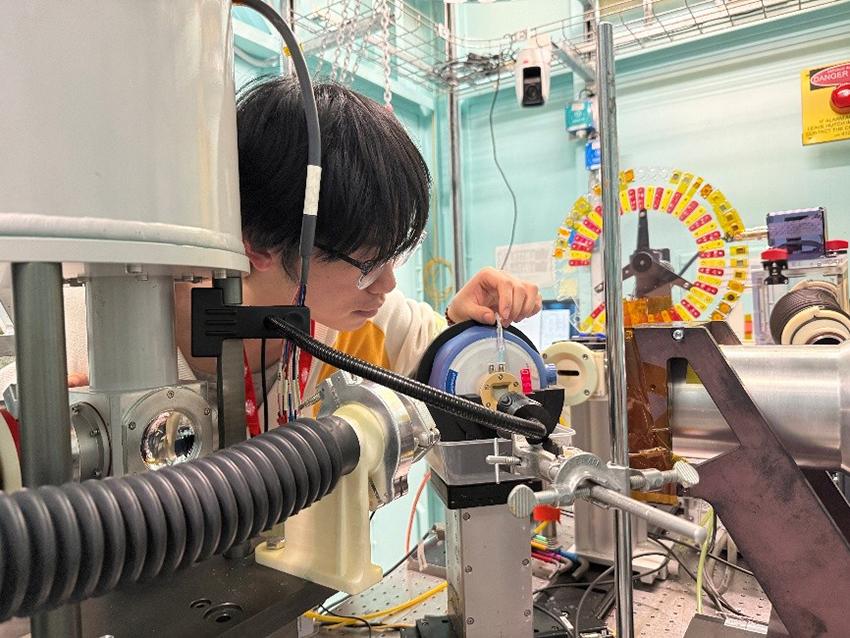
The measurements showed that nickel and cobalt initially existed predominantly as positively charged ions. Under illumination they transformed into more reduced states associated with the active photocatalyst.
Importantly, the transformation was reversible. Repeated light-on and light-off measurements showed the nickel and cobalt sites responding repeatedly to illumination, while control measurements in the dark confirmed that the changes were driven by light rather than the X-ray beam.
Following both the catalyst and the chemistry
Another Australian Synchrotron technique provided a complementary view of what was happening during the reaction.
Using in situ synchrotron infrared microspectroscopy at the Infrared Microspectroscopy (IRM) Beamline, the researchers followed molecules on the photocatalyst surface under illumination.
Together, the two synchrotron techniques provided different views of the same reaction: the spectroscopy techniques followed changes in the nickel and cobalt catalyst sites, while the infrared microspectroscopy helped identify the chemical intermediates as glycerol was transformed into different products.
Combined with other experimental techniques and theoretical calculations, the measurements helped the researchers distinguish the active sites responsible for competing reaction pathways.
The results showed that the zinc indium sulfide surface predominantly favoured a pathway producing hydroxyacetone. Adding nickel and cobalt promoted hydrogen production while shifting more of the glycerol towards pathways producing glyceraldehyde and dihydroxyacetone.
The findings provide new insights into how photocatalysts could be designed to better control which products are generated.
"The exciting aspect is not simply that we can make hydrogen from glycerol," said Dr Gunawan.
"We are beginning to understand how to control the chemistry so that solar energy can be used to produce hydrogen while directing the remaining carbon into useful products rather than waste."
The approach could potentially be extended beyond glycerol to other biomass-derived feedstocks, providing design principles for solar-driven processes that combine renewable hydrogen production with the manufacture of useful chemicals.
Thanks to Prof Bernt Johannessen for his contribution.


