
There is an elegant mathematical equation behind so many different natural phenomena. From the fractal pattern of a romanesco cauliflower sitting on a grocery store shelf to defining the flow of rivers - they all have underlying mathematical properties. The way heat propagates through one object to another also has a mathematical basis that is strikingly complex. Simulating how heat propagates through rods when multiple rods are heated simultaneously is a major feat - as the temperature of each rod influences one another. However, a research team at Tohoku University and Islamic Azad University found a method to rapidly simulate this situation.
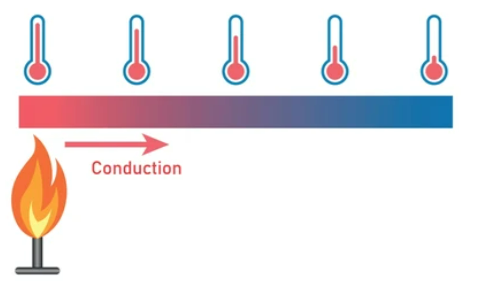
Professor Amir Sadeghi (Islamic Azad University) and Professor Shinya Miyajima (Tohoku University) achieved this by starting with a matrix. A matrix is an array of real numbers arranged in rows and columns. The complementary error function takes real numbers as inputs and takes values between 0 and 2. By computing the value of the complementary error function, we can simulate on a computer how heat propagates through a rod when it is heated. The complementary error matrix function is a matrix-valued extension of the complementary error function.
"A matrix is a way of organizing numbers, so we can better understand how certain systems work," explains Miyajima. "The hard part is figuring out how to arrange the numbers."
To achieve this simulation, the input matrix must satisfy a certain assumption. However, it is not always valid, and even when it is satisfied, the simulation may not be successful. Furthermore, a method for how to compute the value of the matrix complementary error function had never been reported in the literature before. The team had a lot of work to do to figure out how to properly build their matrix to ensure the simulation was accurate.
"This is a complex error function that would require an enormous amount of computational time to evaluate normally," explains Sadeghi. "To avoid this, we derived a new representation of the function. It's like shorthand. This saves time and allows the simulation to be completed much, much faster."
The research team successfully clarified the mathematical properties of the complementary error matrix function, and established methods for computing the values of this function on a computer. These methods enable us to rapidly simulate how heat propagates through each rod when multiple rods are heated at the same time. As a result, we may be able to better predict how heat might spread in real life - and how to avoid getting burned.
The findings were published in Linear Algebra and Its Applications on August 18, 2026.
- Publication Details:
Title: Complementary error matrix function and its numerical computation
Authors: Amir Sadeghi, Shinya Miyajima
Journal: Linear Algebra and Its Applications


