The LaunchPad program offers early-stage companies not ready for dedicated lab or office space access to high-value services, mentorship, and community benefits available through UConn's Technology Incubation Program
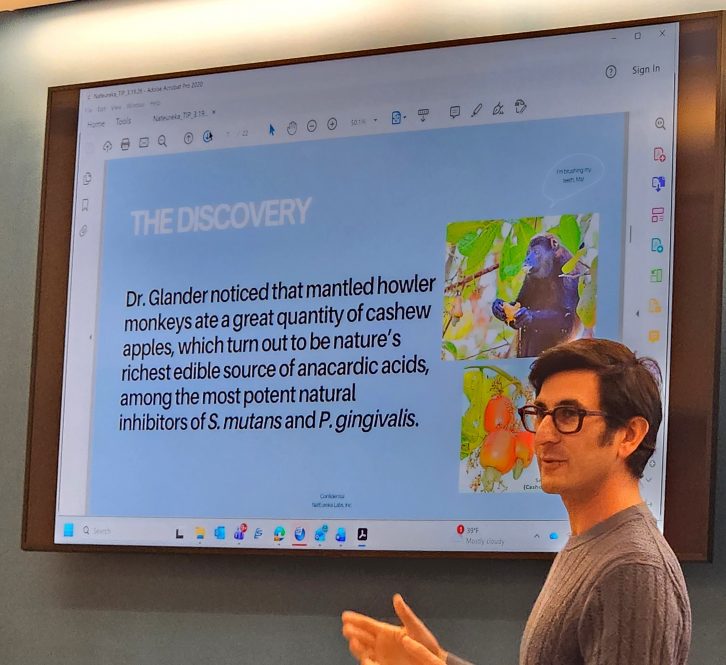
Zach Rome, founder and CEO of Nateureka!, is working with UConn and TIP's new LaunchPad program, linking his company with fellow entrepreneurs. Contributed photo.
On the road to start-up success, there are companies ready for the fast lane and others that still need a little help to get there. UConn's Technology Commercialization Services (TCS) has long supported both types of early stage companies, but in recent years, only those meeting stringent readiness criteria have been accepted into its Technology Incubation Program (TIP). Companies not meeting those benchmarks – even those based on the best of ideas - have been encouraged to keep working and try again.
Now there's another option.
LaunchPad, a TCS initiative introduced in January, offers startups access to the high-value services, mentorship, and community benefits available through TIP, without being formally accepted into the program. With LaunchPad, early-stage entrepreneurs can choose from a range of TCS services tailored to their needs without committing to dedicated lab or office space and the cost that goes with it.
"Launchpad reflects UConn's commitment to supporting innovation across the full lifecycle," says Abhijit Banerjee, Associate Vice President of Innovation and Entrepreneurship with UConn's Office of Vice President for Research (OVPR). "From early experimentation to high-growth commercialization, it strengthens the overall pipeline and ensures promising ideas don't fall through the cracks."
The range of companies that might benefit from LaunchPad runs the gamut, says Steve Criss, administrator of TIP-Storrs. Some are building early proof-of-concepts or prototypes, while others are seeking early investment through the Small Business Innovation Research (SBIR) and Small Business Technology Transfer (STTR) programs. Some may want to engage with UConn faculty or specialized research. Some want TIP's structured support and services without the overhead.
"This is a critical on-ramp for startups that are not yet ready for dedicated lab space but have a well-defined business model and growth trajectory," says Criss. "TIP LaunchPad provides the structure, community, and access to resources that help founders refine their strategy, secure early-stage funding, and position themselves for scale. It's a deliberate step in our pipeline-one that connects promising companies to University assets and accelerates their ability to contribute to Connecticut's innovation economy."
For Zach Rome, founder & CEO a startup developing a novel, natural fluoride alternative, LaunchPad offered proximity to other entrepreneurs - something he lacked working from his home office. As a third-generation pharma entrepreneur with a handful of pharmaceutical startups under his belt, Rome already knew how to draft a business plan. What he needed, and found with LaunchPad, was the ability to network with fellow innovators face-to-face.
"There is real value in getting in front of people and having facetime," says Rome, whose company Nateureka! is the newest startup to join LaunchPad. "I need involvement with other ambitious entrepreneurs working on their own things. In intangible ways, they will help me be successful. The tradeoff made sense for me."
Ric Duncanson, founder and CEO of Marc Antoni Racing, sought something different. As a new entrepreneur, getting help with a business plan is exactly what he needed. LaunchPad also provided Duncanson with a business address, a place to meet with his team, which includes Alexander Dupuy, a UConn Assistant Professor of Materials Science and Engineering, and 3D modeling capability at the Advance Technology Laboratory (ATL) in Storrs.
"The technical stuff, I can navigate with my instincts," says Duncanson, whose company is developing a fast-charging battery for electric vehicles. "The exposure that LaunchPad offers will help me navigate the startup ecosystem."
TIP provides specialized wet labs, office space, expert mentoring, and access to UConn's research resources - all of which accelerates the development of tech-based startups, particularly those connected to UConn. TIP currently has 33 companies operating out of sites in Storrs and Farmington, with 21 more in the pipeline. To accommodate the growth, TCS is adding a new space on UConn's Depot campus in Mansfield - a site at 44 Weaver Road previously home to UConn's Clean Energy Engineering (C2E2). Four companies have been approved to move into the Advance Tech Laboratory (ATL) building in Storrs.
"LaunchPad allows us to accommodate more early-stage companies and eventually integrate them into TIP," Criss says.
UConn companies and entrepreneurs set records and milestones in FY25, despite a challenging innovation landscape nationally. TCS saw an increase in disclosures and affiliated startups, something leaders credit to a revised strategy and fresh approach that includes LaunchPad. The 117 invention disclosures reported in FY25 represent a 30% increase over the previous year. TIP also notched record growth, with a reported $9.9 million in revenue, double that of 2023. Additionally, TIP companies raised $108 million in funding in FY25, a 39% year-over-year increase, while the number of people employed by TIP companies grew to 286.
LaunchPad also provides access to co-working space, programming, venture development support, investor readiness, and connections to university resources and industry mentors through TIP's Entrepreneurs-in-Residence program. A curated network of experienced business leaders and industry experts, EIRs works directly with startups to refine strategy and navigate scaling. Participants also receive complimentary memberships to BioCT and MassBio, as well as access to specially negotiated discounts through TIP's vendor program.
As an arm of the OVPR, TCS facilitates tech transfer, intellectual property management and monetization, along with other facets of innovation and entrepreneurship. LaunchPad is one more way for the TCS team to extend those services and engage and build trust with faculty, notes Banerjee.
"Historically, early-stage companies that weren't quite ready for TIP would go through our evaluation process and, if they didn't meet the criteria, they were either declined or encouraged to come back later after further development," Criss says. "What LaunchPad does is close that gap. It gives us a structured, intentional way to stay engaged with those founders-helping them strengthen their business model, refine their strategy, and build toward readiness for full incubation. It's a more disciplined approach to pipeline development, and ultimately it allows us to support more startups, more effectively, at the earliest stages of their growth-further reinforcing UConn's role as a driver of innovation and startup development across Connecticut."