
Arsenic contamination in drinking water is a global issue, with over 200 million people estimated to be at risk. While water treatment plants remove the metal, the problem persists in low-resource areas or undertreated well water. So, researchers reporting in ACS Omega have designed a simple solution: an arsenic-removing teabag. The system is inexpensive, costing around 7 cents to clean a liter of water, and highly effective, removing over 90% of the arsenic ions present.
Clean drinking water should not depend on access to expensive infrastructure." - Vick Tan
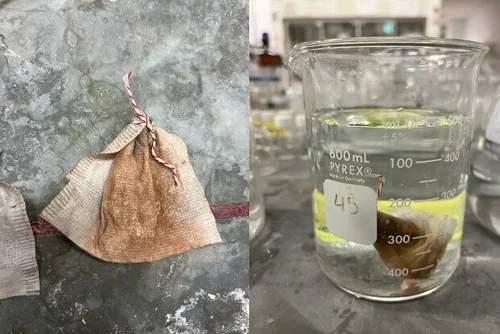
Adapted from ACS Omega 2026, DOI: 10.1021/acsomega.5c12885
"Clean drinking water should not depend on access to expensive infrastructure. Our research shows that simple low-cost materials can be engineered into scalable solutions for arsenic remediation from drinking water, one of the world's most urgent public health crises," explains Vick Tan, a high school student intern and author on the paper.
The World Health Organization (WHO) has set a limit for safe drinking water of 10 micrograms of arsenic per liter. However, due to natural leeching from certain minerals or from human activities like mining, the arsenic concentrations in groundwater can exceed this limit, often requiring high-tech removal systems like reverse osmosis. In regions without wide-scale water treatment, such as parts of Southeast Asia, arsenic exposure remains high. This has led to high rates of arsenic poisoning and health problems related to long-term arsenic exposure, including cancer and childhood developmental issues.
Tan, with a team of researchers led by Adam Braunschweig, proposes a method of removing arsenic ions from drinking water that's as simple as making a cup of tea. Previously, it had been discovered that heavy metals like arsenic naturally stick to some teabags during the brewing process. So, these researchers wanted to create a teabag that was specially designed for removing arsenic ions.
The team took cellulose-based teabags, embedded them with magnetic iron oxide nanoparticles, and filled the bags with pulverized eggshells - two ingredients that are good arsenic adsorbers. Experiments showed that:
- One teabag could remove at least 90% of the arsenic ions from water, and in one 6-hour test, more than 98% of arsenic was removed from 50 milliliters of contaminated water.
- In a sample representative of well water in Bangladesh, one teabag reduced the arsenic content to below the WHO's drinking water limit.
- A used teabag could be rinsed, washed in alkaline solution, dried, and then reused up to five times, though the teabag's arsenic removal efficiency dropped by about 20% with each reuse.
- The cost to treat one liter of water with the teabags is about 7 cents - considerably less than water treatment by reverse osmosis.
The researchers say that this work demonstrates a new, scalable and cost-effective solution to a global health problem, and their future work will focus on making this innovation ready to bring to those who need it.
The authors acknowledge funding from the Army Educational Outreach Program, the Stockholm Junior Water Prize, the Air Force Office of Scientific Research, and the National Science Foundation.


