
Key findings
- Levels of volatile organic compounds (VOCs) were significantly higher in the post-fire period than during the fires.
- The analysis found that the presence of different VOCs peaked at different points during the fires and post-fire phases.
- The median benzene concentrations outdoors, for example, were 0.38 parts per billion (ppb) during the fires and dropped to 0.06 ppb at the end of the sampling period.
A new study of the impact of the 2025 Los Angeles County wildfires has found that even after fires are extinguished, residents who return to their homes may remain at risk of exposure to known carcinogens because of smoke damage.
In the peer-reviewed study — Indoor and Outdoor Volatile Organic Compound Levels During and After the 2025 Los Angeles Wildfires — a research team led by UCLA Fielding School of Public Health scientists found that the levels of volatile organic compounds (VOCs) were significantly higher in the post-fire period (vs. when the fire was burning) and were particularly evident in uninhabited homes within burn zones, suggesting ongoing indoor emissions from smoke-impacted materials.
"These findings underscore the need for targeted interventions to minimize indoor exposures during the recovery phase," said study co-author Michael Jerrett, professor in UCLA Fielding's Department of Environmental Health Sciences and holder of the Jonathan Fielding Chair in Climate Change and Public Health. "These findings raise concerns about indoor air quality post-wildfire, and the potential for prolonged exposure leading to significant health impacts."
The research, shared in the journal Environmental Science & Technology published by the Washington, D.C.-based American Chemical Society (ACS), will be available online Jan. 2 and Jan. 12 in the physical journal.
The January 2025 blazes in Los Angeles County, in both the Pacific Palisades-Malibu area in western Los Angeles, adjacent to the Santa Monica Mountains, and the Altadena-Pasadena communities in the foothills of the San Gabriel Mountains, claimed at least 31 lives, burned more than 37,000 acres, and damaged or destroyed more than 18,000 structures, according to county estimates. Both fires erupted in open areas on Jan. 7, spread into neighborhoods and were only fully contained by Jan. 31.
The researchers began fieldwork on the second day of the blazes, collecting air samples indoors and outdoors, and continued through the post-fire period, ending Feb. 18, 2025. The team of UCLA faculty, staff and students was focused on the prevalence of volatile organic compounds, such as benzene, toluene, ethylbenzene and xylenes (BTEX).
"Some of these are carcinogenic and definitely harmful to human health," said Yifang Zhu, professor in the department of environmental health sciences and a co-author of the study. "What made these urban wildfires particularly concerning was the potential toxicity of the resulting smoke, because VOCs are ubiquitous in residential areas, with common sources including building materials and household products, like cooking and cleaning supplies."
The analysis found the presence of different VOCs peaked at different points during the fires and post-fire phases; the median benzene concentrations outdoors, for example, were 0.38 parts per billion (ppb) during the fires and dropped to 0.06 ppb at the end of the sampling period. This compares to pre-fire background concentrations that ranged from 0.00007 to 0.23 ppb, highlighting the significantly elevated benzene levels observed during the first week of the 2025 Los Angeles fires.
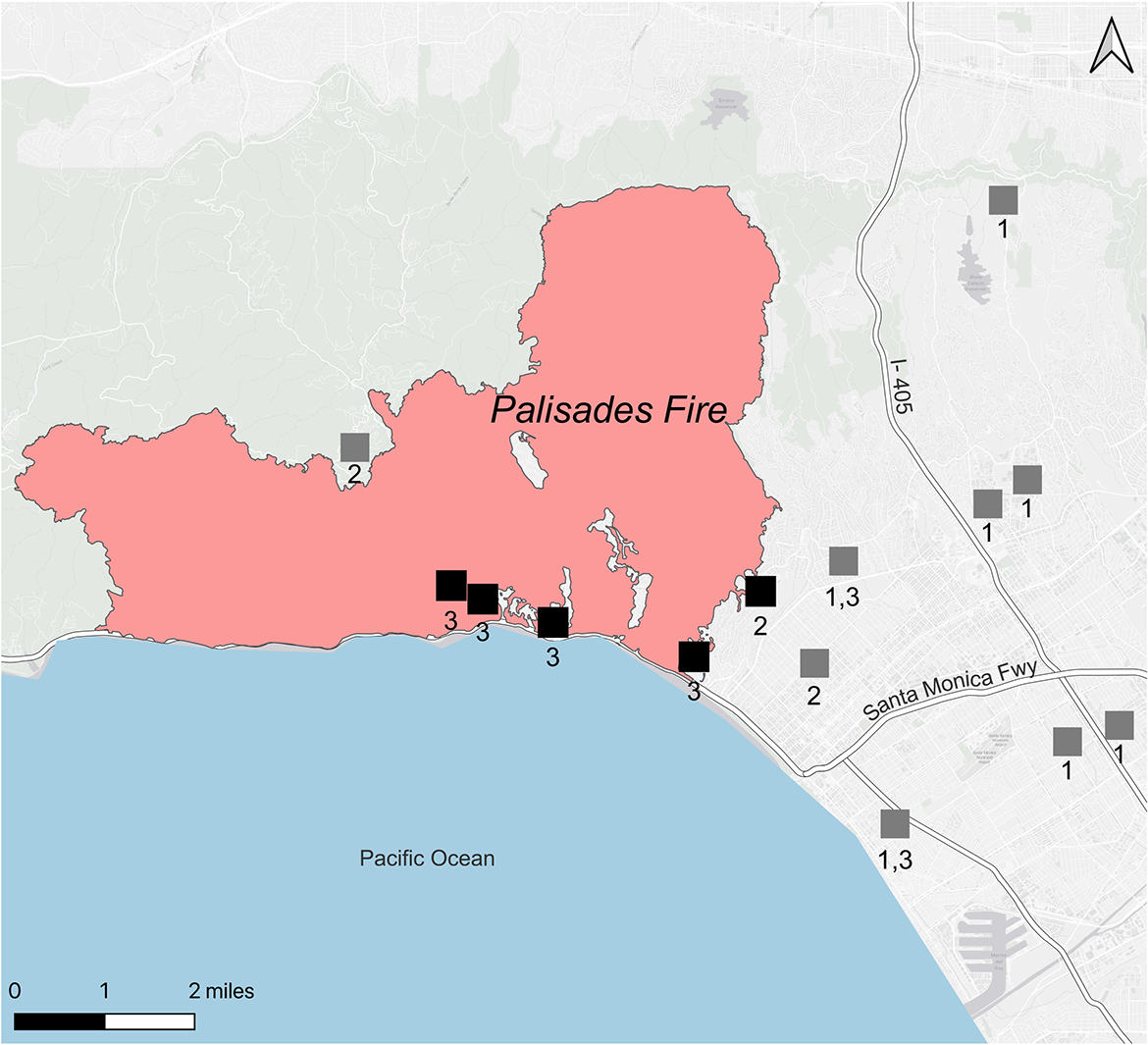
The presence of other compounds — toluene and n-hexane, for example — were found to have peaked in the later stage of active burning, both over the pre-fire background levels and, in some cases, the levels recorded during the blazes, which makes clear the risks of staying in a burn area, researchers said.
"In these cases, the indoor concentrations during active fires remained comparable to outdoor levels, indicating that staying indoors did not fully prevent exposure to fire-related pollutants," said Yuan Yao, a UCLA Fielding researcher and first author of the study. "This indoor/outdoor pattern shifted during the post-fire recovery phase, likely driven by off-gassing from smoke-impacted materials, which highlights the potential for prolonged indoor VOC exposure — even after outdoor fire activity subsides."
Mitigation measures can include regularly opening windows, operating central heating, ventilation and air conditioning (HVAC) systems with filters rated at least Minimum Efficiency Reporting Value (MERV) 13, and using portable High-Efficiency Particulate Air (HEPA) purifiers with charcoal filters when available.
The data makes it clear that anyone living or working in burn areas — from firefighters to residents to construction workers — should understand the risks, the researchers said.
"Even after wildfires are extinguished, residents may remain at risk of exposure to indoor VOCs," Zhu said. "This pattern suggests that smoke-impacted materials within the home could continue to release VOCs into the indoor environment, creating a prolonged source of exposure. To reduce these risks, residents returning to affected homes should adopt measures to improve ventilation and filtration."
Funding
The work was supported by faculty and staff at UCLA, the University of California, Davis, and the University of Southern California, and financial support from the Spiegel Family Fund, the Gordon and Betty Moore Foundation, the R&S Kayne Foundation, and the California Air Resources Board. This analysis is part of the comprehensive and ongoing Los Angeles Fire Human Exposure and Long-Term Health Study (L.A. Fire HEALTH Study), supported by the Spiegel Family Fund.


