
The UK is falling behind other countries in tackling microplastic pollution despite growing evidence of widespread contamination of the environment, food chain and human body, a new report by the All-Party Parliamentary Group (APPG) on Microplastics in collaboration with the Women's Institute and Global Plastics Policy Centre at the University of Portsmouth warns.
The report, 'Tackling Microplastic Pollution in the UK' - being launched today, 1 September, in Parliament - calls for the Government to introduce legally binding targets to reduce microplastic pollution and establish a coordinated national strategy to tackle emissions across the plastics lifecycle.
It also highlights an emerging threat to food security that could have significant economic consequences: the accumulation of microplastics in agricultural soils. Microplastics have also been detected throughout the food chain, including in seafood, the most significant food source to carry microplastics, meat, fruit, vegetables, milk and drinking water, and the report identifies tyres, synthetic textiles, paints, plastic pellets, wastewater systems, packaging, and agricultural plastics among the major sources of microplastic pollution. All of these contributing to growing human exposure, and threat to human health.
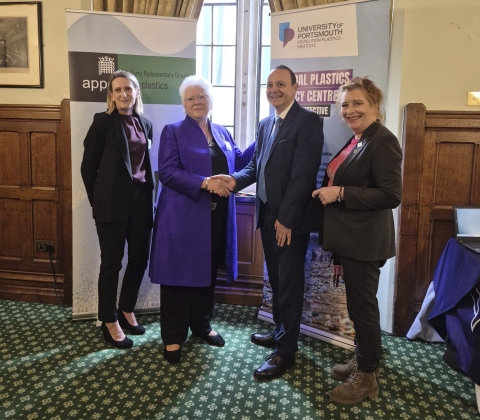
L-R: Melissa Green (Chief Exec NFWI), Jeryl Stone (Chair NFWI), Alberto Costa MP and Professor Cressida Bowyer.
The report calls for five priority areas of action over the next five years:
- Establish a clear UK policy framework with legally binding targets and coordinated leadership.
- Regulate the largest sources of microplastic releases through upstream product and design measures.
- Strengthen producer responsibility and economic incentives to reduce releases across the plastics lifecycle.
- Improve wastewater, sewage sludge and soil protections to reduce major leakage pathways.
- Build a coordinated national monitoring and evidence system to support regulation, evaluate progress and inform future policy.
Microplastic contamination could create costs across healthcare, agriculture, fisheries, waste management and environmental restoration, while declining soil quality and reduced crop productivity could pose longer-term risks to food security.
The UK has an opportunity to move from a fragmented response to a coordinated strategy that tackles microplastics across the plastics lifecycle. We should not wait for every scientific uncertainty to be resolved before acting where the evidence already shows that intervention can prevent pollution and reduce future risks.
Dr Antaya March, Director of the Global Plastics Policy Centre
With climate change already placing increasing pressure on agricultural production, the report argues that protecting soil from additional and avoidable pressures is becoming increasingly important.
Alberto Costa MP, Chair of the All-Party Parliamentary Group on Microplastics, said: "Microplastic pollution is increasingly recognised as one of the defining environmental challenges of our time. We are continuously exposed to microplastics, and the chemicals associated with them through the food we eat, the water we drink and the air we breathe. While research into their long-term impacts continues, it is clear that reducing microplastic pollution at source should be a priority.
"Despite the evidence, the UK's response remains limited. Existing measures tackle only a tiny proportion of microplastic emissions. We urgently need a preventative approach focused on reducing microplastic releases at source to protect human health and food security."
Dr Antaya March , Director of the Global Plastics Policy Centre, Revolution Plastics Institute at the University of Portsmouth said: "The evidence on microplastics has moved on dramatically in the five years since the APPG's first report. What is particularly concerning is the emerging evidence of what this pollution could mean for the health of our soils and, ultimately, our ability to produce food. As climate change puts growing pressure on agriculture, we cannot afford to ignore another avoidable pressure on soil health.
"The UK has an opportunity to move from a fragmented response to a coordinated strategy that tackles microplastics across the plastics lifecycle. We should not wait for every scientific uncertainty to be resolved before acting where the evidence already shows that intervention can prevent pollution and reduce future risks."
Jeryl Stone, Chair of the National Federation of Women's Institutes (NFWI) said: "This report sounds the alarm about the rising tide of microplastics that are flooding our soil, air and water, and are now in our bodies too. WI members have been urging action to stop this plastic tide for 9 years, yet we still have no plan in place from government. The report shows in stark detail the scale and urgency of the challenge. We need a preventative approach focused on reducing microplastic releases at source to protect human health and our food security as well as the environment. The evidence is now impossible to ignore - and it is the time for action.


