
Abstract
A research team, affiliated with UNIST unveiled an integrated air pollution analysis framework that enables more precise assessment of exposure risks from carcinogenic air pollutants commonly emitted from industrial complexes. The approach is expected to help identify exposure "blind spots" often overlooked by conventional assessments and provide a scientific basis for strengthening environmental management policies in industrial areas.
Led by Professor Sung-Deuk Choi of the Department of Civil, Urban, Earth, and Environmental Engineering at UNIST, the research team combined passive air sampling (PAS), three-dimensional air dispersion modeling, and probabilistic health risk assessment into a single analytical framework.
Passive air samplers (PASs) collect airborne pollutants by allowing them to naturally adsorb onto porous, sponge-like media. Because the method is cost-effective and easy to deploy, samplers can be installed across wide areas to generate high-resolution spatial maps of air pollution. However, PAS data alone provide limited insight into where pollutants originate or how they travel through the atmosphere.
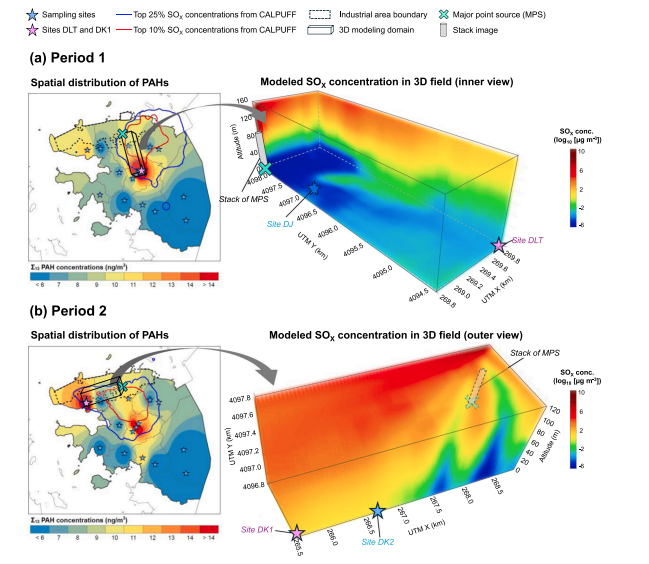 Figure 1. Spatial distribution of the measured Σ13 PAH concentrations and the boundaries representing the top 25 % and 10 % of the modeled SOX contributions from point sources during (a) period 1 (May 26-June 23) and (b) period 2 (June 23-July 21).
To address this limitation, the researchers integrated 3D dispersion modeling, which simulates how emissions released from industrial stacks spread and move under varying wind conditions. This modeling approach makes it possible to track how pollutants rise, disperse, and descend over distances of several kilometers, depending on factors such as stack height and prevailing wind direction-offering a clearer picture of how industrial emissions affect surrounding residential areas.
The team further applied probabilistic risk assessment to better capture exposure risks among high-exposure groups that may be masked by average-based evaluations. Traditional risk assessments often rely on fixed assumptions-such as average outdoor activity time-whereas probabilistic methods treat behavioral and environmental variables as probability distributions. This allows researchers to estimate cancer risks for higher-percentile exposure groups, including individuals who may experience prolonged outdoor exposure on days with elevated pollution levels.
"By moving beyond average values, this framework helps uncover hidden health risks in residential areas near industrial complexes," said Professor Choi. "Our findings provide scientific evidence that can inform policies such as optimizing stack heights, managing emission pathways, and establishing buffer zones to better protect public health."
First author Dr. Sang-Jin Lee added that the framework is not limited to polycyclic aromatic hydrocarbons (PAHs). "This integrated approach can also be applied to other hazardous air pollutants, including volatile organic compounds (VOCs), persistent organic pollutants (POPs), and heavy metals, to better understand their transport patterns and exposure characteristics," he said.
The findings of this research were published online in the Journal of Hazardous Materials on November 14, 2025. This study was supported by a grant from the National Institute of Environmental Research (NIER), funded by the Korean Ministry of Environment. Additional support was provided by the National Research Foundation, funded by the Korean Ministry of Education.
Journal Reference
Sang-Jin Lee, Ho-Young Lee, Seong-Joon Kim, et al., "Pollution characteristics and cancer risk of PAHs in a petrochemical industrial city: Insights from passive air sampling and three-dimensional dispersion modeling," J. Hazard. Mater., (2025).


