
Inside a University of New Mexico research lab, a novel propulsion engine operates at extremely high frequencies, promising to deliver a new avenue for clean energy — but first, researchers have to find materials that can survive its extreme conditions.
Assistant Professor George Koutsakis of The University of New Mexico Department of Mechanical Engineering will lead a $1.6 million grant from the U.S. Office of Naval Research (ONR) to develop and study 3D-printed ceramic materials that can withstand high-frequency propulsion.
"We are grateful to the Office of Naval Research for enabling the world's first academic Rotating Detonation Engine (RDE) Materials Testbed," Koutsakis said. "This platform will allow us to push materials to their limits under extreme conditions and understand how to design the next generation of high-efficiency propulsion systems."
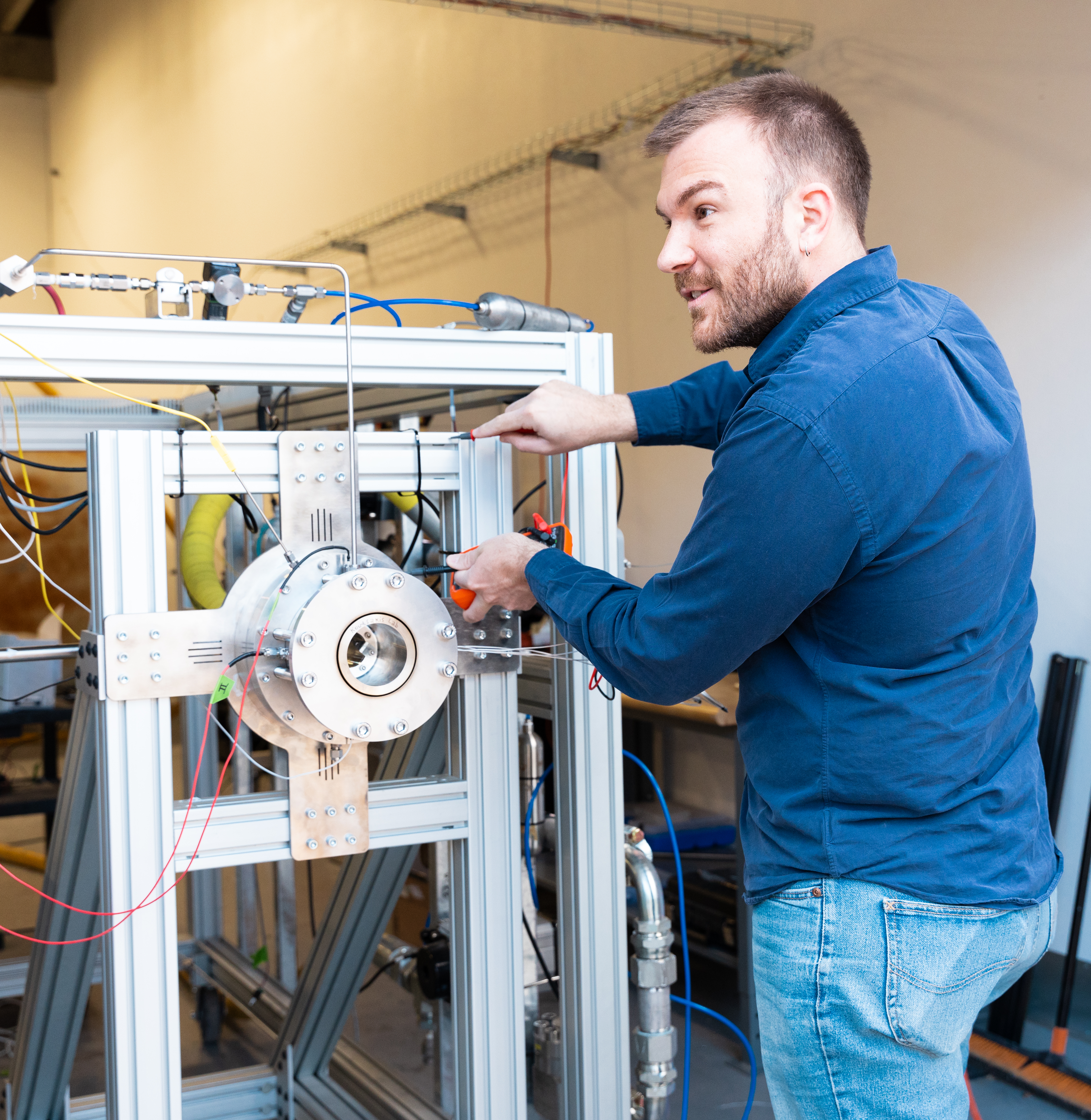
The five-year project, titled "Sustained Thermomechanical Response of High-Frequency Propulsion Materials," is in collaboration with Professor Rodney Trice of Purdue University's School of Materials Engineering.
The project utilizes a rotating detonation engine developed by Koutsakis, which operates at extremely high frequencies and temperatures. The technology could mark a new generation of clean energy and development of a propulsion application with up to 30% higher thermodynamic efficiency. The challenge, which engineers will investigate in the new ONR grant, is ensuring that the materials used in the engine can withstand harsh conditions. The structure developed by UNM is what you might see surrounding a flame on a rocket, except in this case, it's inside a lab designed to careful specifications instead of flying through the air.
For this project, the research team will analyze stress, strain, and crack propagation in ceramic matrix composite structures using an analytical thermomechanics framework and experiments to determine the optimal balance between performance and durability in ceramic materials with and without coatings. To test durability, materials will be exposed to a variety of critical environmental factors across different exposure times in the engine.
Researchers also plan to develop a barrier coating designed to reduce heat flux and enhance resistance to environmental attack.


