
By Joey Garcia, University Communications and Marketing
Students in USF's biomedical engineering program aren't just taking classes or building models - they're bringing ideas to life through hands‑on, industry‑sponsored design projects.
For seniors in the program, this rewarding experience culminated in their capstone presentation. Fourteen prototypes were presented to eager faculty and industry partners, showcasing the graduates' year of hard work.
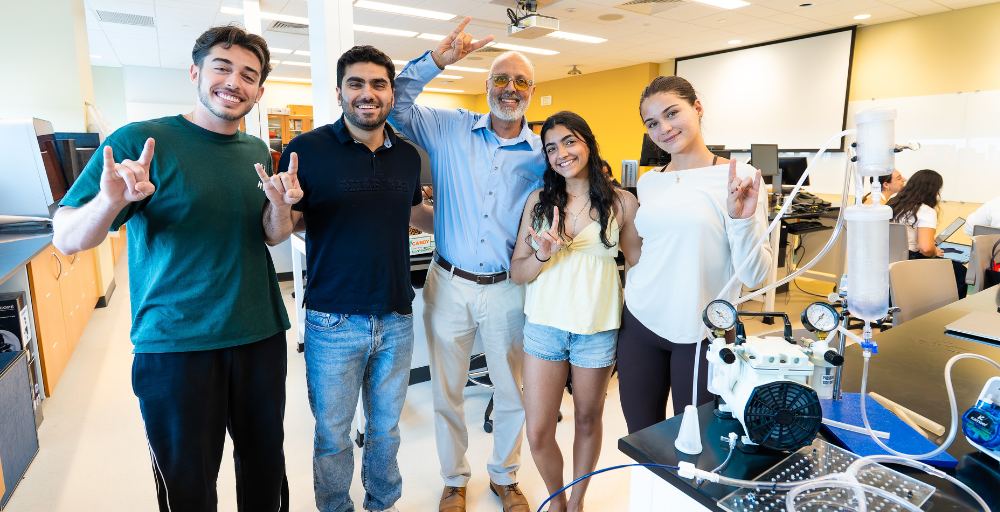
Souheil Zekri (center) speaks with gradating seniors as they prepare for their capstone presentations [Photo by Andres Faza, University Communications and Marketing]
"Our students are developing products that solve real health-related issues," said Souheil Zekri, associate professor and director of capstone design. "We set ourselves apart by creating an immersive experience in which students collaborate in teams and have an actual industry client to design for."
CREATING AN IMMERSIVE CAPSTONE EXPERIENCE
Launched as a joint venture between the USF College of Engineering and the USF Health Morsani College of Medicine, the biomedical engineering program ensures students are designing with purpose through hands‑on, experiential learning.
Zekri begins conversations each summer with the program's corporate partners to gather potential design ideas for the fall semester.
We have a stringent system that mirrors real engineering environments. Students work within constraints such as budget, research cycles and industry standards. They develop multiple prototypes before delivering a final device that proves the concept. It's as close as it gets to what their careers will look like.
Souheil Zekri
Associate professor and director of capstone design
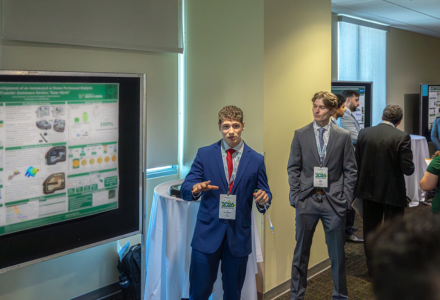
Students produced 14 prototypes in the span of one year in collaboration with their industry partners [Photo courtesy of Lauren Ploof]
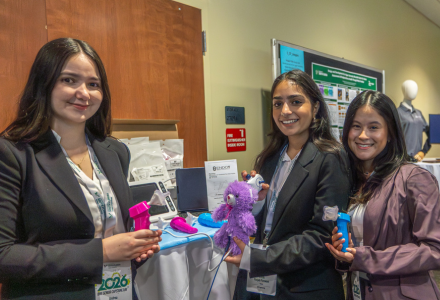
The final designs covered a vast range of projects, such as wearable technology, minimally invasive procedures and improvements to existing medical tools [Photo courtesy of Lauren Ploof]
The result is a system that is engaging and pushes students out of their comfort zone, as noted by biomedical engineering senior Samantha Visconti.
"It was really intimidating at first because we were designing a real medical device," Visconti said. "But as you go through the process, you realize you don't have to be an expert on everything. You learn, adapt and grow as you collaborate with your team and work with your industry partner."
CREATING IMPACTFUL MEDICAL ENGINEERING DEVICES
That hands‑on approach extends beyond the classroom as students develop medical devices tied to real clinical and industry needs, helping them understand how their work could ultimately improve patient care and inform industry practices.
One student team worked with the medical technology company PainTEQ. They were challenged to build a device that uses healing cells from a patient's bone marrow to help repair damaged back joints during a standard procedure. The task required them to enhance patient outcomes while maintaining the procedure's outpatient workflow and affordability.
"We weren't just designing something in isolation. We had to make sure it actually fit into the way physicians work in practice," said Sofia Frank, a biomedical engineering senior. "Every design decision had to make sense in the real world, not just on paper."
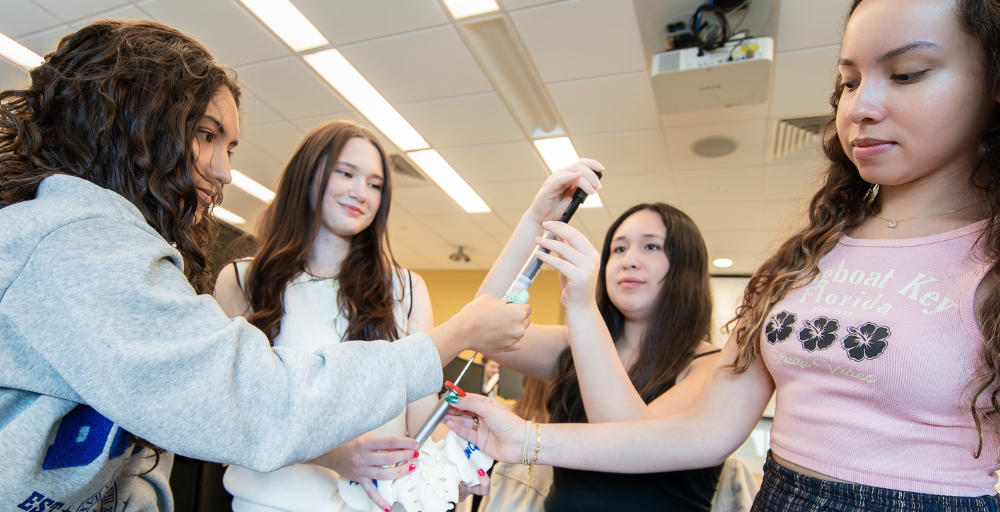
USF biomedical engineering students in the PainTEQ project demonstrate their prototype designed to help bones heal faster during a lower back joint procedure [Photo by Andres Faza, University Communications and Marketing]
We need to stay connected to how students are being educated and how they apply that knowledge in real life. Capstone helps set expectations for what it actually means to develop a medical device. It's the marriage of education and reality.
Dwayne Polzer
PainTEQ's vice president of research and development and quality
Another team partnered with Motiva, a global medical aesthetics company, to develop a fat-purification device to achieve outcomes in fat-grafting procedures. After liposuction, fat must be purified before being reintroduced into the body to avoid complications such as fat necrosis or cyst formation. The students' device aims to standardize and automate that purification process, improving consistency and patient safety.
"Purification is one of the most important parts of fat grafting, and current solutions rely heavily on manual techniques," said Farida Safarli, a biomedical engineering senior. "Our goal was to create something more reliable that could improve patient outcomes, especially for breast cancer survivors."
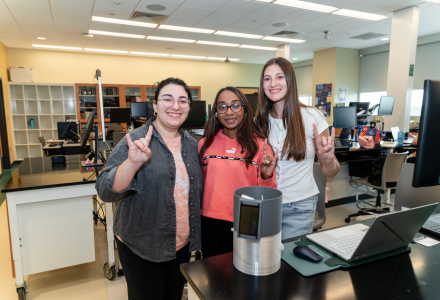
USF biomedical engineering students in the Motiva project created a fat-purification device to be used in aesthetic procedures [Photo by Andres Faza, University Communications and Marketing]
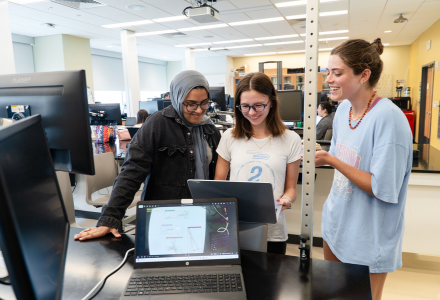
USF biomedical engineering students in the Novanta project developed a computer vision-based tool tracker intended to improve OR workflow efficiency [Photo by Andres Faza, University Communications and Marketing]
In collaboration with industry partner Novanta, students developed a surgical tool-tracking system to improve operating room efficiency and patient safety. The system is designed to prevent surgical items from being unintentionally left inside a patient during surgery, reduce manual tool-counting time and generate data on tool usage to help hospitals optimize surgical trays and reduce costs associated with reprocessing and maintenance.
"This project addresses a current problem in the operating room," Zekri said. "By combining computer vision with workflow analysis, students are creating a solution that improves efficiency, enhances safety and delivers value to hospitals."
WHY INDUSTRY PARTNERSHIPS MATTER
The Tampa-St. Petersburg region continues to emerge as a growing hub for technology and healthcare[TM3] innovation, with USF playing a key role as both a research collaborator and workforce pipeline. As medical device manufacturing and health‑focused technology expand across the region, industry partnerships have become central to preparing students for professional engineering careers.
"It has taken time, but people are realizing Tampa is a gem when it comes to attracting companies in tech and healthcare," Zekri said. "These partnerships give students exposure to how engineering decisions are made beyond the university setting. They learn how to communicate with industry teams, respond to feedback and understand how their work fits into a larger system. That experience is difficult to replicate without strong industry involvement."
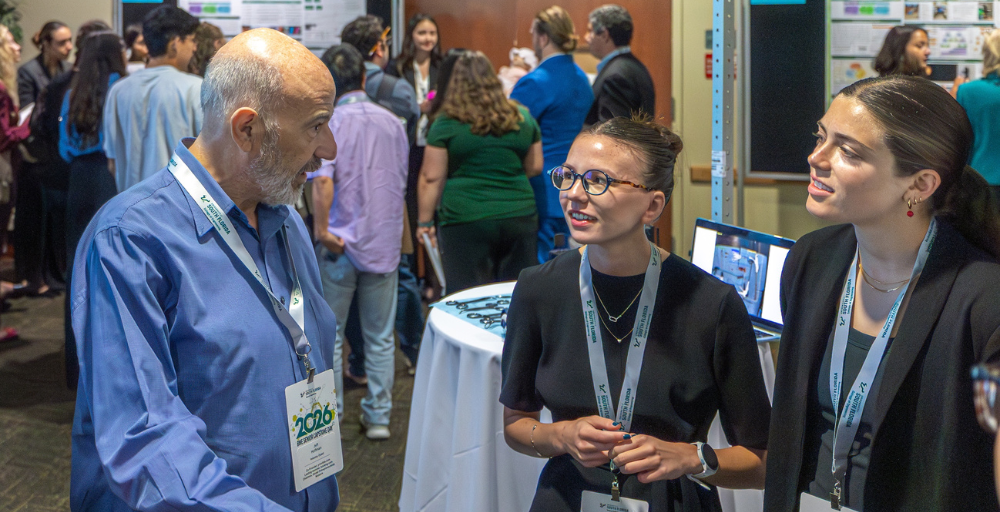
Industry leaders perceive USF and the Tampa Bay area as an investment in the next generation of biomedical engineering talent [Photo courtesy of Lauren Ploof]
From the industry perspective, collaboration with USF is equally valuable. For company leaders, participation in capstone projects is not simply about solving a technical problem. They are also focused on shaping the next generation of engineers and aligning education with real‑world practice.
That impact can be seen in the success of biomedical engineering alumni such as Sophia Alonso, who now works at Jabil, and Mike Rosario in his role as a design engineer at PainTEQ.
The capstone experience at USF is something I've realized is pretty unique. I've spoken with friends in similar programs, and they never had the opportunity to work directly with industry. Being able to apply what we learned in the classroom to real engineering problems made a huge difference. It helped me develop the skills and confidence I needed to transition into my career. It's an experience I'm genuinely grateful for.
Mike Rosario
Design engineer at PainTEQ
Together, these partnerships reflect how a growing ecosystem of faculty, students, alumni and industry collaborate to strengthen both workforce readiness and regional innovation.


