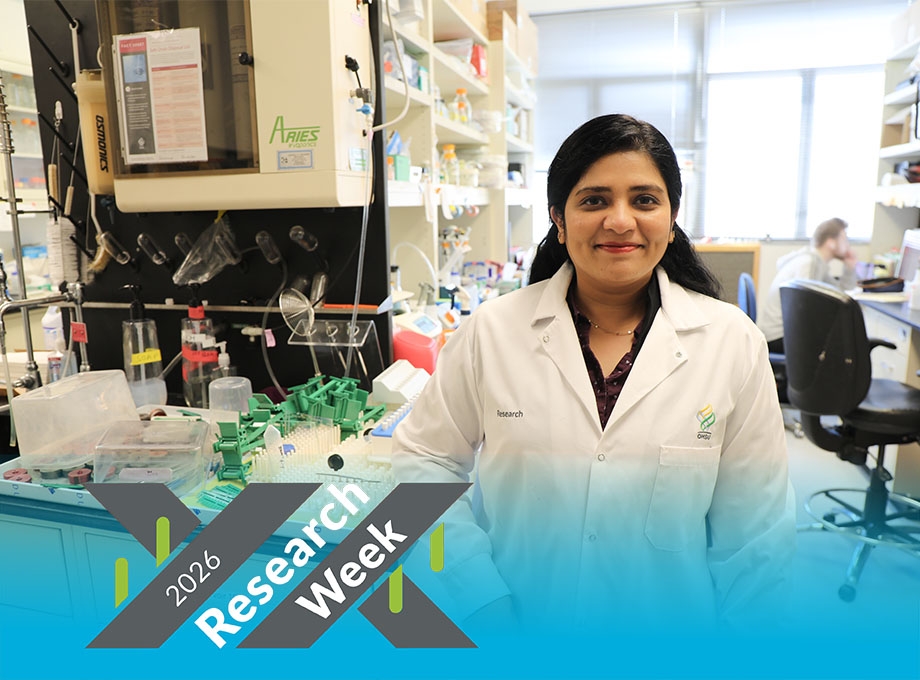
Meghna Gupta, Ph.D., is fascinated by the smallest units of life.
"There is a universe within each cell," she said. "We're still discovering new proteins, and new pathways."
A biochemist and structural biologist by training, Gupta is an assistant professor of chemical physiology and biochemistry in the OHSU School of Medicine who studies subcellular structures known as peroxisomes.
These structures serve an underappreciated but critical role in human health, and Gupta wants to better understand how peroxisomes affect metabolic, genetic and age-related diseases. To do so, her laboratory is harnessing a range of leading-edge imaging systems, including cryo-electron microscopes capable of revealing images to the near-atomic level.
"If we can better understand how these proteins function, we can begin to understand how these organelles behave in disease," she said.
Peroxisomes are tiny compartments inside cells that neutralize harmful substances, break down fats, and make protective fats that are essential for the health of the brain and heart. When these processes go awry, they can contribute to a range of conditions, from rare genetic diseases like adrenoleukodystrophy and Zellweger syndrome to more common metabolic and age-related disorders. She has already discovered unique ultrastructural features inside peroxisomes that have never been seen before and is eager to extend understanding of life's fundamental processes.
She says peroxisomes are crucial.
"You can think of peroxisomes as a kind of buddy for mitochondria that power every cell in the body," she said. "They help mitochondria perform their functions by taking very long-chain fatty acids and breaking them down for mitochondria to use. Imagine a single protein in a very small compartment of a cell. When it malfunctions, it can be very destructive."
Path to science
Her own career path spans the globe.
Gupta grew up in a small town about 125 miles from Delhi, where opportunities for girls to pursue higher education and to dream of a life in science were limited at the time. She didn't have scientists in her family, but she had an interest in medicine and strong support from her parents to think big. The path toward research gradually took shape.
"My parents always believed that education, in any form, has the power to transform lives," she said.
It turns out that Gupta was exceptionally well-suited to science. Among her early achievements was ranking ninth among 100,000 participants in a national fellowship competition in India. The fellowship funded her Ph.D. stipend.
"That gave me the confidence that I belonged in science," she said.
After earning her doctorate from the School of Life Sciences at Jawaharlal Nehru University in Delhi in 2016, she embarked on her career as a postdoctoral researcher at the University of California, San Francisco. She established her own lab at OHSU in 2024.
Gupta appreciates the collaborations that are only possible at an academic health center and the collegiality at OHSU.
"It is very difficult to do everything, from basic science to clinical application, but it helps all of us to be aware of how others are solving problems in cell biology," she said. "At the end of the day, we're all working to improve the health of individuals, and we're all contributing in our own way."