
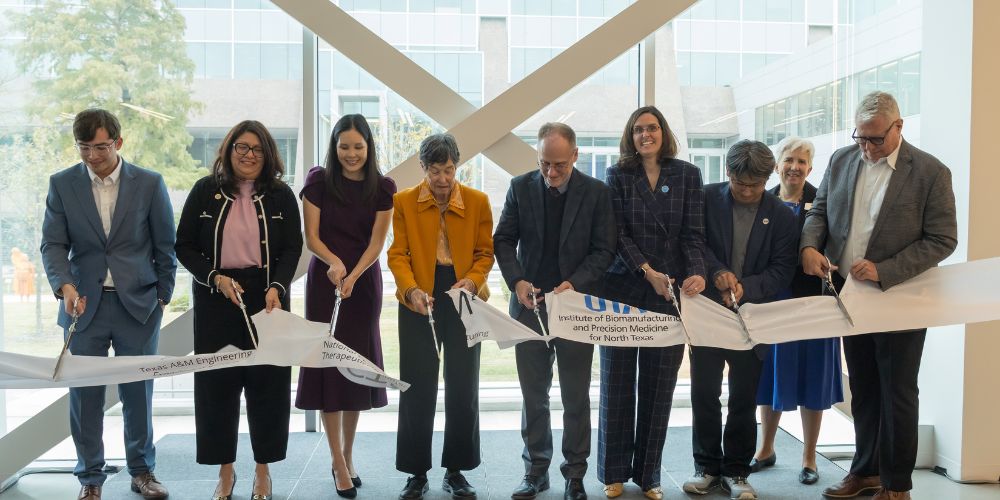
The University of Texas at Arlington and the Texas A&M Engineering Experiment Station (TEES) celebrated the grand opening of a new biomanufacturing training and research hub at Pegasus Park in Dallas on Thursday afternoon.
The National Center for Therapeutics Manufacturing satellite campus (NCTM2) will provide hands-on training for students and industry partners, state-of-the-art lab space, and support for biotech startups, expanding workforce development and research opportunities in North Texas.
The center is a joint venture between UT Arlington's Institute for Biomanufacturing and Precision Medicine (IMPRINT) and TEES.

"Together, we are strengthening the biomanufacturing workforce and expanding access to hands-on training. We're also creating pathways for students, researchers and entrepreneurs to bring lifesaving innovations from concept to market," UTA President Jennifer Cowley said at the ribbon-cutting ceremony. "Our investment is helping ensure that North Texas becomes a destination for biotech talent to develop and thrive."
"By linking our strengths in engineering and biomanufacturing with UTA's leadership in biomedical innovation, we are building a training ecosystem that is broader, stronger and more agile than anything we could build alone," said Rodney Bowersox, deputy director of TEES. "This is exactly the kind of cooperation our state needs to lead the nation in biotechnology."
NCTM2 is located within Bridge Labs, a two-story, 135,000-square-foot facility featuring laboratory and office space designed for both emerging and established biotech companies. NCTM2 occupies 5,003 square feet of space in the Bridge Labs building, which is part of the Pegasus Park center that houses other significant biomanufacturing entities in North Texas.
"By expanding biomanufacturing capacity and accelerating the development of new medical technologies in partnership with Texas A&M Engineering Experiment Station, UTA is helping ensure that lifesaving innovations are created—and deployed—right here in our community," Dallas City Councilwoman Laura Cadena said. "This work strengthens Dallas' health outcomes, supports our hospitals and care providers, and brings cutting-edge solutions closer to the people who need them most."
The demand for domestic biomanufacturing capabilities is growing, and the NCTM2 partnership will position North Texas as a leader in the industry. This is part of a larger national effort to strengthen the U.S. bioeconomy and advance domestic production of vaccines, therapeutics and biopharmaceuticals.
"We are proud to bring IMPRINT's expertise in precision medicine, synthetic biology, and translational therapeutics to this transformative partnership," said Jon Weidanz, UTA's senior associate vice president for research and founding director of IMPRINT. "Together, we are building the backbone of Texas' next-generation biomanufacturing ecosystem and positioning North Texas as a national leader to produce the medicines of the future."
About The University of Texas at Arlington (UTA)
Celebrating its 130th anniversary in 2025, The University of Texas at Arlington is a growing public research university in the heart of the thriving Dallas-Fort Worth metroplex. With a student body of over 42,700, UTA is the second-largest institution in the University of Texas System, offering more than 180 undergraduate and graduate degree programs. Recognized as a Carnegie R-1 university, UTA stands among the nation's top 5% of institutions for research activity. UTA and its 280,000 alumni generate an annual economic impact of $28.8 billion for the state. The University has received the Innovation and Economic Prosperity designation from the Association of Public and Land Grant Universities and has earned recognition for its focus on student access and success, considered key drivers to economic growth and social progress for North Texas and beyond.


