
Key points
- The state's ancient rocks could become a source of hydrogen by using water to stimulate naturally occurring fluid-rock interactions underground.
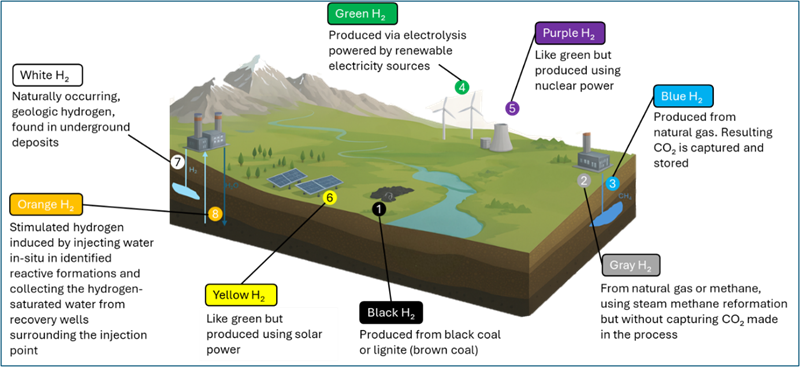
- It is called 'orange hydrogen' as a result of oxidised iron in this water-rock reaction.
- The same rocks can permanently lock away carbon dioxide, potentially combining clean energy production with carbon storage.
Deep beneath parts of Western Australia, injecting CO2-rich water into iron-rich rocks may offer an unexpected opportunity for both clean energy production and carbon storage.
New CSIRO research published in the International Journal of Hydrogen Energy investigated the potential of orange hydrogen in the Yilgarn Craton, one of Australia's oldest and best-preserved geological regions.
Led by Energy Research Scientist Dr Lingping Zeng , the research explored the double advantage of iron-rich rocks.
"Orange hydrogen uses a naturally occurring geological process called serpentinisation, but stimulates it by injecting CO2-saturated water into iron-rich rocks underground," said Dr Zeng.
"Put simply, serpentinisation is when water interacts with iron-bearing minerals in these rocks, the iron is oxidised and hydrogen gas is produced. In an orange hydrogen system, this water–rock reaction is deliberately stimulated to enhance hydrogen generation. The 'orange' name refers to the oxidised iron involved in the process underground."
Australia is particularly well placed to investigate this opportunity because large areas of the continent contain the types of rocks needed for these reactions.
The Yilgarn Craton , stretching across south central Western Australian and named after a local Indigenous word meaning 'white stone' or 'quartz,' is one such region. This geologic block has survived aeons of tectonic movements largely intact and contains some of Earth's oldest crust - including zircon crystals dating back four billion plus years.
Forming the geological foundation of much of Western Australia today, it contains extensive deposits of iron-rich and magnesium-rich rocks that may be suitable for stimulated hydrogen generation.
A potential double benefit
Dr Regina Sander , an experimental reservoir engineer and techno-economic modeller said what makes orange hydrogen especially interesting is that the same rocks capable of producing hydrogen can also help address another challenge: storing carbon dioxide.
"When carbon dioxide dissolved in water flows through these rocks, it can react with minerals and become permanently trapped as solid rock. This process, known as carbon mineralisation, converts carbon dioxide into stable carbonate minerals that can remain locked underground," explained Dr Sander.
"This means the same geological system could potentially generate clean hydrogen while also permanently removing carbon dioxide from circulation.
"However, the conditions that maximise hydrogen generation are not always the same conditions that maximise carbon storage. Understanding these trade-offs is essential if orange hydrogen is to become a practical energy solution," said Dr Sander.
To better understand how these systems behave, CSIRO researchers used advanced geochemical modelling to simulate reactions between underground fluids and mafic-ultramafic rocks within the Yilgarn Craton.
The study examined how temperature, salinity and pH influence both hydrogen production and carbon mineralisation. The results showed that temperature is a major control on hydrogen generation.
Higher temperatures accelerated the reactions responsible for producing hydrogen, allowing more hydrogen to be generated from the rocks. At the same time, temperature also influenced which minerals formed and how efficiently carbon dioxide could be stored.
The research found that carbon mineralisation appears to be most effective within a moderate temperature window of around 150°C to 200°C under the conditions tested. While hotter conditions produced more hydrogen, they did not necessarily result in greater overall carbon storage.
The chemistry of underground fluids also played an important role.
Lower-salinity fluids generally promoted stronger hydrogen generation, while highly saline fluids reduced hydrogen production. Meanwhile, alkaline conditions, meaning fluids with a higher pH, supported greater hydrogen generation by encouraging reactions that produce hydrogen and iron-bearing minerals.
Together, these findings provide important clues about the underground conditions most likely to support successful orange hydrogen systems.
Why the Yilgarn matters
The modelling results indicate that mafic–ultramafic rocks of the Yilgarn Craton have strong potential to support orange hydrogen.
When placed in a regional energy-system context, its dual potential is particularly important given Western Australia is planning several major renewable energy and hydrogen projects across the north-western reaches of the Yilgarn Craton that will require significant energy storage.
While the Yilgarn itself does not contain large underground gas storage reservoirs, the estimated storage capacity of depleted gas fields elsewhere in the state far exceeds the projects' storage requirements of major renewable energy projects in the near future.
It means hydrogen produced here could be transported and stored underground until needed, helping balance supply and demand in a renewable energy system.
What comes next?
While commercial-scale orange hydrogen projects do not yet exist in Australia, the researchers emphasise that this work is an important first step with more to do.
"The next phase of research will focus on laboratory experiments, field trials and identifying the geological settings best suited to combining hydrogen generation with long-term carbon storage. We will also investigate how these systems perform over time and whether they can operate at commercially meaningful scales," said Dr Zeng.
For a country with vast areas of hydrogen-producing and carbon-storing rock, Dr Sander believes that possibility is well worth exploring.
"Orange hydrogen is still at an early stage of development, but Australia's geology gives us a unique opportunity to explore a new pathway for clean energy production," Dr Sander said.
"The next phase is to translate promising modelling results into laboratory experiments and field trials, helping determine whether hydrogen generation and permanent carbon storage can work together at scale," said Dr Sander.
As Australia continues to build its clean energy future, some of the most promising solutions may lie within the ancient rocks beneath our feet.
Led by Energy Research Scientist Dr Lingping Zeng, the research team included Dr Regina Sander, Dr Saeed Salimzadeh , Mr Nicholas Lupton and Mr Michael Camilleri.


