What the research is about
Virtual reality (VR) has become remarkably realistic in terms of visuals and sound. While researchers are also working to reproduce other senses such as touch, smell remains one of the most difficult senses to recreate.
In fact, this challenge is not new. Research on olfactory displays dates back to the 1960s, with an early system called Sensorama-a pioneering device that combined images, sound, vibration, and even smell to create immersive experiences. Despite more than half a century of research, technologies that allow us to control smell as freely as vision or sound have remained out of reach.
Conventional olfactory displays have faced several key challenges: delays before a scent is perceived, difficulty in adjusting intensity, and lingering odors that mix with new ones. For example, when moving from a "forest" scene to a "café" in VR, the scent of trees may remain and blend with the smell of coffee-disrupting the sense of immersion.
To address these issues, a research team led by Specially Appointed Professor Takamichi Nakamoto at Institute of Science Tokyo (Science Tokyo) set out to tackle a difficult goal: to release scents precisely when needed-and remove them just as precisely.
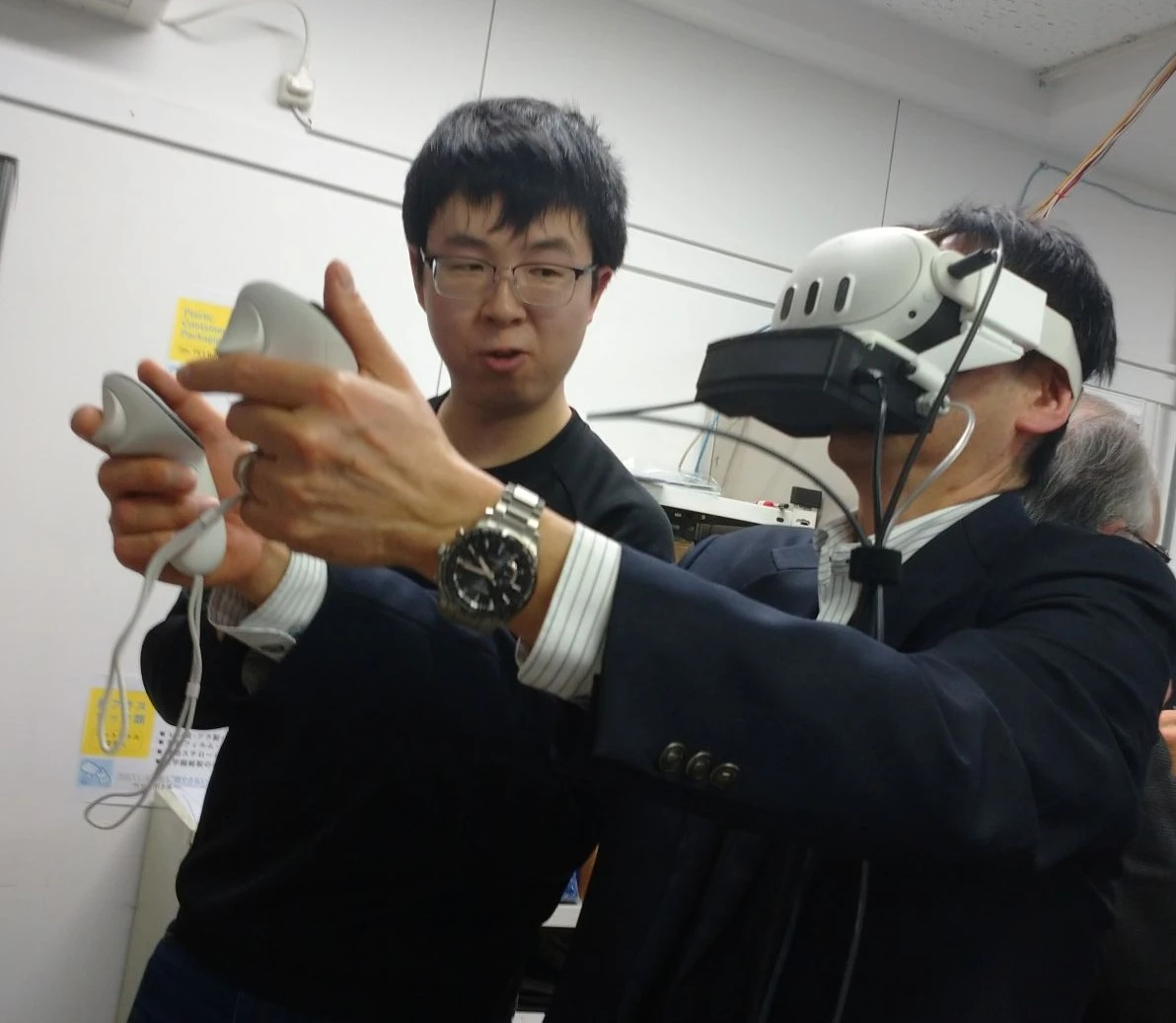
The team developed a compact wearable device that can be attached to a VR headset. It can handle up to eight types of scents-such as rose, orange, coffee, lavender, mushroom, and sulfur-and generate them close to the user's nose, enabling a more realistic experience.
Why this matters
The key innovation of this research lies in three technologies that enable precise control of smell. The novelty is not simply that the device can generate scents, but that it can simultaneously control the amount, blending, and timing of scents.
1. Precise control of extremely small amounts
The device can control liquid fragrance ingredients at the nanoliter scale (one billionth of a liter). Previously, scent intensity was adjusted indirectly-for example, by changing temperature or airflow. In contrast, this system directly controls the amount of scent released. This represents a shift toward quantitative and reproducible control of smell.
2. Instant mixing and generation of scents
The system uses a component called a SAW (Surface Acoustic Wave) device, which converts liquid into a fine mist using ultrasonic atomization. Multiple scent ingredients are atomized and mixed at the same location, allowing the intended scent to be reproduced accurately. The average time for users to perceive a scent is about 3.17 seconds-comparable to existing olfactory displays, which typically take several seconds.
3. Rapid removal of lingering odors
An external air pump removes air around the nose, quickly clearing any remaining scent. The air is passed through an activated carbon filter before being released, preventing unwanted diffusion into the surroundings.
In addition, this airflow helps reduce the device's internal heat by about 48%, contributing to stable operation.
What's next
This technology has the potential to significantly enhance VR experiences. In the study, the researchers developed a virtual travel system that combines visual scenes, sound, and scent, allowing users to experience environments more vividly (see photo).
Applications go beyond entertainment. Changes in the sense of smell are known to be early indicators of diseases such as Parkinson's disease and COVID-19. This device could contribute to early diagnosis and monitoring. It may also be applied to brain-computer interfaces (BCI), which connect the human brain with computers.
Comment from the researcher
Wearable olfactory displays are a practical way to introduce smell into VR. Although wearable devices are limited in size, we have made it possible to generate and blend scents made up of many components by carefully designing the system's circuitry and mechanical parts. Because smell is closely linked to memory and emotion, presenting scents can transform digital environments into more vivid and lifelike experiences.
(Takamichi Nakamoto, Specially Appointed Professor, Institute of Integrated Research, Institute of Science Tokyo)

Dive deeper
Explore more research in Science for All
Science for All showcases cutting-edge research at Science Tokyo and highlights the ideas, people, and possibilities shaping the future.