
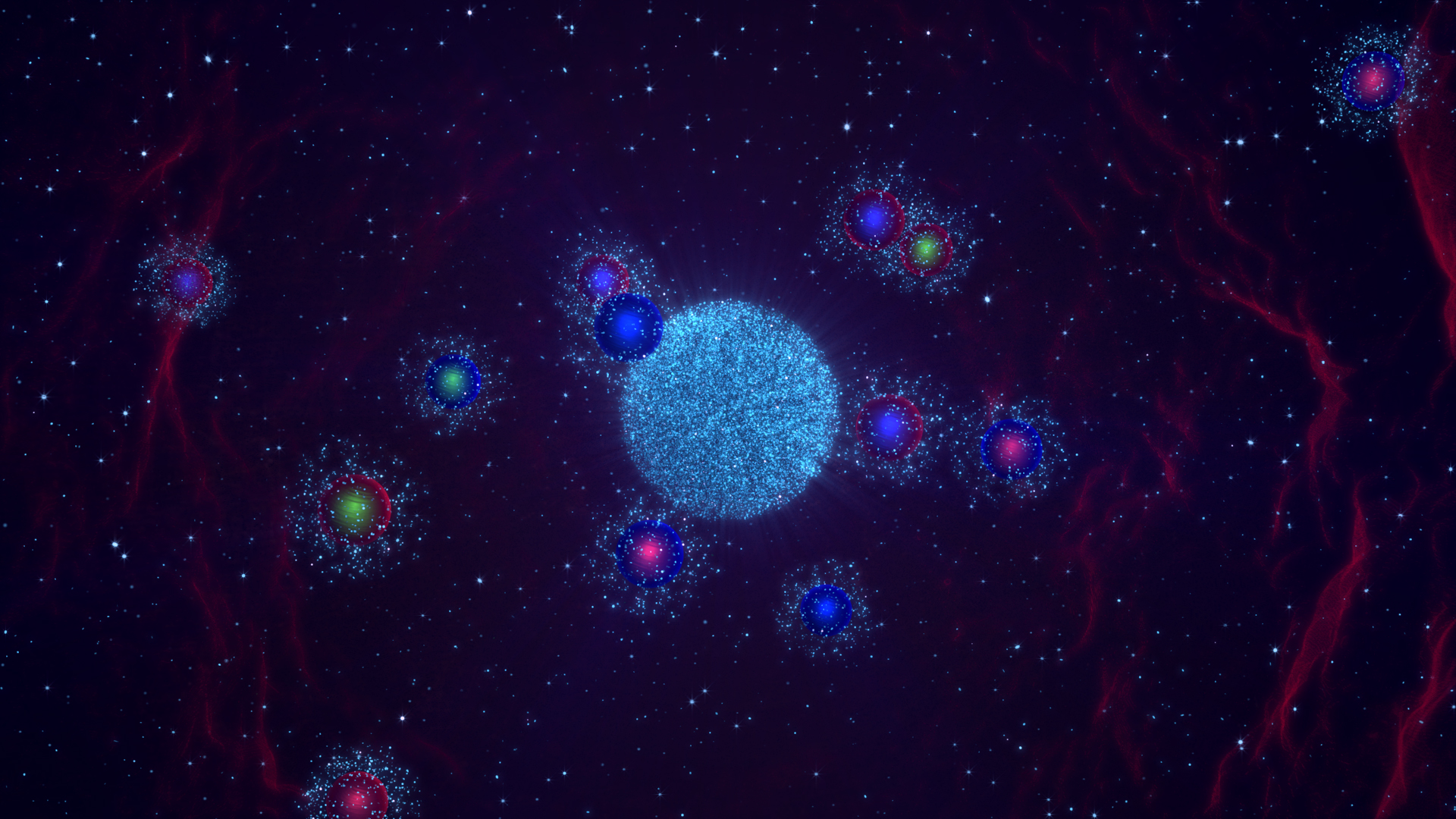
Artistic representation of a Higgs boson (centre) produced by a proton-proton collision in the LHC. (Image: CERN)
What is the fate of the Universe? Why is there more matter than antimatter? What lurks beyond the Standard Model?
Each of these questions requires further study of the Higgs boson. Each is explored in the latest edition of the CERN Courier, the international magazine for particle physicists. Physicists have been studying the Higgs boson intensively since its discovery in 2012, but many questions remain unanswered. The High-Luminosity LHC, which will succeed the LHC in 2030, will provide a dataset of 380 million Higgs bosons, a sample more than ten times larger than any studied to date. LHC physicists Valentina Cairo and Steven Lowette explore what physicists expect to learn from this exceptional dataset. Leading accelerator physicists Gianluigi Arduini, Philip Burrows and Jacqueline Keintzel then report on the findings of a working group that was mandated to compare seven proposals for large-scale colliders to follow the High-Luminosity LHC.
The Higgs boson is thought to have first given mass to elementary particles in a Universe-wide reconfiguration of fundamental forces that rippled throughout the cosmos a fraction of a second after the Big Bang. This edition of the Courier also explores another such shift, first imagined by physicists Roberto Peccei and Helen Quinn, that may have taken place even earlier. If correct, the fruit of this theory would be a new elementary particle known as the axion. CERN theorist Clara Murgui explains how this theory has the potential to solve two deep puzzles in fundamental science. Representatives of the MADMAX and ALPHA experiments describe two innovative new ways that will be used to search for the axion in the next ten years.
Also in the January/February edition: the community says farewell to Chen-Ning Yang; news from a busy two months in neutrino physics; the first indirect evidence for primordial monsters; and much more.


