
In an age of search engines, online databases, and AI assistants, it is easy to forget that for most of modern history research was done using books, paper, and pencils. If you have ever looked up a definition or searched the etymology of a word online instead of driving to the library, you have the Waterloo innovators behind the New Oxford English Dictionary Project to thank.
When the original Oxford English Dictionary - the largest and most comprehensive history of the English language ever created - was published in 1928, it was the result of more than seventy years of collective effort. Researchers had begun collecting historical examples of word use in 1857: in the decades that followed, more than 800 volunteers collected millions of quotations, which they wrote out by hand on slips of paper.
Between 1884 and 1928, Oxford University Press (OUP) published 125 small books containing definitions as they finished them, which they then collected into a 12-volume set containing more than 400,000 definitions. There was just one problem: the dictionary had taken so long to assemble that it was already out of date! By 1933, OUP published the first of four eventual supplements containing new words: users would have to look up a word in the original dictionary, then check the supplement separately if they couldn't find it.
In the 1980s, the publishers at OUP decided it was time to create a second, complete edition of the Oxford English Dictionary - ideally in less than seventy years. That's where the cutting-edge Department of Computer Science at the University of Waterloo came in.
The longest book every digitized
Dr. Frank Tompa, Distinguished Professor Emeritus of Computer Science, was a young professor specializing in databases. At the time, databases were relatively simple and small collections of information stored on tapes or large disks and strictly organized. When Waterloo administrators arranged with OUP to help with the New OED project, they turned to Tompa and his colleague Dr. Gaston Gonnet to figure out how to digitize and organize the dictionary. "We didn't know what this database would be like, or how it would work," Tompa remembers, "but we knew that it was too important to say no." Together with graduate students, administrators, and professors from across the university, they created the Centre for the New Oxford English Dictionary in 1984.
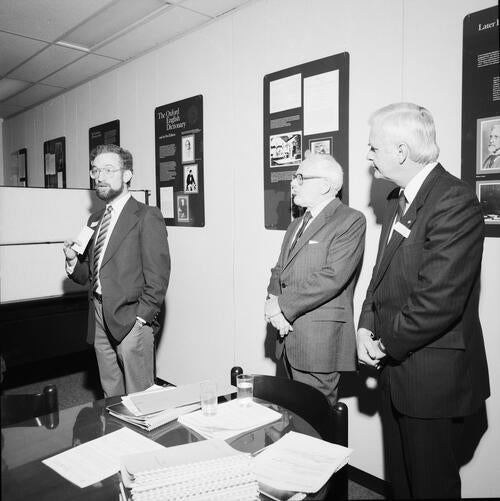
Frank Tompa (left) shows Waterloo administrators the Centre for the Oxford English Dictionary (University of Waterloo Special Collections & Archives)
The first problem the team faced was digitizing the existing dictionary: it only existed in printed books and on steel printing plates, and image-to-text software was too rudimentary to handle the dictionary's complex and inconsistent use of fonts, italics, and special characters. Ultimately, OUP hired a firm in Pennsylvania to manually type out the dictionary one page at a time, then mail the discs with the text files to Waterloo.
"At the time, nothing had been computerized that was that big," Tompa says. "There were a few specialized computer databases, like the law database LEXUS-NEXUS, but nothing searchable, nothing like the OED. For reference, the Bible takes up maybe 5 MB of storage, the complete works of William Shakespeare maybe 12? The Oxford English Dictionary was 540 MB of information. It was enormous - ten times the size of the average computer's memory!"
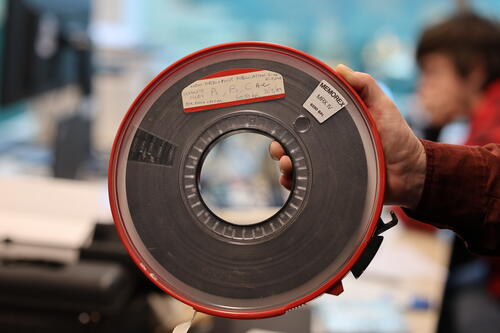
A magnet tape spool used to send samples of formatted text from Waterloo to Oxford (courtesy of the University of Waterloo Computer Museum)
They also faced a UI-UX problem: communicating an electronic dictionary's usefulness to the libraries, scholars, and students who would use it. To make sure the new OED would work for its users, the Computer Science researchers teamed up with colleagues in the Faculty of Arts to build a study surveying humanities experts around the world. "There was no Google back then," Tompa says. "People didn't really understand the concept of looking things up by category - for example, looking up all the words used by Geoffrey Chaucer. It was kind of like asking horse and buggy drivers how they would use a car, and where they would like the steering wheel to be."
Climbing "Scholarly Everest"
Further complicating matters, the formatting of the original dictionary was inconsistent and had to be rewritten and reorganized so that a computer could understand it. The team wrote several new programs to help standardize the dictionary's format, tag the data, and make it understandable for both the human editors and the computers processing it. Gonnet created a grammar-based search system, GOEDEL, that would allow users to write complex queries, such as "finding all of the etymologies mentioning the word 'knife.'"
Once the team developed GOEDEL, as well as an index software called PAT, they could invite scholars to do experimental research using the New OED Project. One academic used the database to help her build a dictionary of Caribbean English. Another medieval scholar searched for all the words that had entered English from Anglo-Norman French.
Thanks to the interdisciplinary work and collaboration of researchers on both sides of the Atlantic, the Second Edition of the Oxford English Dictionary was published in 1989, only five years after work began. Time magazine called it "a scholarly Everest." This OED contained more than 615,000 definitions, which could be accessed via 20 printed volumes - or, by 1992, a two-disc CD-ROM. Now, updating the digital dictionary would be as simple as typing a few lines of text.
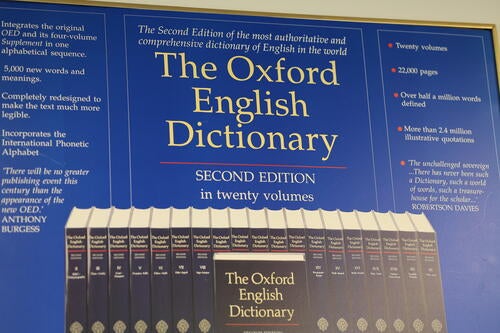
A poster advertising the Second Edition of the OED (courtesy of the University of Waterloo Computer Museum)
Meanwhile, at the University of Waterloo, the computer science researchers found applications for their database innovations that went far beyond the OED. In 1991, Tompa, Gonnet, and Dr. Tim Bray co-founded OpenText: a tech company that powered early search engines like Yahoo! and Netscape, and quickly became an essential part of helping governments and corporations employ the power of the emerging Internet. Today, OpenText is the third-largest Canadian tech company, with more than 22,000 employees worldwide.
"The New OED Project was iterative, collaborative, and very fun," Tompa says. "It was such a great example of how people in the arts and technology can help each other learn and innovate. Some people like to stay in their own silos, but I really enjoyed working with all those users. That's why I got into computer science - to create something that would be useful for people."


