
At a time of persistent gender gaps in the commercialization of science, women researchers have produced scientific innovations with major impact at Washington State University. This series will profile four of those innovators over the following weeks.
As a high school student in Great Britain in the late 1970s, Kate Evans faced a system of forking paths.
"Girls did cooking and sewing, and boys did woodwork, metalwork and technical drawing," Evans said. "I said, why can't I do that? I was the first girl to do woodwork, metalwork and technical drawing, not cooking and sewing."
It was not the last time Evans would burst into a boys club. As she entered the world of science, she found herself one of few women in the field of tree fruit. As her career grew, she juggled raising children and navigating male-dominated spaces. Even when she was the obvious expert in the room, she had to learn how to be the "slightly pushier" voice in order to be heard.
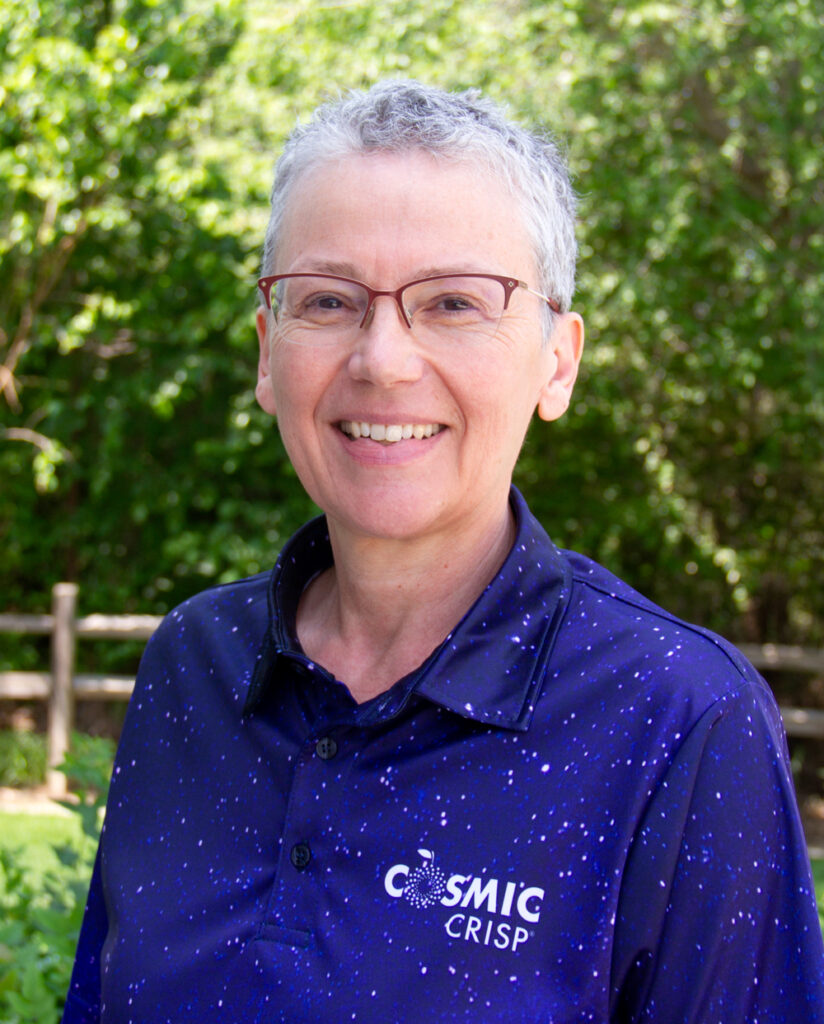
Today, Evans - who brought the Cosmic Crisp® apple to market and is busily working on WSU's next signature apple, the Sunflare™ - is one of several women at Washington State University who are bucking the national gender gap in research commercialization.
Recent studies show women scientists are less likely to commercialize their discoveries than men; a paper published this year put the gender gap at 14%, and the disparity was greater among senior researchers. This gap reflects a wider range of gender inequities in the sciences, which appear in graduation rates, faculty positions, and promotions.
At WSU, however, the top three commercialized research discoveries have come significantly from the work of women: the Cosmic Crisp®, developed by Evans and her predecessor, Bruce Barritt; a vaccination training program for pharmacy technicians, created by Kimberly McKeirnan; and the MDR1 genetic test in dogs and cats, designed by Katrina Mealey.
Royalties are not the only measure of public impact of commercialized innovations. For example, an anti-bias training program for police officers in high-risk encounters, developed by Lois James, an associate professor of nursing, has already had an impact on policing across the country. The program, known as the Counter Bias Training Simulation, or CBTSim, has been taken by hundreds of police officers, and James has expanded it for 911 operators and health-care workers.
"These successes reflect the strength of WSU's research community and our longstanding commitment to translating discovery into public impact," said Vice President for Research Kim Christen. "Commercialization is one important way WSU research creates value beyond the university, helping transformative ideas move from the laboratory into practical applications that improve lives, strengthen industries, and serve communities across Washington and beyond. Just as importantly, these examples highlight the importance of supporting researchers throughout the innovation process so promising discoveries can achieve meaningful impact."
Evans, McKeirnan, Mealey and James discussed their experiences in science and commercialization in recent interviews. They noted that women in academia and research already face a series of work-life challenges - from raising families to navigating the unspoken nuances of male-dominated environments - before the idea of commercializing a discovery even comes into the picture.
All of that may make the idea of taking on patenting or licensing a discovery even more daunting. Mealey described it as a continual series of tiny hurdles, and said she had an important example in the kind of determination that's needed in her PhD advisor at Texas A&M University.

"Multiple hurdles are in your path, and you just have to have the perseverance to continue to cross them," Mealey said. "I think a lot of people get tired of that, or don't want to deal with it, or don't know how to do it. My mentor would just figure out what the next hurdle was, and what she needed to do to get by that. I think that's really what success is in entrepreneurship - working through all those tiny hurdles."
Other researchers echoed that theme of mentorship as vital for women navigating the world of research commercialization. Having benefitted from such mentorship, they now seek to provide it to others.
James and McKeirnan are serving as Innovation Liaisons, offering mentoring and guidance through the process of commercialization to their peers on the faculty. The Office of Research program connects scientists to the resources and information to guide them through the process.
"On the Innovation & Entrepreneurship team, a central priority is broadening participation and ensuring all faculty see a path to bring their ideas to impact," said Jeremy Tamsen, senior director of Innovation & Entrepreneurship for the Office of Research. "Programs like Innovation Liaisons are helping make commercialization more visible and accessible. We're especially proud to celebrate the women featured here, whose leadership and accomplishments highlight the powerful role faculty innovators play in advancing health, safety, and economic opportunity.
James said the Office of Research's innovation and entrepreneurship program was crucial to guiding her through bringing her anti-bias training program to market, and she wants others to understand that it's not as difficult as it may seem.
"It was very collaborative, very organic - not a stressful process," she said. "I understand the idea of commercialization can be scary for people. 'I don't know how trademarking works. I don't know how licensing works. I don't know what's involved with a patent.'
"But I just felt completely supported. It didn't matter if I completely knew what was going on. That's what the office was for, to take care of that and let me focus on the science."
Commercialization of WSU discoveries
Over the past decade, Washington State University has brought in more than $82 million in royalties from scientific discoveries brought to market through the Office of Research's Innovation and Entrepreneurship program.
The top-earning innovations are:
- Cosmic Crisp®: WSU's signature apple is the fourth-most popular variety in the U.S., and Washington state is the only producer of Cosmic Crisp® in U.S. There are more than 22 million Cosmic Crisp® trees in Washington, and the variety has brought in more than $28 million in royalties.
- Pharmacy Technician Vaccination Training: Some 170,000 pharmacy techs have taken the program designed and licensed at WSU, resulting in millions of vaccinations. The training has produced more than $14 million in royalty revenue.
- MDR1 Genetic Testing in Dogs: An estimated 2.5 million licensed MDR1 tests have been performed, and royalty revenues have exceeded $5 million. The patent expired in 2022, so it's difficult to cite a specific total number of tests given, but it's estimated to be more than 5 million.


