
The newly redesigned Institute of the Environment and Energy delivers sociotechnical approaches to environmental and energy sustainability, environmental health, and ecosystem restoration while empowering communities, governments, learners, and businesses
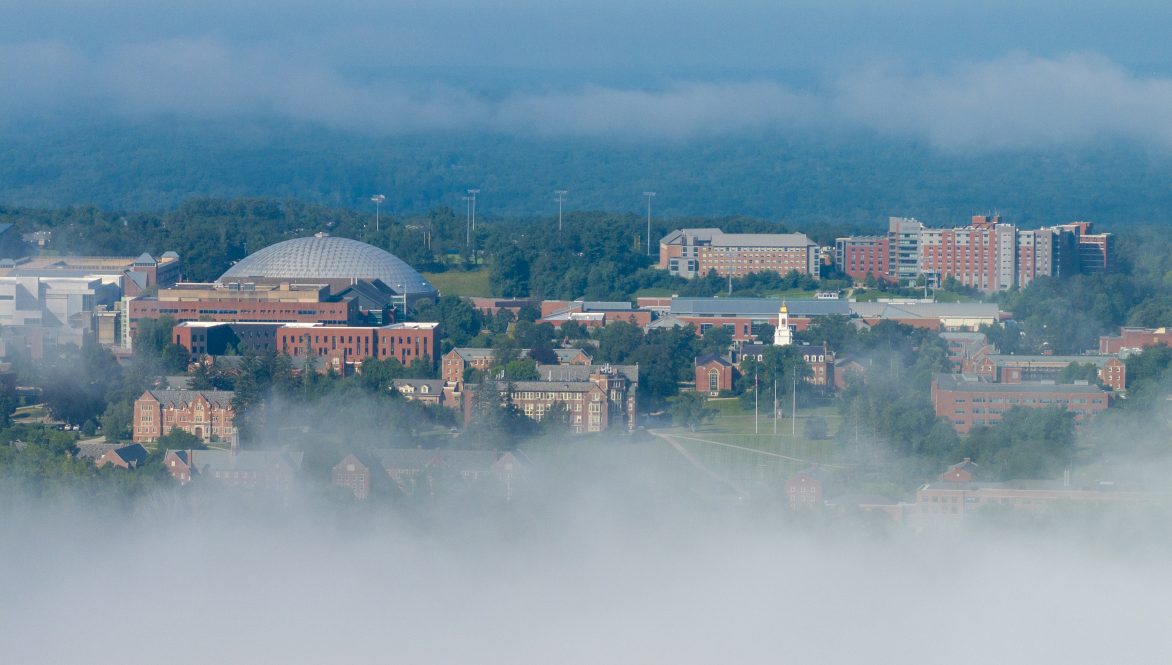
UConn Storrs appears from the fog during the summer of 2025.
There has never been a more pressing need to develop sustainable, equitable, reliable, and accessible energy, protect ecosystems and environmental health, and mitigate natural hazards. UConn's Institute of the Environment and Energy (IoEE) is up to the task.
The IoEE includes faculty from 10 UConn schools and colleges. Over the last six years, researchers affiliated with the Institute have generated almost $100 million in funding and contributed to more than 600 publications. Additionally, IoEE centers/units have supported more than 900 students and provided over 300 community assistance projects.
"Within the state, region, and beyond, we want to spearhead decision-making for resilience, environment, and energy," says Emmanouil Anagnostou, the executive director of both the IoEE and UConn Tech Park. "We see ourselves as an interdisciplinary hub supporting UConn research and education, with a particular focus on student experiential learning and professional workforce education."
The IoEE is addressing the causes and impacts of climate change that are creating monumental challenges and requiring interdisciplinary and innovative approaches and expertise. It also seeks to bridge discovery with real-world outcomes.
The Institute rebranded in 2025 from the former Institute of the Environment, uniting several complementary centers and units under shared purpose. They include:
- The Center for Environmental Sciences and Engineering (CESE)
- The Eversource Energy Center (EEC)
- The Natural Resources Conservation Academy (NRCA)
- The Thriving Communities Technical Assistance Center (TCTAC)
- The Office of Sustainability (OS)
Individually, each center utilizes a wide range of approaches, tools, and technologies to address issues pertaining to health, community, food systems, ecosystems, and energy. They all meld into the IoEE's mission and serve as a positive example of the importance of interdisciplinary collaboration.
The CESE advances the IoEE by providing the interdisciplinary research infrastructure and expertise needed to address urgent challenges in environmental health, water, sustainability, and resilience.
"Through its state-of-the-art laboratories, CESE offers a broad range of analytical solutions and method development services for academic, government, industry, and nonprofit partners, with capabilities that span environmental science, human health, materials science, and more," says CESE Director Michael Hren.
The EEC complements the IoEE by bridging UConn's broad, interdisciplinary work in climate, sustainability, and environmental systems with applied, energy-focused research that directly supports modern power systems. The Center also plays a critical role as a collaboration facilitator and increases the University's research competitiveness, as well as preparing students and workers with valuable training.
"The Eversource Energy Center brings together students, researchers, and industry leaders to drive innovation in weather and climate resilience, power systems, and sustainable technologies for the electric grid-turning cutting-edge research into practical solutions that strengthen grid reliability and build a more resilient future for Connecticut and beyond," says EEC Director Diego Cerrai.
The NRCA contributes to the IoEE by engaging Connecticut youth in innovative science learning programs across the state.
"The NRCA fits naturally within the IoEE mission because it takes environmental education beyond the classroom and puts it into practice in local communities," says Center Director Laura Cisneros. "It gives students hands-on opportunities to work with community partners and make a real impact, which really aligns with the Institute's focus on engagement and meaningful change."
TCTAC aids communities facing environmental challenges with equity-oriented technical support. "By implementing TCTAC's service themes - environmental quality, energy sustainability, climate adaptation, and environmental health - the New England TCTAC translates IoEE's knowledge‑transfer venues into direct results through a team of engineers and social science researchers, alongside sustainability practitioners, community health workers, and tribal stakeholders," says TCTAC Director Carolyn Lin.
Finally, the OS ensures that UConn continues to uphold the highest standards in campus sustainability, student opportunity, and global climate engagement through sustainability reporting, internship programs, Zero waste initiatives, UConn@COP, and student-oriented action events throughout the year.
Student Research and Opportunities
The Institute is already making significant progress on its outreach and education initiatives.
"The UConn Office of Sustainability collaborates with the other units of the Institute of the Environment and Energy to connect academic learning with real-world impact," says OS Director Patrick McKee. "Through several experiential learning programs, applied research initiatives, and campus-focused sustainability projects, we empower students to help develop solutions that improve how UConn operates and advances sustainability across the university, while also supporting their professional growth and career development as future sustainability leaders."
Through the OS, EEC certificate programs, CESE fellowships, and partnerships with Connecticut companies, the IoEE provides opportunities for students to conduct meaningful research and step into career pathways.
"We see experiential learning as a steppingstone to strengthening future opportunities for our students," says Eleanor Shoreman-Ouimet, associate director of the IoEE.
Students and faculty conduct meaningful work through advanced resources. These include wet labs, a real-time grid simulator, priority access to high-performance computing, field training, and NASA-Supplied equipment.
"We have an important role in student hands-on training and generating research that is beneficial to society and industry alike," says Anagnostou.
Drawing on Expertise
As a new institute, the IoEE is building robust research collaborations across colleges, disciplines, and skill sets to meet current and future calls. To that end, IoEE leadership has initiated a think tank program to identify research priorities and build fruitful partnerships.
The 20-person faculty group has been meeting throughout the spring to discuss funding opportunities, challenges, areas for interdisciplinary collaborations, and future considerations.
"In large part, the think tank is intended to translate research into applied solutions to environmental and community challenges; as well as inspire new research collaborations across disciplines and stakeholders," Shoreman-Ouimet says.
The IoEE is continuing to expand its efforts this summer, building new connections that develop and translate world-class research into actionable solutions and meaningful impact for communities across Connecticut and beyond.


