
Public institutions in Germany must provide their information in easy language. They receive support from the start-up KLAO, which has developed an AI solution for more inclusion.
Government websites, bank notifications or letters from insurance companies are sometimes written in a complicated way. So complicated, in fact, that even well-educated people with German as their mother tongue find it difficult or impossible to understand the content.
How must it be for the six million people in Germany who urgently need a language that is easy to understand? For example, people who are learning German as a foreign language, who have cognitive impairments or learning difficulties.
In order to enable the inclusion of these groups, the legislator has gradually issued guidelines in recent years: These oblige public institutions and companies to use so-called Easy or Simple Language.
Easy language is rarely offered
Easy language ("Leichte Sprache") is a simplified form of German with short sentences and simple words. Its rules have been described in the DIN SPEC 33429 standard since 2025.
What does easy language look like? Here is a translation example from the weather forecast: "The weather conditions will deteriorate during the day; strong gusts of wind and precipitation are to be expected." To put it simply:
"The weather will get worse today.
There will be a lot of wind.
And it's going to rain."
Doesn't sound so difficult. But: "Despite the legal obligation, a good 90 per cent of public institutions do not provide information in easy language," says Fabian Schlausch, a Würzburg expert in special education. In order to make progress here, he has been driving the start-up KLAO ("Klare Automation") since 2024.
People with learning difficulties work together
The Würzburg-based start-up supports public institutions in efficiently translating texts into certified, rule-compliant easy language. It has developed AI software for this purpose.
According to Fabian Schlausch, KLAO fills a gap: "Until now, anyone who needed extensive texts in easy language could have this done by agencies, which is very expensive. Or they can use standard AI tools. But then you usually end up with results that are neither DIN-compliant nor satisfactory," says the founder.
His start-up has another special feature to offer, as it focuses on social inclusion: "People with learning difficulties check and certify the texts together with us." This is the only way to guarantee full DIN conformity.
Expertise in three areas combined
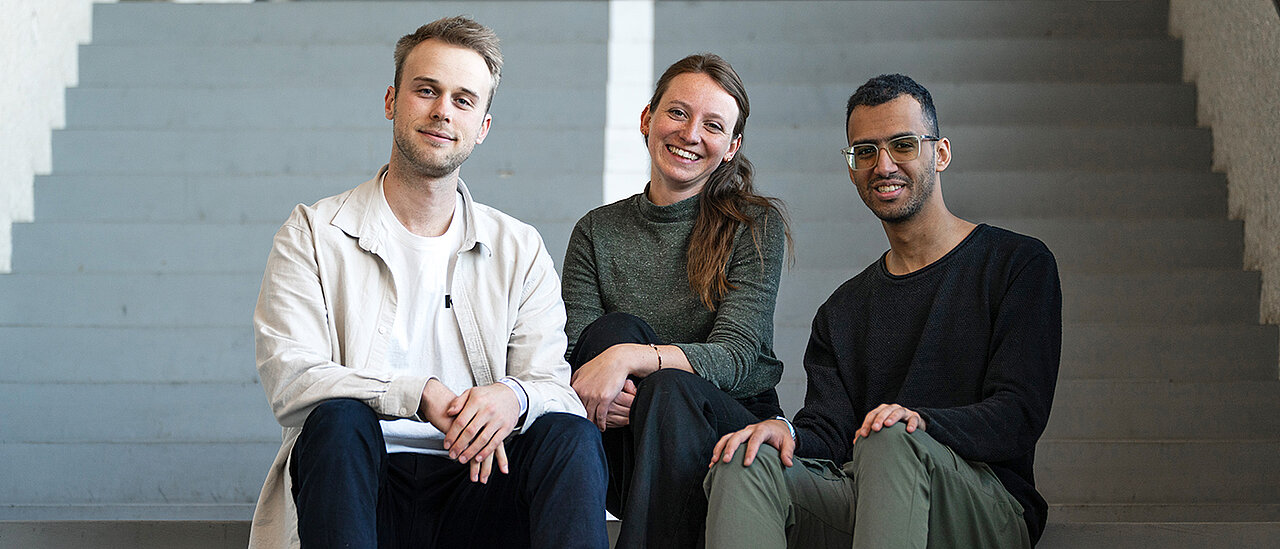
To drive his start-up forward, the special education teacher has put together an interdisciplinary team. It has expertise in special education, AI and marketing:
Fabian Schlausch (CEO) is a special education teacher (University of Würzburg) and is responsible for strategy, sales and collaborations.
Abdullah Abdelrazek (CTO) develops the AI architecture of KLAO. He has experience in software development thanks to his Master's degree in Artificial Intelligence (Technical University of Applied Sciences Würzburg-Schweinfurt).
Svenja Fischer (CMO) is a brand strategist with a Master's degree in Brand and Media Management (Technical University of Applied Sciences Würzburg-Schweinfurt). She manages marketing, communication and operational processes.
Raphael Schrauth is a special education teacher (University of Würzburg) and a certified translator for easy language.
The website of the start-up: www.klao.eu
Start-up grant from the exist programme
The KLAO team is currently receiving three exist start-up grants from the Federal Ministry for Economic Affairs and Energy, co-financed by the European Social Fund: it is receiving financial support for twelve months to develop its business plan and prepare for market entry with the support of the University of Würzburg.
The exist project is managed at the university by the Chair of Special Education in the Context of Blindness and Low Vision and Inclusive Education. Its head, Professor Dino Capovilla, supports the team as a mentor.
How the start-up came about
The idea for KLAO was born when Fabian Schlausch was still a JMU student of special education. He was working as an assistant on a research project about digital accessibility. "The topic of easy language kept coming up - combined with the question of how to reliably translate large volumes of text into easy language," explains the founder.
Then ChatGPT came onto the market. This was an impulse for the student: he started to build and test an AI for easy language himself. He continued to pursue this project after completing his degree, in parallel with his work as a research assistant in special education.
Well supported by the university's start-up assistance team
The results seemed promising to him. That's why he sought support early on - including from the university's start-up assistance team at the Service Centre for Research and Technology Transfer SFT. "I received very good support there, especially with the exist application," he says.
The SFT is available to all students, employees and alumni who want to set up their own business. It prepares all exist grant applications together with the applicants and is responsible for the success of the project vis-à-vis the funders.
The next goals of the start-up
The exist grant ends in August 2026, by which time the team would like to tap into new sources of funding and acquire as many more customers as possible. KLAO currently has business contacts with several public administrations, including the city of Würzburg and the Fürstenfeldbruck district office.
Web links
KLAO start-up project: www.klao.eu
Start-up counselling at the University of Würzburg
Funding programme exist


