
Repeatedly losing and gaining weight does more than frustrate dieters - it also accelerates muscle loss in middle-aged people, according to new UC San Francisco research that comes as weight-loss medications transform obesity treatment.
In a study published July 21 in Radiology, the researchers found that people whose weight repeatedly fluctuated lost significantly more thigh muscle over four years than people whose weight remained relatively steady, even though both groups finished the study at about the same overall weight as when they began.
"When people's weight cycled, they lost tremendous amounts of muscle along with the fat, and they didn't gain the muscle back," said Thomas Link , MD, PhD, professor of Radiology, who led the study, along with co-first authors, Adrian A. Marth, MD, and Gabby Joseph, PhD. "This tells us that understanding how to protect muscle while people are losing weight is important for overall health."
Although the study was not conducted in people taking GLP-1 drugs, Link said that the insight addresses a question likely to become increasingly important as more people go on and off weight-loss therapies.
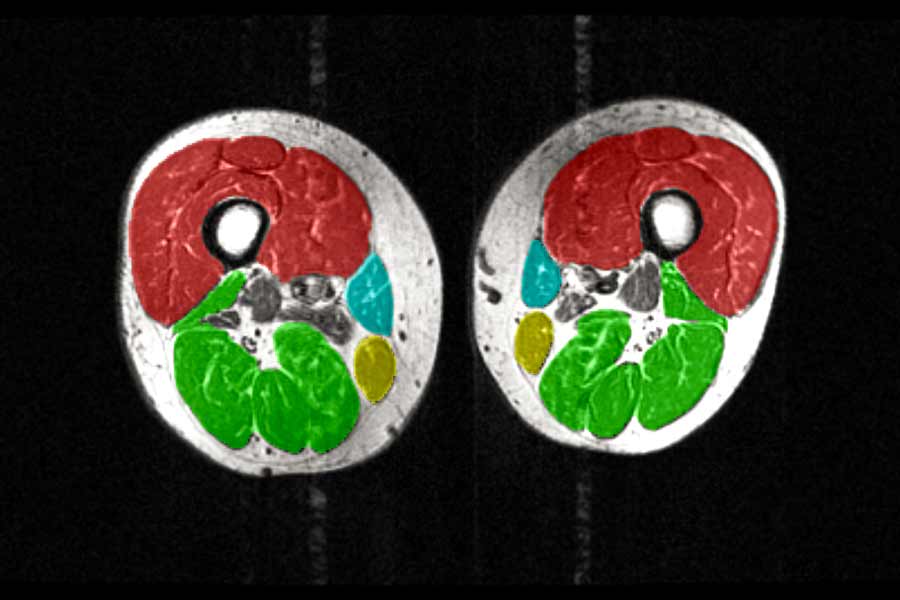
MRI images of thigh muscles in a 62-year-old participant in the study, including quadriceps (red), hamstrings (green), sartorius (turquoise) and gracilis (yellow).
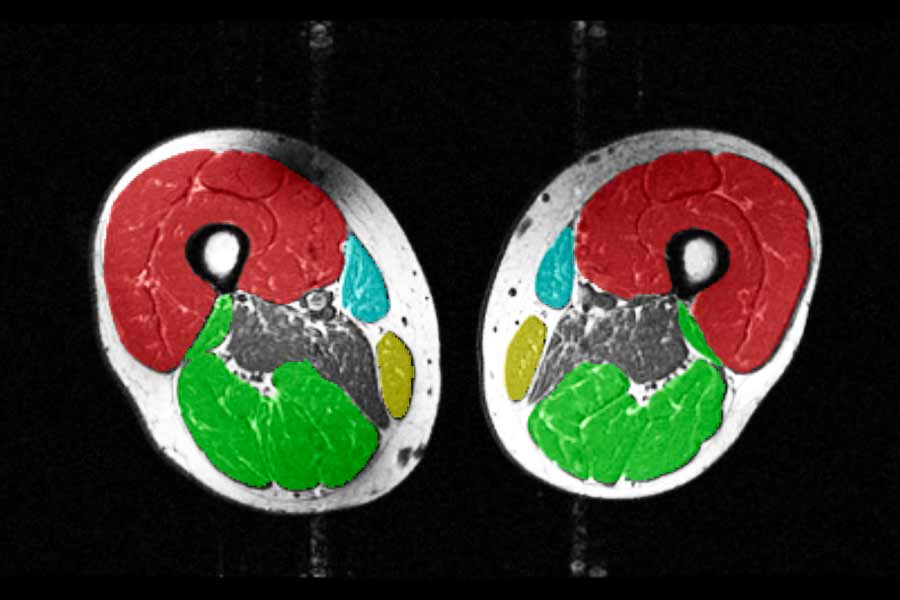
The top image shows the muscles at the start of the study, and the bottom image shows them after 48 months of weight cycling. Over this period, the participant's muscle volume decreased by 16% while his BMI decreased by only 1.6%.
Images by Link Lab
Looking beyond the scale
The researchers analyzed MRI scans and health data from 1,433 middle-aged participants in the Osteoarthritis Initiative, a long-running study of adults at risk for knee osteoarthritis that is funded by the National Institutes of Health (NIH). While some participants maintained a stable weight during the four-year study, others experienced repeated weight fluctuations.
Using artificial intelligence to analyze MRI scans, the team measured thigh muscle volume, fat within the muscles, and fat surrounding the knee. The difference between the two groups was striking.
People whose weight repeatedly fluctuated lost nearly four times as much thigh muscle over four years as those whose weight remained relatively steady. The loss was about 3.7% of thigh muscle volume in weight cyclers, compared with about 1% in non-cyclers, after accounting for age, sex, baseline BMI, physical activity, diet, and other health factors.
The findings also suggest that preserving muscle during weight loss deserves as much attention as losing fat.
"We need to better understand how weight loss affects the body in ways that aren't about the number on the scale," said Link.
"Fat loss is just one piece of a much larger puzzle that includes how weight loss affects arthritis, muscle, bone, and other factors," Link said. "As more people use effective weight-loss therapies, we need to be thinking about how those pieces fit together."
Authors: Other authors include Katharina Ziegeler, MD, Virginie Kreutzinger, MD, Felix Liu, MS, John A. Lynch, PhD, Michael C. Nevitt, PhD, Charles E. McCulloch, PhD, of UCSF, and Nancy E. Lane, MD of UC Davis Health.
Funding: This work was supported by the National Institutes of Health (grants R01-AR064771, R01-AR078917, N01-AR-2-2258, N01-AR-2-2259, N01-AR-2-2260, N01-AR-2-2261, N01-AR-2-2262, and R01‐AG‐070647) and the UCSF Core Center for Musculoskeletal Biology and Medicine (grant P30AR075055).
Disclosures: The authors have no competing interests.


