
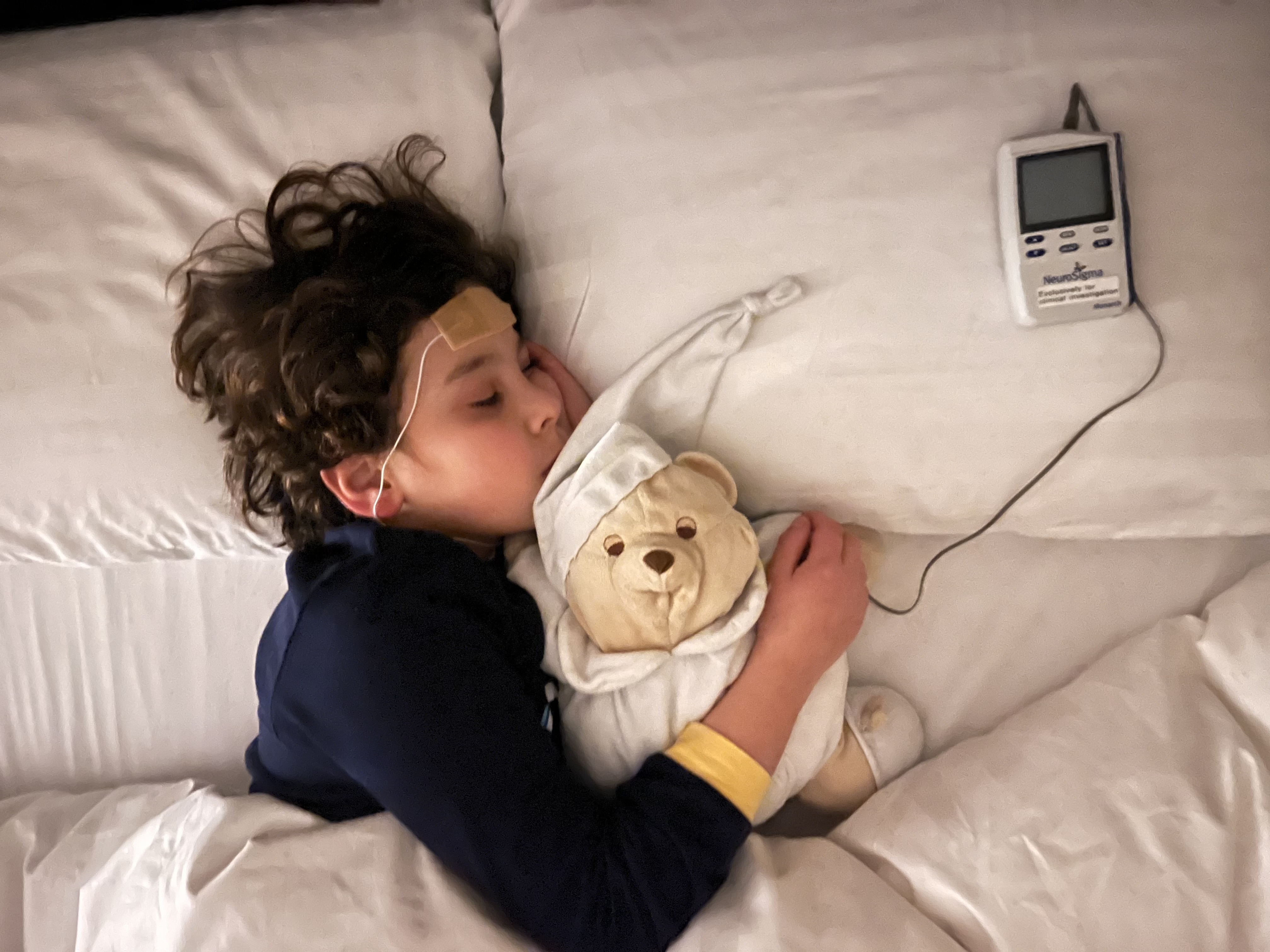
A large multicentre clinical trial involving the University of Southampton has shown that a device cleared by the USA FDA to treat ADHD is not effective in reducing symptoms.
The device - which uses an approach called trigeminal nerve stimulation (TNS) - was cleared for use by the United States Food and Drugs Administration (FDA) to treat ADHD in 2019, based on a small study.
The new findings from a larger multicentre trial with 150 children and adolescents, published in the journal Nature Medicine, suggest authorities should revisit the original evidence that supported the FDA clearance. Notably, TNS is currently not recommended for use in the UK by NICE guidelines.
The trial was led by King's College London and funded by a partnership between the National Institute for Health and Care Research (NIHR) and Medical Research Council (MRC), with further support from the NIHR Maudsley Biomedical Research Centre.
Attention-Deficit/Hyperactivity Disorder (ADHD) affects 5-8 per cent of school-age children worldwide. It is associated with age-inappropriate problems with attention and/or hyperactivity and impulsivity that can impair everyday functioning. Stimulant medications improve symptoms in 70 per cent of those who take them in the short term but there is less evidence of their long-term effects.
To provide an alternative to medication, researchers have developed and trialled approaches that use non-invasive stimulation of the brain, working on the regions that have been identified as influential in ADHD.
One of these approaches involves stimulating the trigeminal nerve (TNS), targeting a branch of this facial nerve which is thought to activate the brainstem and from there other brain regions that may be relevant to ADHD - particularly the locus coeruleus, which plays a role in arousal which is typically diminished in people with ADHD. TNS is thought to stimulate other brain regions associated with attention such as frontal and thalamic areas via the brainstem in a bottom-up manner.
A previous small trial in the United States with 62 children diagnosed with ADHD has shown that when TNS is applied every night for 8 hours for 1 month it is effective in reducing symptoms - this research led to its clearance by the FDA for use in the US. However, the control condition involved no stimulation at all and blinding was not tested after one month, raising questions about a potential placebo effect.
This new UK clinical trial across two sites in Southampton and London tested TNS in a wider range of 150 children and adolescents diagnosed with ADHD aged between 8 and 18 years old and applied a more rigorous placebo condition. Half of the sample received real TNS for about nine hours every night for four weeks through battery-powered electrodes applied to the forehead. The other half of the sample received the 'sham' condition where electrodes were still applied to the forehead every night for four weeks but participants only received 30 seconds of stimulation every hour at a lower frequency and pulse width, which are thought to be non-effective and hence act as a 'control' condition.
Professor Katya Rubia, Professor of Cognitive Neuroscience at Institute of Psychiatry, Psychology & Neuroscience (IoPPN), King's College London and senior author of the study said: "Our study shows how important it is to design an appropriate placebo condition in clinical trials of brain therapies. There is a large placebo effect with high-tech brain therapies, in particular for patients and families that have an expectation that they can adjust brain differences associated with ADHD. It is hence paramount to control for placebo effects in modern brain therapies to avoid false hopes."
Professor Samuele Cortese , NIHR Research Professor at University of Southampton and study Lead for the Southampton site, stated: "Rigorous evidence, such as that generated by this study, is essential for supporting shared decision-making regarding interventions for ADHD. It empowers individuals with ADHD and their families to make informed choices about the treatment of ADHD. Clinicians, individuals with ADHD, and their families need to know which treatments work and which do not based on the best evidence."
Dr Aldo Conti, postdoctoral researcher at IoPPN and at Florence Nightingale Faculty of Nursing, Midwifery & Palliative Care, King's College London and first author on the study said: "Unlike the earlier study, which was limited to younger children, we also included adolescents, a clinically important group given well-documented challenges with long-term medication adherence. These design choices enabled a more robust and clinically relevant evaluation of TNS."
By comparing the groups researchers evaluated effectiveness of TNS by assessing the symptoms of ADHD as reported by parents, alongside other outcomes such as, mind-wandering and attention, depression and anxiety, and sleep.
The trial showed that TNS was safe with no serious adverse events and most participants considered it a mild or no burden to use. However, the results showed no significant change in ADHD symptoms, objective measures of hyperactivity, attention and associated behaviours around mood and sleep.
This project was funded by the Efficacy and Mechanism Evaluation (EME) Programme which is a partnership of the Medical Research Council (MRC) and National Institute for Health and Care Research (NIHR).
The trial was run by the King's Clinical Trials Unit and recruitment involved the CAMHS clinics within the following NHS trusts: South London and Maudsley NHS Foundation Trust, Hampshire and Isle of Wight Healthcare (previously known as SOLENT NHS Trust), Central and North-West London NHS Foundation Trust, Oxleas NHS Foundation Trust and South-West London and St. George's Mental Health NHS Trust.
External trigeminal nerve stimulation in youth with ADHD: a randomized, sham-controlled, phase 2b trial by Conti, A.A. et al was published in Nature Medicine.


