
Olive oil is the Swiss army knife of foodstuffs. It can dress salads, sauté vegetables, even grease squeaky hinges. And for archaeologists, its ubiquitous presence in excavated pottery offers a window into the economic, political and social organization of the ancient world.
But perhaps, in certain environments, that prevalence has been overstated.
An interdisciplinary team of Cornell researchers - ranging from classicists to food scientists to engineers - has determined that organic residues of plant oils are poorly preserved in calcareous soils from the Mediterranean. This means decades of archaeologists have likely misidentified olive oil in ceramics, failing to recognize other plant oils or perhaps mistaking them for animal fat.
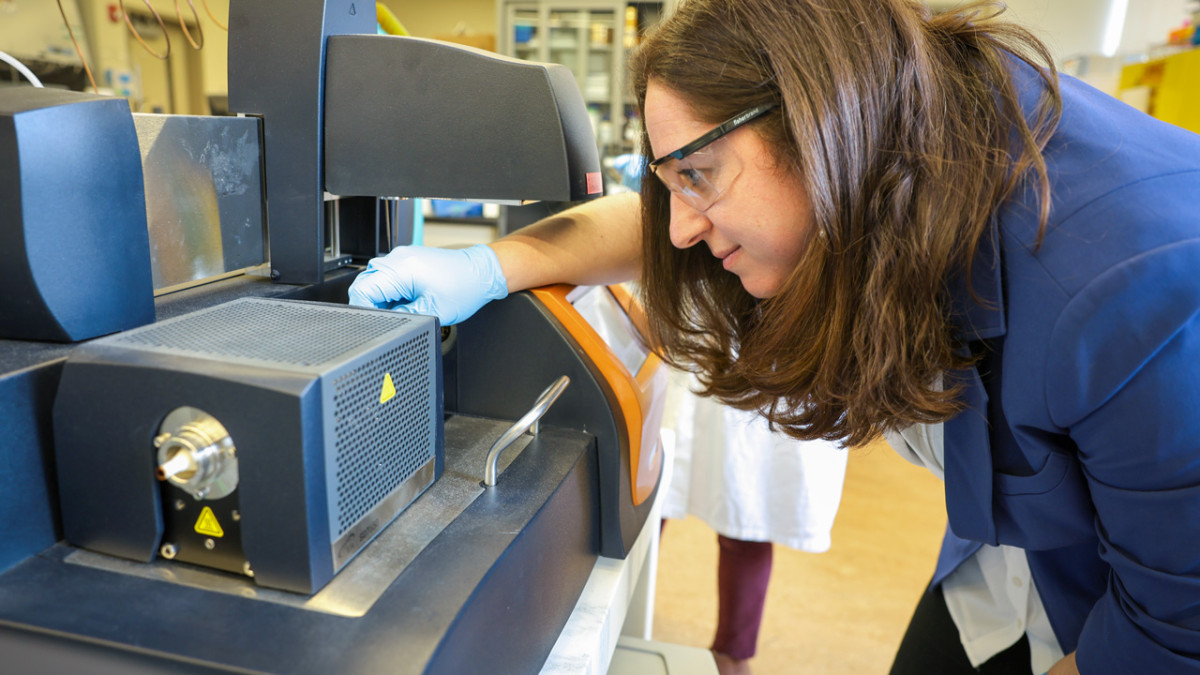
Goldfarb and her research group helped develop an in-lab experiment to test how unique soil chemistries catalyze specific types of break down in the food residues found on pottery.
The findings were published Nov. 24 in the Journal of Archaeological Science.
The project began in 2019, when the study's lead author, Rebecca Gerdes, Ph.D. '24, was a doctoral student in the Department of Classics in the College of Arts and Sciences. As an undergraduate, she had also studied chemistry, and she wanted to explore the ways that discipline could be applied to archaeological science.
"I usually describe my work as: I wash ancient dirty dishes, I save the rinse liquid, and I use the molecules in it to figure out how people are using their pots," said Gerdes, currently the Hirsch Postdoctoral Associate at the Cornell Institute of Archaeology and Material Studies in A&S.
This organic residue analysis is an established subdiscipline of archaeology. But many claims about finding olive oil had not been revisited, and there was no experimental evidence in the Mediterranean for why it could be difficult to identify. At the recommendation of her Ph.D. chair, Sturt Manning, Distinguished Professor of Arts and Sciences in Classical Archaeology (A&S), Gerdes decided to dig much deeper.
"One of the things that I was realizing early in my Ph.D. was people were making all sorts of claims about what they had found in pots in the eastern Mediterranean, and there was a lot of room for backing those claims up with more solid experimentation," she said. "I wanted to answer some interesting archaeological questions, but I realized I had to do some method development first."
And so launched a cross-campus collaboration - "up and down Tower Road," Gerdes said - that spanned a diverse group of researchers in three different colleges and numerous facilities.
Gerdes found a key partner in Jillian Goldfarb, associate professor of chemical and biomolecular engineering in Cornell Engineering, who was confident that her lab, which studies the breakdown of organic waste into biofuels, could provide the methodologies Gerdes was searching for.
But first, they needed to get their hands dirty.
'We didn't have to wait 3,000 years'
At the time, the pandemic was at its peak, so Gerdes could not travel overseas to sample the geological conditions of Cyprus, the island nation in the eastern Mediterranean Sea that was her focus. So she did the next best thing: She had a bit of the Mediterranean brought to her. She turned to the Cornell Soil Health Lab in the College of Agriculture and Life Sciences, which was able to receive the Cyprus soil samples, sterilize them and release them to the team for safe study. The lab's director, Bob Schindelbeck, played a critical role in helping Gerdes understand how soils behave. Together with Goldfarb's research group, Gerdes developed an in-lab experiment to test how unique soil chemistries catalyze specific types of break down in the food residues found on pottery.
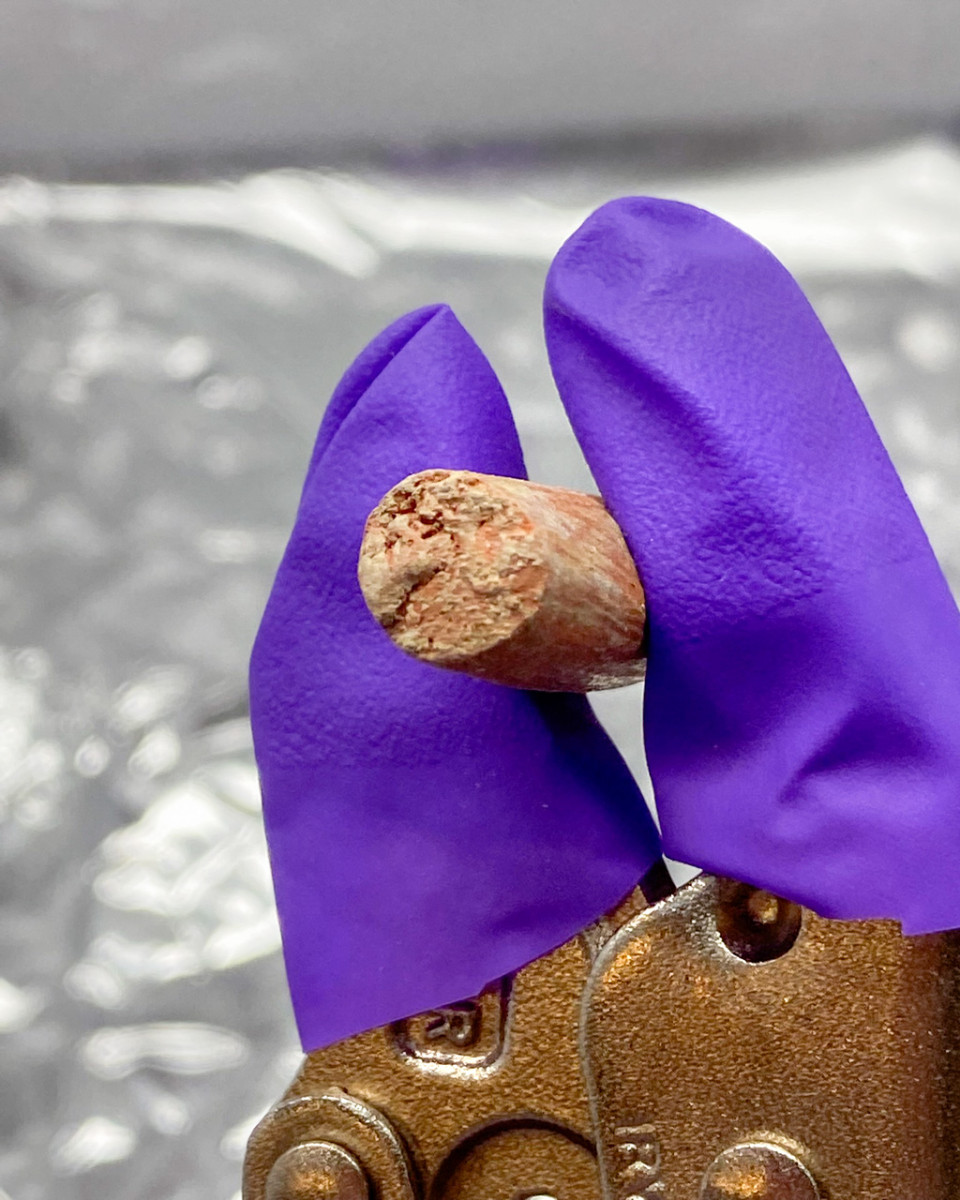
A ceramic sample is shown after incubation, with soil crust on its exterior.
The team created little ceramic pellets using rolled-out terracotta clay - "I was thinking about playing with Play-Doh the whole time," Gerdes said - and fired them in a tube furnace. The pellets were then soaked in olive oil and buried in two types of moistened soil: a sample from one of the Soil Health Lab's agricultural fields and the sample from Cyprus, which had been selected for its relevance to an actual archaeological site and collected by Thilo Rehren at the Cyprus Institute.
"What turns out to be critical is this soil is really common in the eastern Mediterranean, so it impacts a lot of major historical periods, especially where we're looking at trade and connectivity in that region," Gerdes said. "The Late Bronze Age [c. 1650-1100 BC] is one of those time periods."
The samples were placed in incubators at 50 degrees Celsius for up to a year. After excavation, the olive oil residues were extracted and the researchers studied the profile of the molecules that had been preserved.
"We managed to do it in the lab at an accelerated rate, so we didn't have to wait 3,000 years to finish my Ph.D.," Gerdes said.
The team's analysis showed that the amount and composition of the olive oil residue in the ceramic pellets had degraded in the calcareous, alkaline soil from Cyprus, with lower yields and a loss of dicarboxylic acid plant oil biomarkers, compared with samples that were buried in the mildly acidic New York soil.
"There's definitely a sense among archaeologists of wanting to believe that you found olive oil, because it makes a nice story. And because it's such an economically important Mediterranean product, there is a default assumption that if you found molecules that match olive oil, then you must have found olive oil," Gerdes said. "The problem is that olive oil overlaps in its composition with a bunch of other plant oils. And if you start to degrade it, then it gets even worse - it starts looking like an animal fat."
'It all starts with one amazing student'
As excited as Gerdes was by the results, she was equally gratified by the number of collaborators and resources she found across Cornell.
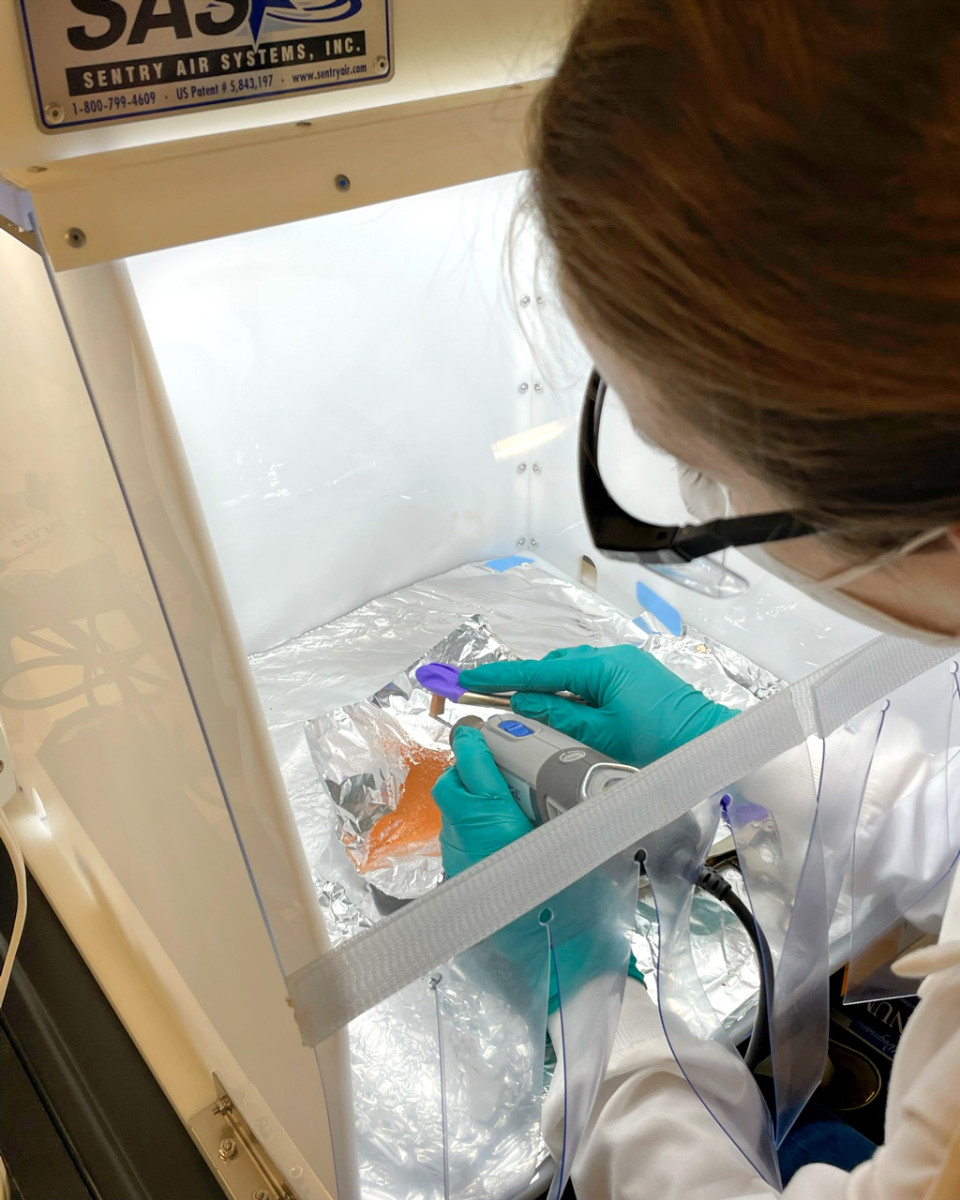
Gerdes drills the exterior off a ceramic sample at the Cornell Center for Materials Research.
Her team used lab space from the Schroeder Research Group at the Boyce Thompson Institute. Joe Regenstein, professor emeritus of food science (CALS) and a member of Gerdes's Ph.D. committee, helped her set up the extraction of the organic residues. Goldfarb's group translated fundamental chemical engineering analysis techniques from their biofuel research to quantify residues. The researchers also received assistance from the Cornell Center for Materials Research, who helped them work with powdered ceramic samples safely, and they cleaned their glassware at the Cornell Stable Isotope Lab.
The team also included undergraduate co-authors Hanna Wiandt '24, Malak Abuhashim '23, M.Eng '24 and Avery Williams '22, who, like the faculty involved, were able to connect across disciplines and develop a common vocabulary and set of expectations and goals, according to Goldfarb.
That level of collaboration demonstrates why Cornell has the potential to become a world-leading interdisciplinary hub for biomolecular archaeology.
"We really want to build out an analytical center for this," Goldfarb said. "We're thinking about how engineers and scientists can be of use in building out new methodologies and applying the fundamental skills and the applied skills that we have to new knowledge areas. And it all starts with one amazing student - now a postdoc - to get the conversations going."
The research was supported by the National Science Foundation; Cornell's Department of Classics, the Cornell Institute of Archaeology and Material Studies, the Engineering Learning Initiatives, the Mario Einaudi Center for International Studies and the Institute of European Studies; and the American Society for Overseas Research.


