Australian researchers and student interns have taken to the skies above France this week, testing technology that could help future civilisations produce fuel and essential chemicals from resources available in space, the Moon, or Mars.
The University of Western Australia's International Space Centre team is undertaking three parabolic flights from Bordeaux aboard Novespace's Airbus A310 Zero-G, with the final flight taking place yesterday.
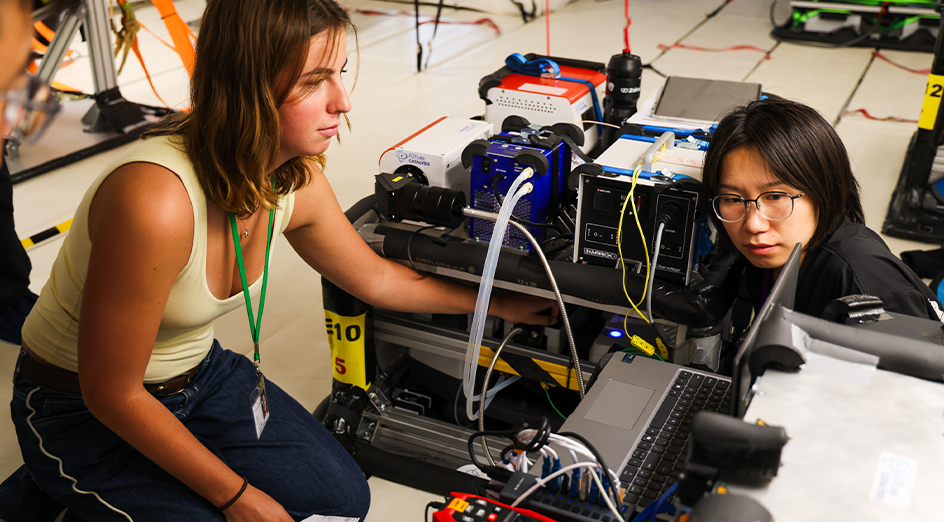
Across the campaign, 93 parabolic manoeuvres provide repeated periods of variable gravity, allowing researchers from the UWA Centre for Future Catalysis to investigate how gravity affects a light-driven chemical reaction.
The experiment converts methane and carbon dioxide into syngas, a mixture used to produce fuels and other chemicals. The findings could inform both future space exploration and chemical manufacturing on Earth.
Scientific lead Professor Hongqi Sun, Director of UWA Centre for Future Catalysis, said the flights offered an opportunity to test the process under conditions unavailable in a conventional laboratory.
"We want to understand what changes when gravity is taken out of the equation," Professor Sun said.
"That knowledge could help us develop ways to use resources available on other worlds, while also improving chemical processes here on Earth."
Joining the research team are three student interns: Caroline Berg from the University of Melbourne, Finley Wallace from the University of NSW and Laura Stokes from UWA.
The students were involved in a national competition open to undergraduates at any Australian university, giving the successful applicant a rare chance to participate in a live international microgravity research campaign.
Reflecting UWA's commitment to building Australia's next generation of researchers, the interns are gaining hands-on experience in preparing and conducting experiments in weightlessness.
International Space Centre Director Professor Danail Obreschkow said student participation was central to the campaign.
"We want Australian students to see that they can play a direct part in space research," Professor Obreschkow said.
"For these interns, that means working alongside researchers and taking an experiment from the laboratory into weightlessness. We hope their experience encourages many more students to explore where science and engineering can take them."
The campaign is delivered through a contract between UWA and Novespace, with the Australian team sharing the flights with the French Space Agency CNES.