Using a dual-cation substitution approach, researchers at Science Tokyo introduced ferromagnetism into bismuth ferrite, a well-known and promising multiferroic material for next-generation memory technologies. By replacing ions at both the bismuth and iron sites with calcium ions and heavier elements, they modified the spin structure and achieved ferromagnetism at room temperature. Additionally, negative thermal expansion was observed. This ability to engineer magnetism and thermal expansion in a multiferroic material aids in realizing future memory devices.
Engineering Weak Ferromagnetism and Thermal Expansion in Bismuth Ferrite (BiFeO3)
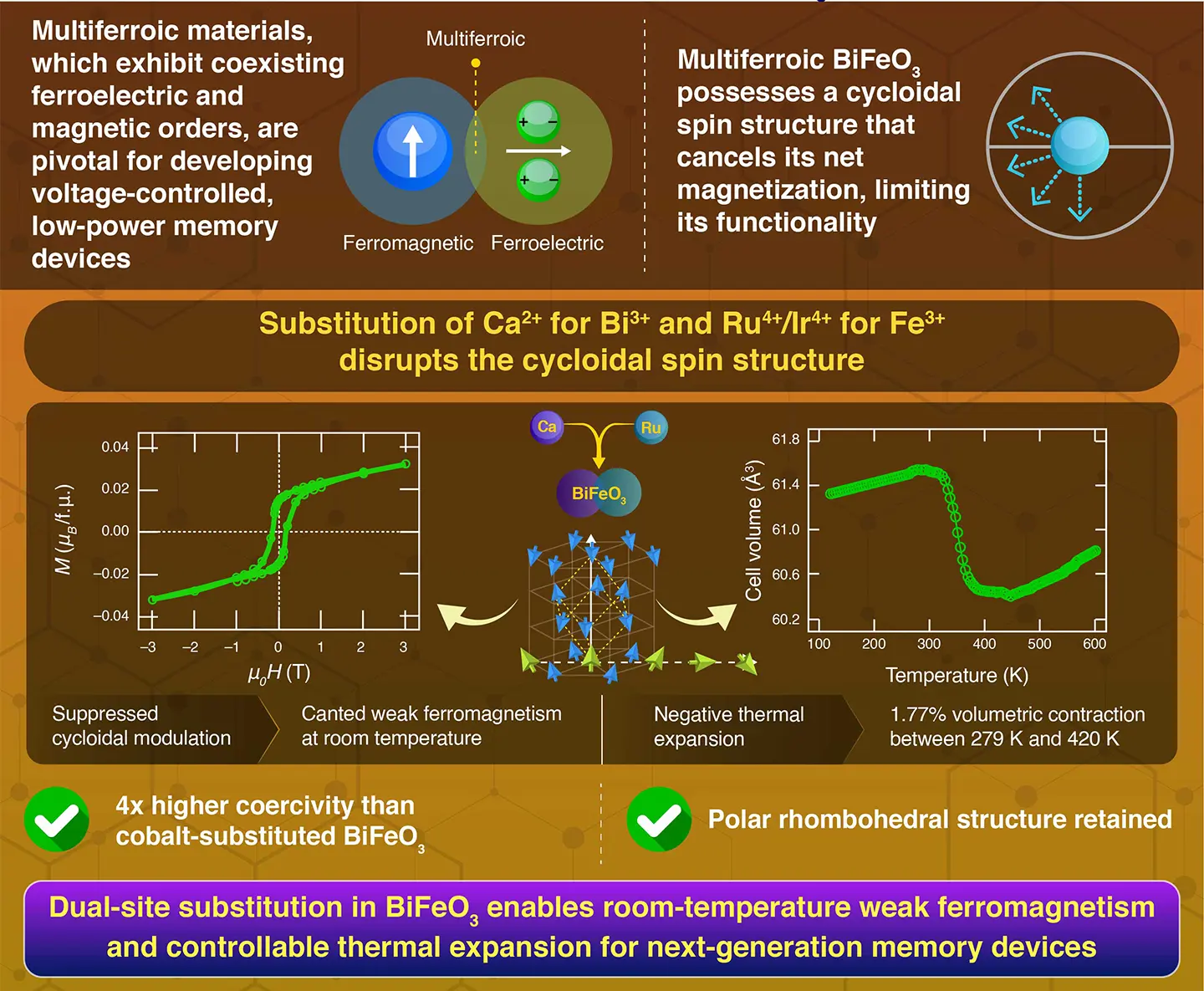
Multiferroic materials, which show both ferroelectricity and ferromagnetism, hold strong potential for use in low-power memory devices where information could be written electrically and read magnetically. Among these materials, bismuth ferrite (BiFeO3) is one of the most widely studied because it combines ferroelectricity with antiferromagnetism at room temperature. However, BiFeO3 naturally forms a cycloidal spin structure, which is a wave-like pattern of rotating spins. This pattern cancels out any net magnetization and makes the material difficult to use in magnetic devices.
Theoretical studies have long suggested that if this cycloidal modulation were removed, the tilted spins would produce the weak ferromagnetism needed for applications. Earlier efforts to break the cycloid focused on substituting cobalt ions for iron ions. This approach successfully changed the spin arrangement from a cycloidal pattern to a canted antiferromagnetic one with ferromagnetic behavior. The success of this method pointed researchers toward a new idea: using elements with stronger spin-orbit coupling might enhance the magnetic properties even further.
Following this idea, a research team led by Professor Masaki Azuma from the Institute of Integrated Research at Institute of Science Tokyo (Science Tokyo), Japan, and Sumitomo Chemical Co. Ltd., along with graduate students Kano Hatayama and Jun Miyake, and collaborators from the Kanagawa Institute of Industrial Science and Technology, Kyoto University, the Nagoya Institute of Technology, and the Japan Synchrotron Radiation Research Institute, Japan, carried out a new type of dual substitution.
They replaced ions at the iron site with heavier 4d and 5d transition metals, such as ruthenium or iridium. These ions have much stronger spin-orbit coupling than cobalt ions. Because these ions carry a higher charge, the team also replaced part of the bismuth ions with calcium to maintain charge balance. This combined substitution created a new set of BiFeO3-based compounds with significantly altered magnetic and thermal expansion properties. Their findings were published online in the Journal of the American Chemical Society on November 28, 2025.
Azuma explains, "We found that simultaneous substitution of ruthenium or iridium for iron and calcium for bismuth suppressed the cycloidal modulation and produced canted weak ferromagnetism at room temperature while still keeping the polar rhombohedral crystal structure."
Compounds such as Bi0.9Ca0.1Fe0.9Ru0.1O3 and Bi0.9Ca0.1Fe0.9Ir0.1O3 showed clear ferromagnetic behavior at room temperature. Their spontaneous magnetization was similar to that of cobalt-substituted BiFeO3, but their coercive fields were nearly four times higher. This increase in coercivity is useful because it improves the stability of stored information in future multiferroic memory devices. Computational analysis revealed that the improved magnetism arises from strong spin-orbit coupling within the ruthenium and iridium. This effect increases the planar single-ion magnetic anisotropy, which weakens the cycloidal modulation.
The researchers also made an important additional discovery. The dual substitution greatly lowered the temperature at which the material loses its ferroelectric properties. This change produced a phenomenon known as negative thermal expansion near room temperature, where the material contracts when heated. One combination, Bi0.85Ca0.15Fe0.85Ir0.15O3, showed a volume contraction of 1.77% upon heating between 279 K and 420 K (about 6 °C to 147 °C). This behavior could help solve problems caused by thermal expansion in electronic components that combine different materials.
These results show that carefully chosen combinations of tetravalent and divalent ions in perovskite oxides can reshape the spin structure, stabilize ferromagnetism, tune thermal behavior, and create a versatile platform for future device innovations. "These findings open new avenues for designing multifunctional materials that combine magnetoelectric coupling with thermal expansion control and offer strong potential for future memory technologies and advanced structural applications," says Azuma.
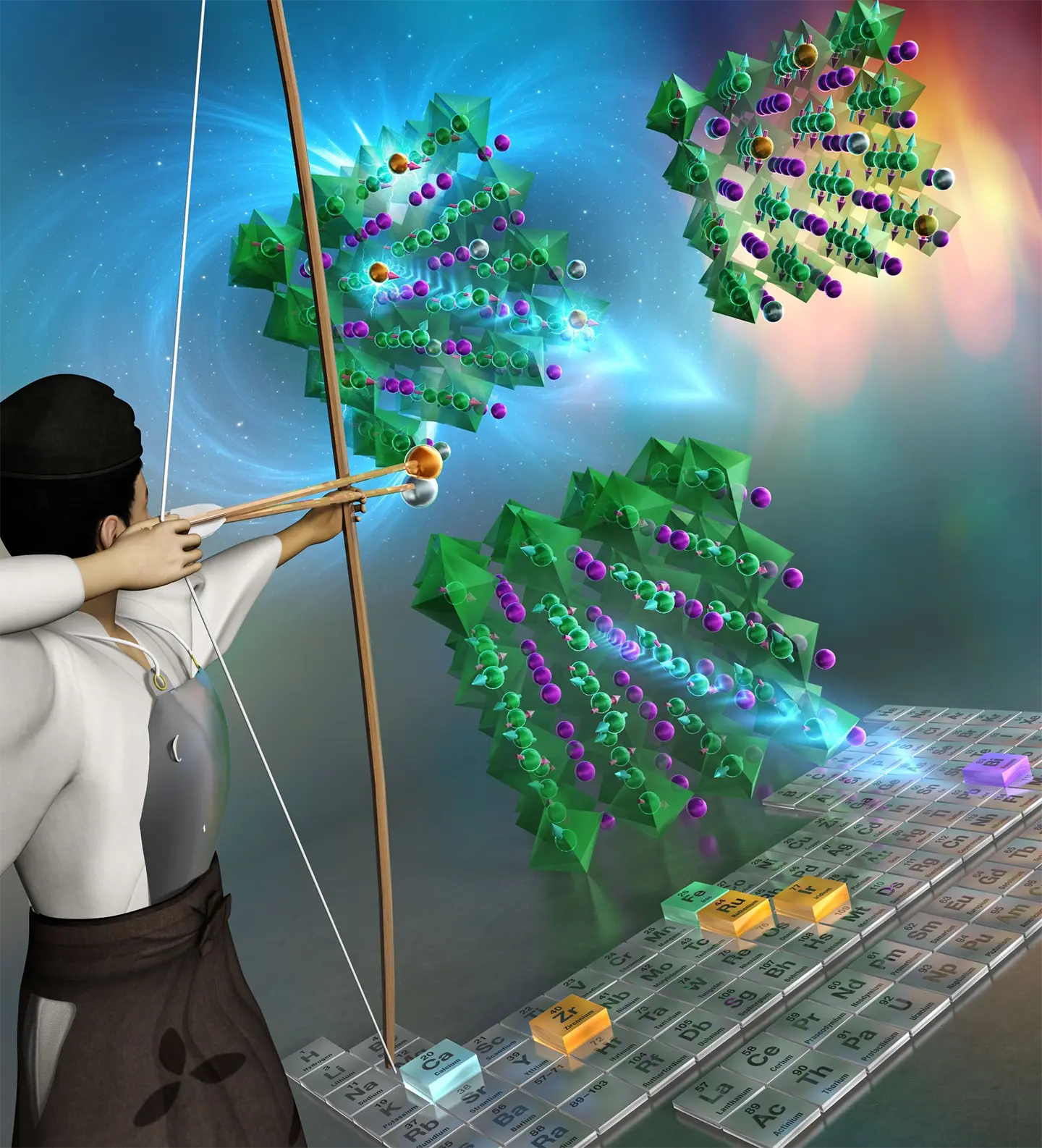
Image caption: By replacing ions at both the bismuth and iron sites in bismuth ferrite (BiFeO3) with heavier elements such as ruthenium and iridium, researchers suppressed the material's natural spin cycloid and unlocked stable weak ferromagnetism at room temperature, a key requirement for low-power memory technologies. Negative thermal expansion near room temperature was also observed.
Image credit: Professor Masaki Azuma, Institute of Science Tokyo
License type: Original content
Usage restrictions: For use in scientific news only. Attribution is required. Cannot be used without permission.
Reference
- Authors:
- Kano Hatayama1, Jun Miyake1, Daiki Ono1, Yusuke Shiono1, Takumi Nishikubo2,1,3, Koomok Lee1,3,4, Shogo Wakazaki1, Hena Das2,1, Kei Shigematsu1,2,3,4, Tomoko Onoue5, Ko Mibu5, Shogo Kawaguchi6, Takafumi Yamamoto1,7, and Masaki Azuma1,2,3,4
- Title:
- Achieving Canted-Spin Weak Ferromagnetism and Negative Thermal Expansion in A- and B-Site Substituted Bismuth Ferrite
- Journal:
- Journal of the American Chemical Society
- DOI:
- 10.1021/jacs.5c12255
- Affiliations:
- 1Materials and Structures Laboratory, Institute of Science Tokyo, Japan
2Kanagawa Institute of Industrial Science and Technology, Japan
3Research Center for Autonomous System Materialogy, Institute of Science Tokyo, Japan
4Sumitomo Chemical Next-Generation Eco-Friendly Devices Collaborative Research Cluster, Institute of Science Tokyo, Japan
5Department of Physical Science and Engineering, Nagoya Institute of Technology, Japan
6Japan Synchrotron Radiation Research Institute, SPring-8, Japan
7Department of Chemistry, Kyoto University, Japan