
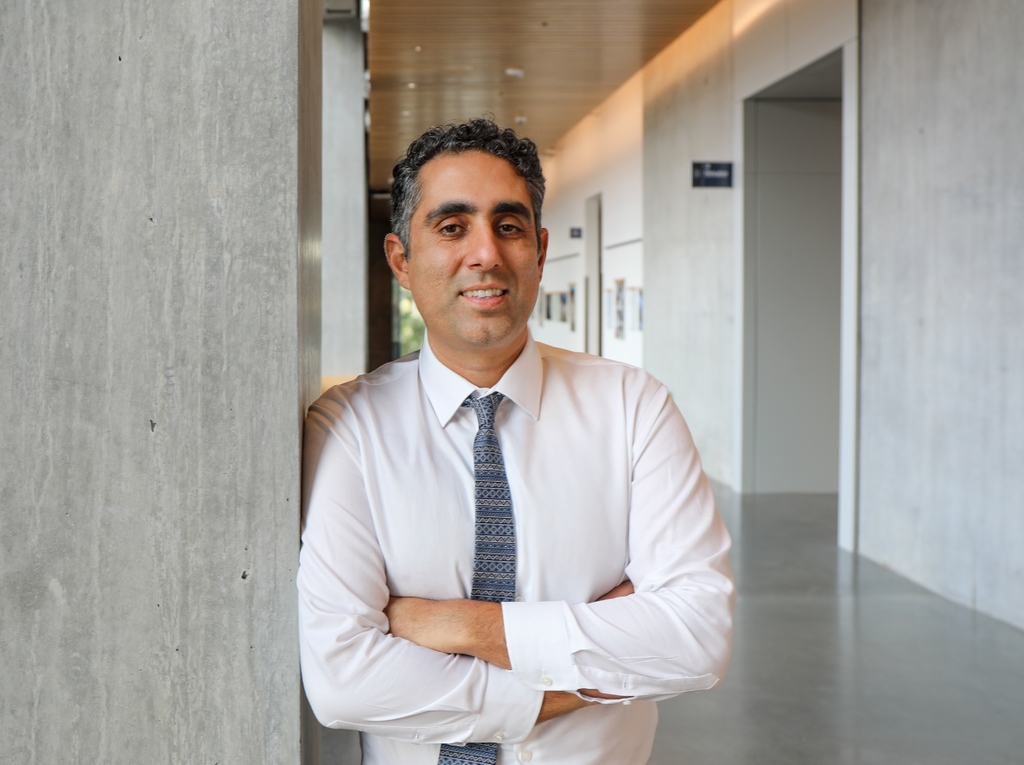
Screening, diagnosing and curing cancer at its earliest, most treatable stages has become a welcome and regular occurrence for radiation oncologist Nima Nabavizadeh, M.D.
This has been made possible by a simple blood test that can not only detect more than 50 types of cancer, but also pinpoint where it's coming from with striking accuracy.
Chief medical officer for the Knight Cancer Institute's Cancer Early Detection Advanced Research Center, or CEDAR, Nabavizadeh is the principal investigator for the PATHFINDER 2 study. PATHFINDER 2 is the largest interventional multi-cancer early detection, or MCED, trial in North America. It is examining the safety and efficacy of Grail's Galleri MCED blood test in an intended-use population.
Oregon Health & Science University was the top-enrolling site for the ongoing PATHFINDER 2 study's initial phase. The team enrolled 6,125 of the 35,000 participants — all adults older than 50 with no suspicion of cancer — making it the highest-enrolling interventional study in the history of the Knight Cancer Institute.
In October, Nabavizadeh traveled to the European Society for Medical Oncology conference in Berlin, Germany, to present initial PATHFINDER 2 results. He highlighted key findings, which found that the Galleri blood test:
- Increased the number of screen-detected cancers by more than seven-fold when added to standard-of-care screenings for breast, colorectal, cervical and lung cancers;
- Has a 62% positive predictive value, which means it accurately identified cancer in six out of 10 participants with a positive cancer signal;
- For true positives, accurately identified the cancer's origin 92% of the time;
- Found cancer in early stages a majority of the time, most of which had no recommended screenings;
- Had a false-positive rate of just 0.4%;
- Was safe, with less than 1% of all participants undergoing an invasive procedure because of the test.
"It's actually been really thrilling," Nabavizadeh said of the PATHFINDER 2 experience. "Having a blood test that detects a signal for a cancer in somebody with no symptoms and then seeing it confirmed on imaging? It's a game-changer. It's completely revolutionary."
Multi-cancer early detection tests
Cancer leaves clues — molecular traces — in the blood. Researchers developed the MCED test to analyze this circulating cell-free DNA, or cfDNA. Using a machine-learning algorithm, the test examines methylation patterns to distinguish cfDNA originating from healthy cells versus cancerous cells.
Methylation is a natural chemical process that is essentially the body's way of using tiny chemical tags to manage its operations. It acts like an "on" and "off" switch for genes, helping cells decide which instructions to follow and when, and keeping many crucial body processes running smoothly.
The Galleri MCED test screens for more than 50 types of cancer. It works in three steps by:
- Analyzing blood for circulating cfDNA;
- "Reading" specific methylation patterns on the cfDNA to identify if it came from a cancer cell;
- If cancer is detected, using pattern recognition technology to predict which organ the cancer may have originated in.
Positive predictive value improves
OHSU was one of seven health care organizations that worked with Grail, Inc. from 2019 to 2023 on the original PATHFINDER clinical trial, in which OHSU also led recruitment nationally. PATHFINDER 2 results show the updated test has improved performance over the version used in the first PATHFINDER trial, with its positive predictive value, or ability to accurately predict cancer, increasing from 43% to 62%.
"OHSU's Knight Cancer Institute is one of the premier cancer institutions in the world, both from a research and a patient care perspective," said Eric Fung, M.D., Ph.D., senior vice president of clinical development at Grail, Inc. "We are honored to partner with OHSU in the development of clinical evidence for our groundbreaking MCED program. Our partnership reflects our commitment to innovation and scientific rigor, and a shared mission to improve outcomes from cancer."
Fung said data from PATHFINDER 2 will be submitted to the Food and Drug Administration as part of the Galleri premarket approval application in the first quarter of 2026, with a potential decision expected in 2027. For those not eligible for clinical trials, the test is commercially available at OHSU as a laboratory-developed test.
For PATHFINDER 2, OHSU deliberately expanded enrollment beyond the Portland area, reaching rural and urban communities across Oregon. The Oregon Rural Practice-based Research Network, known as ORPRN, helped deliver the Galleri blood test to The Dalles and Hood River, while an OHSU coordinator living in southern Oregon enrolled patients through sites like Bay Area Hospital in Coos Bay and Roseburg. Strategic partnerships with Salem Health in Salem and St. Charles Hospital in Bend further broadened the geographic reach.
This multi-site approach, coupled with support from OHSU's Knight Community Outreach and Engagement team, ensured representation from underserved and minority populations.
REACH trial for Medicare beneficiaries
Rural outreach will continue as OHSU embarks on its third clinical trial with Grail, a study called REACH that examines the benefit the Galleri blood test can have in the Medicare population. To be eligible, participants must be 50 or older, on Medicare, and have no history of cancer within the last three years. With REACH, patients will be tested annually for three years at potentially no cost to the patient.
Learn more about OHSU's REACH clinical trial. To see if you are eligible to participate in the REACH study, fill out this interest form


