
The amount and distribution of the tau protein in the brain differs between early and late-onset Alzheimer's disease. This is shown by a new study from Karolinska Institutet published in the journal European Journal of Nuclear Medicine and Molecular Imaging. The results also indicate that blood tests do not always reflect changes in the brain.
Alzheimer's disease is characterized by the accumulation of the protein tau in the brain. In the current study, the researchers wanted to investigate how this accumulation differs between people who develop the disease early and late in life, and how well different biomarkers in blood and brain reflect the development of the disease.
The study included 57 participants, of whom 39 were patients with mild cognitive impairment (MCI) or Alzheimer's disease from Karolinska University Hospital and 18 healthy control subjects. All underwent brain imaging with so-called tau-PET, a form of brain imaging that uses a weakly radioactive substance that binds to the protein tau. MRI scans, cognitive tests and analysis of the biomarker p-tau217 in blood were also used.
Tau accumulates early in temporal lobes
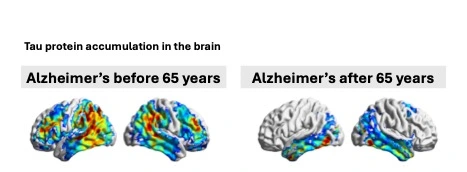
The researchers saw that tau accumulates early in the temporal lobes of the brain in people with Mild Cognitive Impairment (MCI). In patients with Alzheimer's dementia, the spread was greater in those who developed the disease before the age of 65, with more widespread changes in the frontal and parietal lobes compared to those who developed the disease later.

"We observed that people with early onset have a more extensive spread of tau in the brain, even in earlier stages of the disease," says first author Mariola Zapater-Fajari, researcher at the Department of Neurobiology, Care Science and Society at Karolinska Institutet.
At the same time, the analysis showed that the levels of p-tau217 in the blood increased with the severity of the disease, but that these levels did not always correspond to how much tau was present in the brain. In some cases, patients with late onset had high levels in the blood despite relatively limited accumulation in the brain.

"Our results suggest that blood-based biomarkers capture certain aspects of the disease, but not the full picture of how tau spreads in the brain," says last author Agneta Nordberg, professor at the same department.
The study also shows that tau-PET had a stronger link to cognitive impairment than the blood marker, especially in people with early onset. All these suggests that tau PET could be a better marker for monitoring disease-modifying treatments.
The researchers emphasize that the study is based on a cross-sectional study, which means that the results need to be confirmed in larger and longer-term studies.
See the study for funding and possible conflicts of interest.
Publication
"Tau PET in early and late onset Alzheimer's disease: associations with plasma p-tau 217, atrophy and cognition" , Mariola Zapater-Fajari, Marco Bucci, Konstantinos Chiotis, Ove Almkvist,,Anders Wall, Jonas Eriksson, Gunnar Antoni, Ilaria Pola, Kübra Tan, Wiebke Traichel, Andrea L. Benedet, Nicholas J. Ashton, Henrik Zetterberg, Nenad Bogdanovic, Agneta Nordberg, European Journal of Nuclear Medicine and Molecular Imaging, online June 26, 2026, doi: 10.1007/s00259-026-08015-w


