Lithium metal has long been considered the ideal material for next-generation rechargeable batteries because it can store far more energy than the graphite anodes used in today's batteries. However, bringing lithium metal batteries into widespread use has proven difficult because lithium tends to grow into needle-like structures called dendrites during charging, reducing battery life and creating potential safety hazards.
Now, researchers from Tohoku University's Institute for Materials Research (IMR) have identified a key factor that could help overcome this challenge. Rather than simply increasing the amount of lithium salt in the electrolyte, the team discovered that there is an optimal concentration that allows lithium to deposit evenly while forming a stronger protective layer on the battery's surface.
Details of their discovery was published in ACS Electrochemistry on June 29, 2026.
Electrolytes carry lithium ions between a battery's electrodes during charging and discharging. Scientists have often focused on highly concentrated electrolytes because they can suppress dendrite formation. However, why some electrolytes perform better than others has remained unclear.
To investigate this, the researchers systematically examined electrolytes containing different concentrations of lithium bis(trifluoromethanesulfonyl)imide (LiTFSI) dissolved in a mixture of ethylene carbonate and propylene carbonate. By combining multiple analytical techniques--including pulsed-field gradient nuclear magnetic resonance (PFG-NMR), electrochemical measurements, electron microscopy, impedance spectroscopy, and nanoindentation--they linked ion transport in the electrolyte with the mechanical properties of the protective solid electrolyte interphase (SEI).
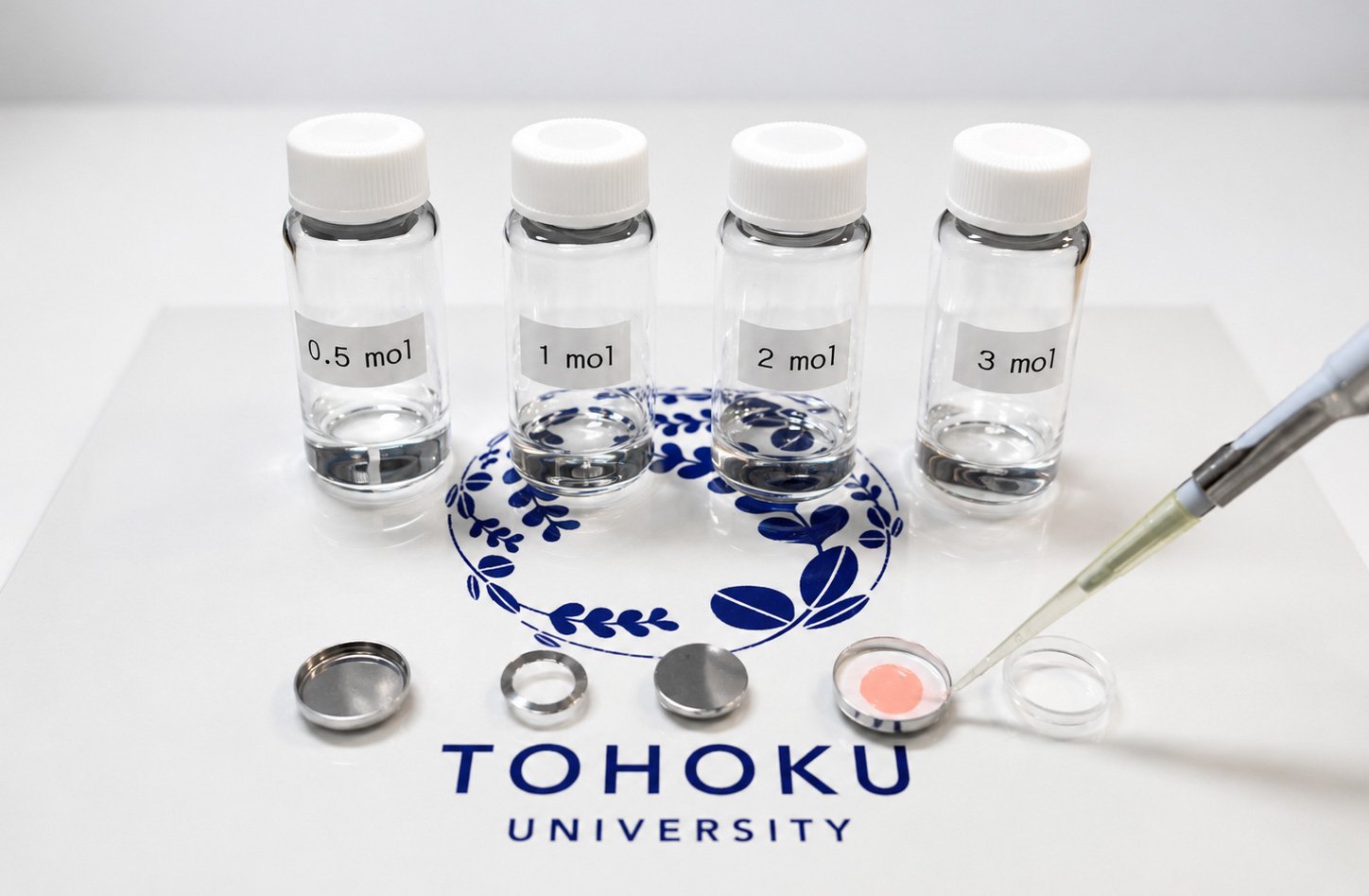
The team found that electrolytes containing 1-2 molar (M) LiTFSI produced the best results. At these concentrations, lithium ions and negatively charged TFSI ions moved together through the electrolyte at nearly the same rate. This cooperative transport created a more uniform flow of ions to the electrode surface, allowing lithium to deposit as smooth, dense layers instead of uneven, dendritic structures.
The researchers also found that this balanced ion transport produced a harder, more mechanically stable SEI layer. In comparison, dilute electrolytes formed weaker protective layers that allowed porous lithium deposits to develop, while highly concentrated electrolytes reduced ion mobility and hindered electron transport, ultimately leading to non-uniform lithium growth.
"Our results show that achieving stable lithium metal deposition is not simply a matter of increasing the salt concentration," said Hongyi Li, an assistant professor at Tohoku University's Institute for Materials Research. "Instead, the key is creating a balance where lithium ions and anions move cooperatively while maintaining a mechanically robust interfacial layer. This provides a new design principle for developing practical lithium metal batteries."
The findings offer a new way of designing electrolytes by optimizing both ion transport and the stability of the interface between the electrolyte and the electrode. Rather than relying solely on highly concentrated electrolytes, researchers can target this intermediate concentration regime to improve battery performance, safety, and lifespan.
Additionally, the study provides important insights for the development of next-generation lithium metal batteries for electric vehicles, portable electronics, and large-scale renewable energy storage. By identifying the fundamental relationship between ion transport and interfacial stability, the researchers have established practical guidelines for designing safer, longer-lasting, high-energy-density rechargeable batteries.
- Publication Details:
Title: Correlated Ion-Pair Diffusion Enables Balanced Transport Kinetics and Interfacial Stability for Lithium Metal Anodes
Authors: Rongkang Jin, Hongyi Li, Mariko Ando, Tetsu Ichitsubo
Journal: ACS Electrochemistry
DOI: 10.1021/acselectrochem.6c00140