The result on his computer screen looked impossible.
Late one night in 2009, Nate Orloff was alone in a laboratory, analyzing measurements from a set of experimental thin films sent to him by Darrell Schlom, the Tisch University Professor in Cornell University's Department of Materials Science and Engineering.

Nate Orloff as a graduate student measuring Ruddlesden-Popper materials circa 2009, work that led to the first evidence that the material family could be electrically tuned.
"I jumped out of my chair and shouted, 'Eureka,'" said Orloff, who at the time was a graduate student at the University of Maryland. "My computer immediately fell off the desk, crashed to floor, and broke the headphone jack."
What Orloff saw that night would help launch a scientific journey spanning 17 years, multiple institutions and generations of graduate student researchers.
That journey culminated June 15 in a paper by a multi-disciplinary team published in Nature Electronics and the achievement of what was one of the most elusive goals in microwave electronics.
'Crazy Ruddlesden-Popper things'
For more than two decades, scientists searching for better materials for wireless electronics have faced a seemingly unavoidable tradeoff: A material could be tunable - able to change its electrical properties on demand by applying a voltage - or efficient, losing very little energy as heat. Getting both properties at once could improve components used in wireless communications, radar systems, satellites and other devices that rely on controlling microwave signals with precision.
A federal research program was initiated in 1999 to find such materials. Nearly every scientific team involved focused on using barium strontium titanate - all but one.
"Our team was the only one working on these crazy Ruddlesden-Popper things that most considered a dead-end approach," Schlom said.
The layered crystalline materials, known as Ruddlesden-Popper thin films, were prized for exceptionally low energy loss at microwave frequencies. But according to the accepted understanding of their crystal symmetry, they shouldn't have been able to provide the tunability needed for practical devices.

Darrell Schlom, the Tisch University Professor in Cornell University's Department of Materials Science and Engineering, has spent more than two decades studying Ruddlesden-Popper materials for microwave electronics.
"We were very lonely pursuing this because, just from a symmetry perspective, people would say, 'That thing may have low loss, but it's never going to tune,'" Schlom said.
That changed in 2009 when Orloff, who is now a physicist at the National Institute of Standards and Technology, was developing a new technique for measuring the dielectric properties of thin films across a wide range of frequencies. At the time, he didn't know he was handling a potentially transformative material sent to him by Schlom.
"Jim Booth, my advisor, was interested in these materials for their unique properties," Orloff said, "but to me, as a graduate student, I just saw 'control and one, two and three'."
The team's "eureka" moment came when one of his measurements of strontium titanium oxide with composition Sr4Ti3O10, a layered Ruddlesden-Popper thin film, suggested something remarkable: The supposedly untunable material might, in fact, be tunable after all.
While it was an exciting and scientifically interesting finding for Orloff and Schlom, the material was commercially impractical. The effect only appeared in an in-plane geometry, in which the electric field moved sideways through the material. Real-world devices such as voltage-tunable capacitors used in microwave circuits generally require an out-of-plane design, in which the electric field moves vertically through the film, enabling smaller, more efficient components.
The team published their findings and over the next decade kept returning to their Ruddlesden-Popper materials, trying to find a way to preserve their low microwave loss while making them more tunable and more practical.
Lane Martin, one of their collaborators who is the director of the Advanced Materials Institute at Rice University, had a phrase for what they were chasing.
"This has been the holy grail for decades," Martin said.
Rewriting the rules
The 2009 research result did not solve the problem so much as redefine it. The Ruddlesden-Popper materials appeared tunable, but only in a geometry far removed from the compact devices industry wanted.
So Schlom's group began asking a more radical question: What if they could change the symmetry of the material itself? The idea took shape when calculations by Craig Fennie, the late associate professor of applied and engineering physics at Cornell, showed that, theoretically, it should be possible to change the symmetry in a specific family of Ruddlesden-Popper compounds made from barium, strontium, titanium and oxygen - a prediction promising enough that the group filed a patent.
Working with collaborators at Cornell, the University of Connecticut, Rice University, the University of Maryland, Boise State University and the National Institute of Standards and Technology, Schlom and his doctoral student at the time, Matthew R. Barone, Ph.D. '22, engineered a new version of the material by inserting carefully spaced rock-salt layers. The strategy effectively rewrote the material's internal rules, allowing it to exhibit the out-of-plane behavior needed for practical devices while preserving the low-loss characteristics that had made the Ruddlesden-Popper thin films attractive in the first place.

Matthew Barone, Ph.D. '22, utilizing the molecular-beam epitaxy system to grow the thin films at Cornell's Platform for the Accelerated Realization, Analysis, and Discovery of Interface Materials.
Early experiments suggested they were onto something. Measurements by the researchers showed that the material exhibited out-of-plane ferroelectricity, evidence that the symmetry-breaking strategy was working.
That result was an important clue, but it was not enough. Low-frequency measurements had shown that the material could be coaxed into the right kind of electrical behavior. What the team still needed to know was whether it would deliver that same tunability with low loss at the high microwave frequencies relevant for practical devices.
"We knew from the measurements from Martin's group that this thing was ferroelectric," said Florian Bergmann, a physicist at the National Institute of Standards and Technology and co-first author on the paper. "That's what kept our drive going and what convinced me to keep digging deeper."
'There was a pit of despair'
The project had begun with one measurement breakthrough, but it would require another to finish it. Orloff's 2009 technique had shown that the original thin films were tunable, but the new out-of-plane devices posed a different metrology problem entirely.
The frequencies most relevant for modern communications systems are among the most difficult to measure accurately because at those high frequencies, the signal from the material can be distorted by the test structure itself - the metal electrodes, wiring and geometries surrounding the dielectric. So when the researchers first tested the new Ruddlesden-Popper devices at microwave frequencies, the results were confusing.
"We couldn't interpret the data," Orloff said. "It started off with a lot of excitement, then there was this pit of despair. We wanted to turn that corner."
For many projects, that might have been the end. Instead, the team embarked on another years-long effort, this time to invent a better way to measure the material itself.
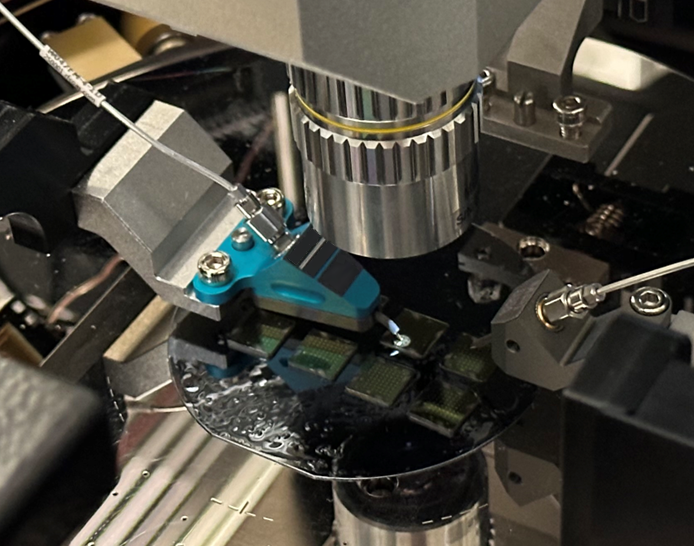
A microwave measurement setup used by Florian Bergmann and his colleagues at the National Institute of Standards and Technology in Boulder, Colorado.
At the National Institute of Standards and Technology, Meagan Papac, a postdoctoral researcher at the time, began to develop a new metrology approach capable of characterizing the material in an out-of-plane, metal-insulator-metal capacitor geometry at frequencies beyond the reach of conventional techniques. She was soon joined by Bergmann and other colleagues when a breakthrough eventually came from an unexpectedly simple idea.
"The secret to how we made the measurement work is we measured nothing," Bergmann said. "We measured a control - a sheet of metal that had the same topology as the device."
Measuring that control structure let the team perform an additional round of calibration, subtracting away distortions caused by the test structure itself and isolating the dielectric's true microwave response. The result transformed what had looked like noisy, incomprehensible data into something meaningful.
"The fit actually went through the data," Bergmann said. "That was the moment we knew we were extracting real material properties."
With Schlom, Orloff, Bergmann, Martin, Barone, Papac and materials scientist Zishen Tian among the many authors, those measurements became the centerpiece of the team's Nature Electronics paper published on June 15, confirming what the researchers had hoped for years: Their material combined strong tunability with exceptionally low microwave loss in an out-of-plane geometry relevant to real devices. They had found the holy grail.
'A huge deal'
For the researchers, the discovery represents more than just a new material.
"It opens up a whole new throughput that could expand the classes of materials that are available for these microwave applications and measurements," Martin said. "It's what the community of materials makers and designers have been wanting, and now we have a pathway forward. It's a tough one, but we have one that exists."
Aiden Ross, a graduate research assistant at Pennsylvania State University who contributed to the project, said the implications extend beyond a single dielectric.
"Once you're able to control loss, it opens up the door to a lot of high-frequency applications," Ross said. "If you can control the polarization and the dielectric response, then you can control all these other effects too."

Researchers used advanced microscopy to confirm the atomic structure of an engineered Ruddlesden-Popper material. The diagrams show how alternating layers in the crystal helped produce the material's unusual combination of tunability and low energy loss.
The material itself could eventually find applications in tunable filters and quantum information systems. Orloff said two especially promising directions are microwave resonators and electro-optic modulators, devices that help convert electrical signals into optical ones for communications networks.
"The backbone of the internet is really electro-optic modulators," Orloff said. "Demonstrating this technology for out-of-plane tunability opens a couple applications of next-generation devices."
Bergmann said the work also points to the scalability that industry often values as much as raw performance.
"Those material properties are super homogenous, which is not natural in ferroelectrics," Bergmann said. "That's a huge deal because if a company builds something on one day, they have to trust they can build it the same on the next day."
For Schlom, the achievement underscores the value of combining expertise across disciplines. Creating extraordinary materials is only half the challenge. Proving they work requires equally extraordinary measurements.
"My group and I engineer the structure of materials at literally the atomic layer level - but our skill in isolation is little more than a curiosity," Schlom said. "The magic of teaming is that it can compound capabilities to achieve the unthinkable."
Syl Kacapyr is associate director of marketing and communications for Duffield Engineering.