
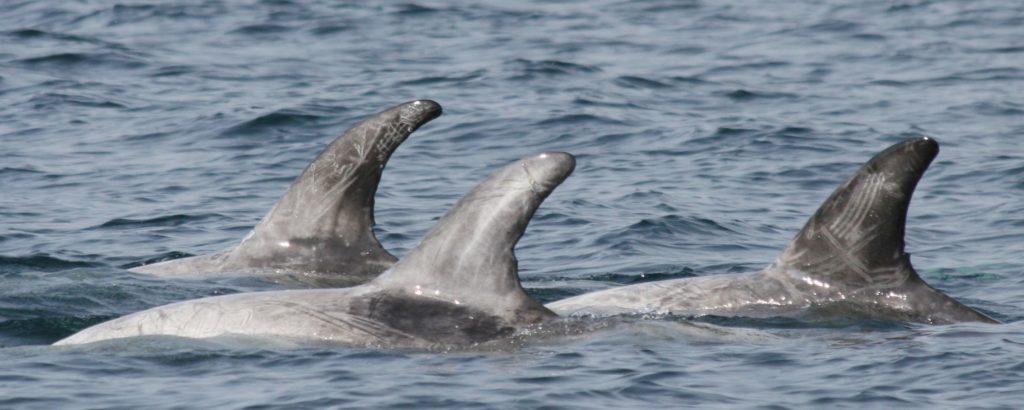
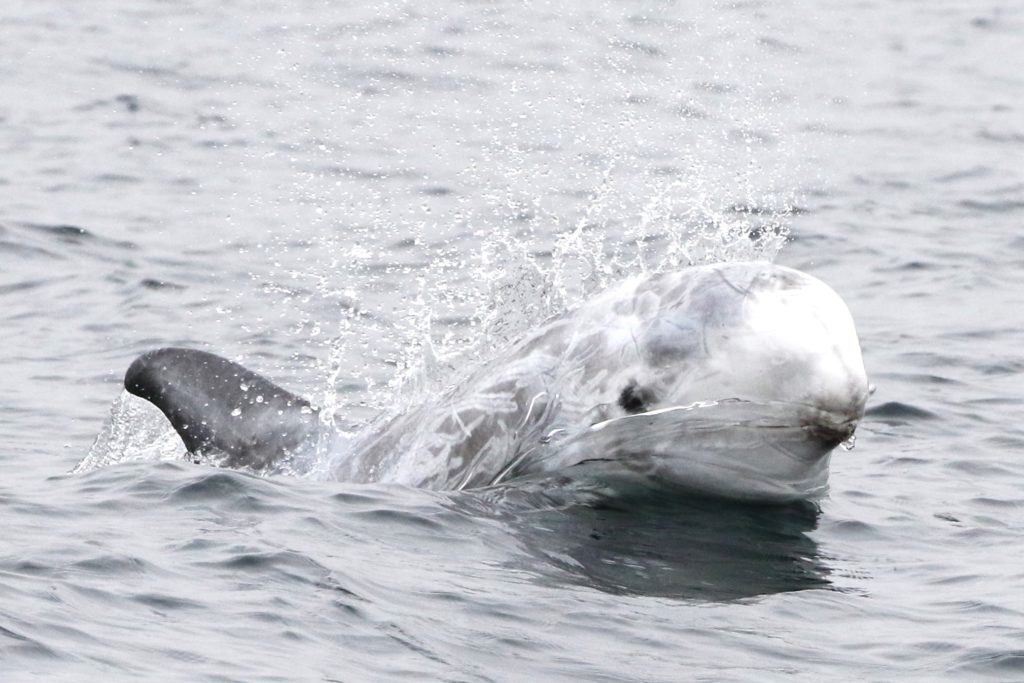
Risso's dolphins around the British Isles are part of a single population - genetically distinct from those elsewhere in the Atlantic, new research shows.
Scientists studied the DNA of dolphins that stranded in England, Scotland and Wales from 1992 to 2016.
The results showed that that Risso's dolphins found around the British Isles are their own genetic entity, suggesting they don't mix much with other Risso's dolphins from further away and are genetically distinct from the closest populations in the Azores, the Mediterranean, and possibly the wider north Atlantic.
"The results support the notion of Risso's dolphins in British waters having been isolated from other populations for some time. However, we did not sample every nearby part of the Atlantic, so it's not yet clear where the boundaries of this unit lie," said co-lead author Nicola Hodgins, from MARA and a Visiting Researcher at the University of Exeter.
While the study found no significant genetic differences between the animals around different parts of the British Isles, there may still be evidence of "sub-structuring" - meaning that the dolphins may still live in or return to specific areas around the British Isles, in addition to remaining in specific groups over their lifetime.
For example, recent analysis of Risso's dolphins in Scottish waters found less than 3% matches between individual dolphins photo-identified on the west and northern coasts, implying that Risso's dolphins exhibit a significant level of preference for particular areas. This is particularly important because Risso's dolphin numbers may be decreasing in some regions.
To explore these boundaries and find out whether Risso's dolphins in British waters are truly unique to this area, more genetic samples are needed, with comparisons from nearby regions such as Norway, the Celtic Sea, the south‑west English Channel and the Bay of Biscay.
Using more advanced DNA techniques could further add resolution and give a fine-grained picture of connectedness between groups of Risso's dolphins around the British Isles - key information needed to accurately assess their conservation status.
It could be argued that the population should be recognised as a "sub-population" by the IUCN - as has been done for the Mediterranean sub-population, which is classified as Endangered.
Future research combining information on behaviour, appearance, movements, vocalisations and genetics will help researchers better understand how Risso's dolphins around the UK are connected, how they use different habitats, and how best to protect them.
Hodgins said: "Good conservation requires habitat-specific management. While Risso's dolphins are currently managed as a single UK population, local populations can face different threats and use habitats in different ways.
"Effective protection must therefore focus on safeguarding important habitats and addressing pressures at a local scale, where conservation measures can have the greatest impact."
The research team included MARA, Nova Atlantis, Environmental Investigation Agency, Whale and Dolphin Conservation, Zoological Society of London, and the universities of Exeter, Glasgow, Zurich, Western Australia and Taiwan.
Samples used in this study were collected by the UK Government funded stranding programmes, the Scottish Marine Animal Strandings Scheme (SMASS) and the Cetacean Strandings Investigation Programme (CSIP).


