
Whenever Nadeen Chahine and Clark Hung, Columbia biomedical engineers and orthopedic scientists, meet patients living with the pain of knee osteoarthritis, their stories remind them why they set out to design a better implant that can regenerate the knee.
Men and women in their 60s, 50s, and even younger are enduring bone-on-bone pain in their knees caused by osteoarthritis while they are forced to wait for a knee replacement surgery that's usually reserved for older patients.
Knee replacement surgery-which replaces a diseased joint with a metal and plastic implant-is one of the most common surgeries in the United States. Nearly 800,000 knee replacement procedures are performed each year in the U.S. alone, and the number is expected to rise rapidly to two million by 2030.
But the implants have a limited lifespan that precludes their use in younger patients.
"Right now, you want to perform the surgery when you think the implant will outlive the patient," says Clark Hung, professor and vice chair of the Department of Biomedical Engineering at Columbia University's School of Engineering. Implants typically last 15-20 years. But replacing a worn-out implant is a difficult process that may improve knee function while also coming with greater risk of infection, longer recovery, and persistent stiffness and lower mobility.
"The people we speak with are in tremendous pain, with limited mobility, and are suffering. They don't want to wait years and years to be eligible for a replacement," says Hung. "They want to play with their kids now, pain-free, not when the kids have grown up and left the house."
With those patients in mind, Hung and Chahine have been leading a project, funded by a contract from the Advanced Research Projects Agency for Health (ARPA-H), to create a new biological knee joint that can last a lifetime, expand joint surgery to younger patients, and provide a better joint for all patients.
Two years into the project, ARPA-H has now given the team the green light to move into the second phase of development and begin preclinical testing of their "living knee" implant, called NOVAKnee.
"My family always asks me, 'how are things going in the lab, are you going to solve my aches and pains?'" says Nadeen Chahine, professor of biomedical engineering in the Department of Orthopedic Surgery at Columbia University Vagelos College of Physicians and Surgeons. "More typically, I would tell them about our important scientific progress in the lab, and how one day those discoveries might help create a cure for joint disease. But with NOVAKnee, I can confidently tell them, 'Yes, we now have a living knee joint we're making in the lab that will improve your quality of life really soon.'"
Why knee replacements need new technology
In addition to their limited lifespan and poor outcomes with revision surgery, the metal and plastic materials of current implants create some major drawbacks.
Although knee replacement surgery is successful for most patients, about 20% of patients are dissatisfied with the outcome because they continue to have stiffness and persistent pain that limits their activity and diminishes their quality of life. In some cases, implant complications like hardware loosening, instability, or infections require a revision surgery. The risk of five-year revision is as high as 35% for younger adults in their 50s.
The holy grail of orthopedic medicine is to reconstruct and regenerate musculoskeletal tissues and joints when they are injured or diseased. Artificial materials, like plastic and metal, simulate the properties of the human knee in part.
"Our decades of research studying cartilage have shown that no other material has the same joint lubrication or load-bearing properties of articular cartilage. Based on this, we decided that we needed a strategy to regenerate a living knee, rather than simply replacing it," says Chahine. "With our collaborators here at Columbia and at the University of Missouri, our multidisciplinary research team was incredibly poised and energized to tackle this grand challenge."
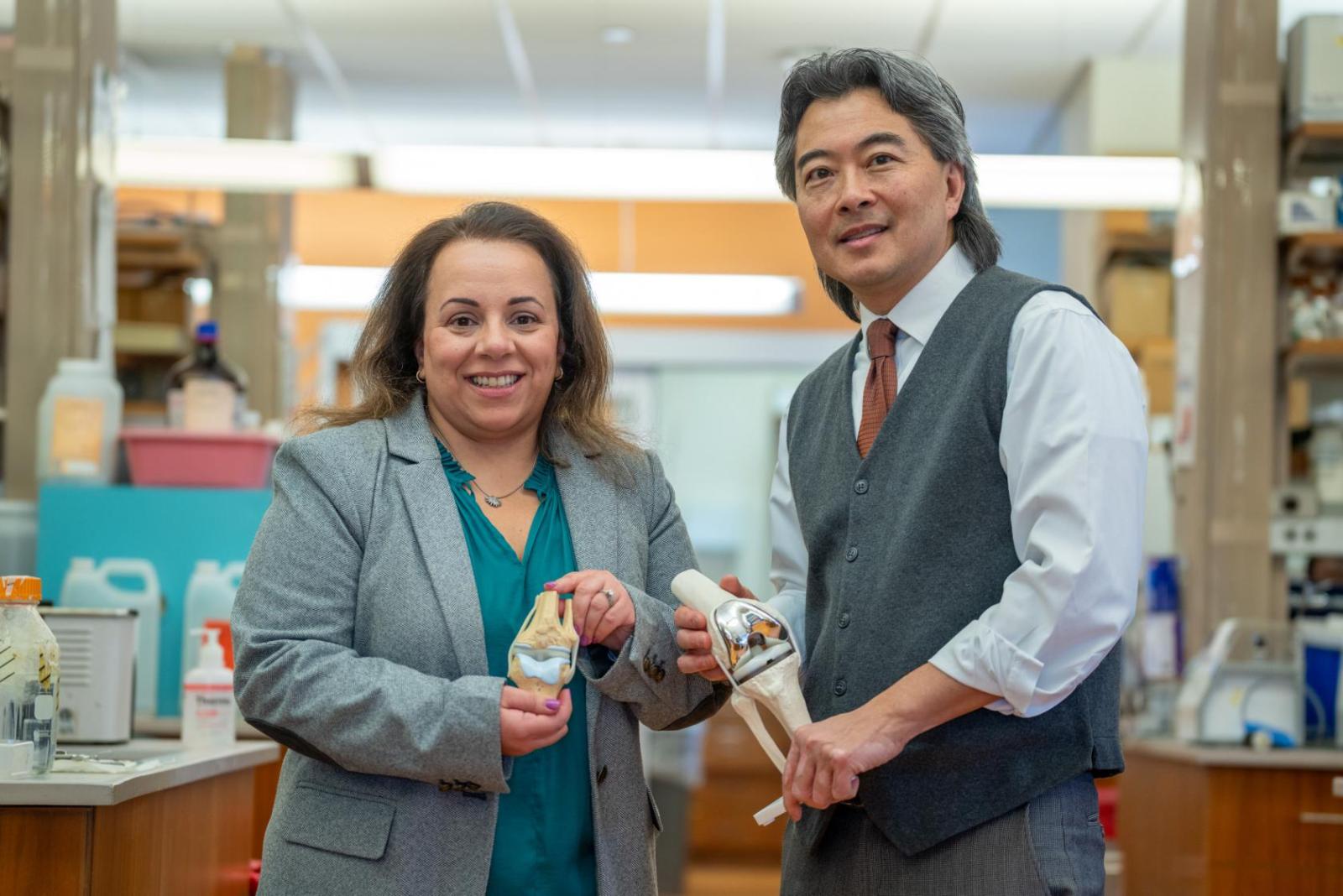
Nadeen Chahine and Clark Hung lead a team developing NOVAJoint, a revolutionary biocompatible, low-cost, patient-specific knee joint replacement. Photo by Steve Myaskovsky.
Solution: Knee replacements made from stem cells
The development of NOVAKnee stems from two decades of research by several Columbia University musculoskeletal researchers hailing from the Department of Orthopedic Surgery (VP&S), School of Engineering & Applied Science, College of Dental Medicine, and the Columbia Stem Cell Initiative, with unique chemistry that bonds them.
The Columbia design for this new joint looks like current metal and plastic replacement joints and will be surgically implanted with the same procedures. But NOVAKnee is a living, 3D-printed human organ, created with a biodegradable scaffolding material infused with stem cells. After implantation, the cells will regenerate the joint's natural cartilage and bone tissues as the scaffold disappears.
The team identified new biomaterials and used them to design an implant that can sustain the loading of the human knee. The implant contains combinations of biomaterials to make femoral- and tibial-shaped implants, sized to the patient's knee. Then it gets seeded with cartilage and bone cells, derived from stem cells either from the patient's own body (lipoaspirate from the abdomen) or from adult inducible pluripotent stem cells.
Collaboration by the teams of Alice Huang, associate professor of bioengineering (in Orthopedic Surgery), Chang Lee, associate professor of craniofacial engineering (in Dental Medicine), and Treena Arinzeh, professor of biomedical engineering, led to NOVAKnee's integrated and validated biological design. NOVAKnee is designed to integrate seamlessly with the patient's existing bone and restore pain-free joint function.
Columbia team is first ARPA-H project to move into preclinical testing
The Columbia researchers have been working to create the biological knee replacement over the past two years with support from ARPA-H. The agency selected the Columbia team for the project-under its Novel Innovations for Tissue Regeneration in Osteoarthritis (NITRO) program-in 2024.
On April 6, 2026, ARPA-H announced that the NOVAJoint team has met all the necessary milestones to move into the preclinical phase of the project. It is the first ARPA-H team to win such approval. Team member James L. Cook, the William C. and Kathryn E. Allen Distinguished Chair in Orthopaedic Surgery at the University of Missouri School of Medicine, will lead the preclinical studies.
The preclinical phase also represents a transition from implants made in Columbia's research labs to those manufactured by industry partners, following clinical standards for potential use in patients.
If the NOVAKnee implant meets its goals in the preclinical testing stage, the first human clinical trials are projected to begin in 2028.
Engineering challenges
The first two years of the ARPA-H project were dedicated to translating that research into a prototype and overcoming technical challenges.
One of the team's toughest was the selection of the joint's biodegradable scaffolding material and implant design. "The material needs to have load-bearing properties when first implanted, but also needs to biodegrade over time," Chahine says. "We selected polymers that are new to the medical implant field. The new materials allow us to balance strength, ductility, and manufacturability using 3D printing. We had to optimize the implant to achieve a design that wouldn't fail mechanically, is safe for implantation in the body, and can seamlessly integrate into the clinical workflow."
Close collaboration among Gerard Ateshian, Andrew Walz Professor of Mechanical Engineering and professor of biomedical engineering, Roshan Shah, Russell A. Hibbs Associate Professor of Orthopedics, and James Cook led to a NOVAKneedesign that should foster adoption by surgeons once the implant is FDA-approved.
Bringing NOVAKnee to market
A critical component of this program's metrics is accessibility and insurance coverage. To ensure that this technology is available to all patients impacted by osteoarthritis, the researchers have developed pathways for commercialization to reach all Americans. To accelerate this breakthrough technology's path to patients, NOVAJoint Orthopedics (www.novajointortho.com) has been established as an independent company committed to commercializing the NOVAKnee implant and extending the technology across orthopedic applications. In close partnership with Columbia University, NOVAJoint Orthopedics will continue advancing regulatory engagement with the FDA following a successful pre-IND by the research team. Despite the success to date, the team remains cognizant of the high risk-high reward "moon shot" nature of the project.


