
Using muon spin rotation spectroscopy, researchers from Japan and Canada successfully captured the rapid conversion of an imidoyl radical into a quinoxalinyl radical occurring within nanoseconds. The technique enabled real time detection of a highly reactive aromatic heterocyclic radical generated during the isocyanide insertion reaction, using muonium as a molecular tracker. The discovery is expected to advance particle-driven radical chemistry-exploring functional properties and offering new strategies for molecular transformation reactions.
Muonium-Driven Radical Formation Tracked in Real time Using TF-µSR
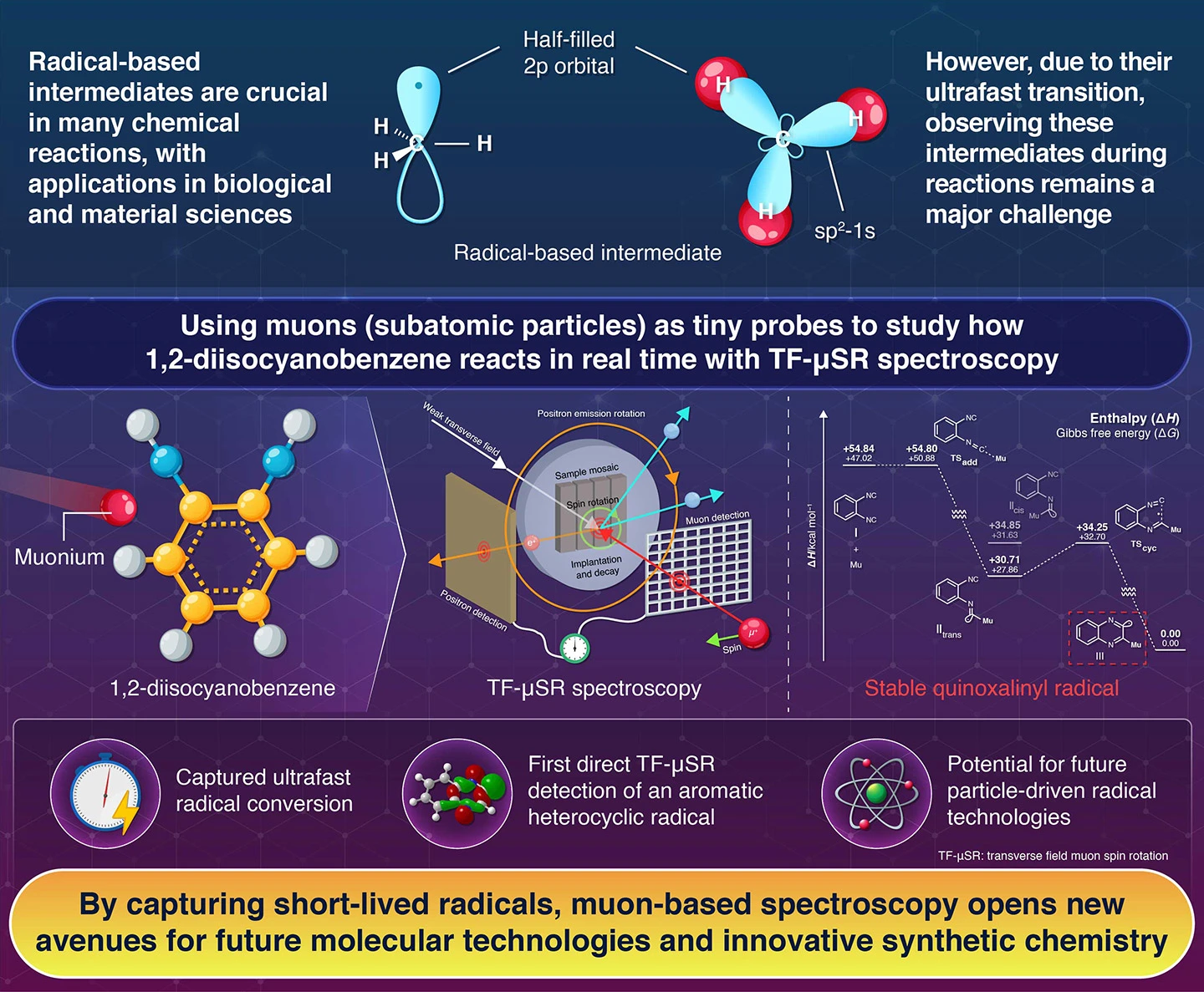
Radicals are highly reactive and short-lived chemical intermediates that play a central role in organic synthesis, materials design processes, and biomolecular chemistry. However, their fleeting lifetimes often make them difficult to observe directly, especially when the reactions occur in a billionth of a second. By observing these radicals in real time, various functional properties and open-shell reactivity mechanisms can be explored, opening new avenues in the field of organic chemistry. However, capturing these radicals has, therefore, remained a long-standing challenge in molecular chemistry.
Addressing this challenge, a research team led by Associate Professor Shigekazu Ito from the Department of Chemical Science and Engineering at Institute of Science Tokyo (Science Tokyo), Japan, along with graduate student Mr. Kazuki Iwami of Science Tokyo, and research scientists Dr. Kenji M. Kojima and Dr. Iain McKenzie of TRIUMF, Canada, devised a new strategy for observing radicals in real time.
They used an advanced technique called transverse field muon spin rotation (TF-µSR) spectroscopy, which detects positrons emitted from muons (subatomic particles) to analyze reaction intermediates at the atomic level. Their study, published online in Chemistry-A European Journal on November 24, 2025, reveals the successful capture of a quinoxalinyl radical generated in an isocyanide-based reaction.
Muonium is a light isotope of hydrogen formed when a muon captures an electron. To observe the radical intermediates in real time, the researchers first tagged the starting molecule 1,2-diisocyanobenzene with muonium to track its reaction step-by-step. Using TF-µSR to detect the signals of muon decay, the researchers were able to observe how muonium formed an imidoyl radical that almost instantly folded into a cyclized quinoxalinyl radical product-all happening within a few billionths of a second.
"We wanted to visualize the ultra-fast radical processes that are fundamental in organic chemistry. TF-µSR allowed us to follow the imidoyl radical as it converted into a quinoxalinyl radical, uncovering a cyclization that happened in mere nanoseconds," explains Ito.
Unlike previous studies where imidoyl radicals persisted long enough to be observed directly, here the intermediate instantly collapsed into a cyclized product. Once formed, the quinoxalinyl radical displayed remarkably high reactivity, readily abstracting hydrogen atoms from the surrounding solvent molecules. Temperature-dependent experiments confirmed this reactivity, demonstrating how particle-induced radical chemistry differs from traditional radical pathways.
"The results show how muon-based techniques can reveal chemical events that occur far too quickly for conventional spectroscopy. Understanding such ultrafast cyclization reactions could open new pathways to designing radical transformations," notes Ito.
Overall, the study sets a new benchmark in radical chemistry with the first direct observation of an aromatic heterocyclic radical using TF-µSR. The study also highlights the potential of TF-µSR spectroscopy as a powerful tool for unraveling the behavior of heterocyclic radicals, which are central to pharmaceuticals, biomedical technologies, and molecular electronic applications. In the future, the technique could enable chemists to better control particle-driven reactions and build more precise radical insertion methods-accelerating innovations in synthetic chemistry, molecular engineering, and particle-assisted catalysis.
Reference
- Authors:
- Shigekazu Ito1, Kazuki Iwami1, Kenji M. Kojima2, and Iain McKenzie2
- Title:
- Observation of Quinoxalinyl Radical Produced by Muonium Addition to 1,2-Diisocyanobenzene
- Journal:
- Chemistry-A European Journal
- Affiliations:
- 1Department of Chemical Science and Engineering, School of Materials and Chemical Technology, Institute of Science Tokyo, Japan.
2Centre for Molecular and Materials Science (CMMS), TRIUMF, Canada


