What the research is about
What if a city could understand the movements of people and vehicles in real time?
And what if it could predict accidents or traffic congestion before they happen - and take action in advance?
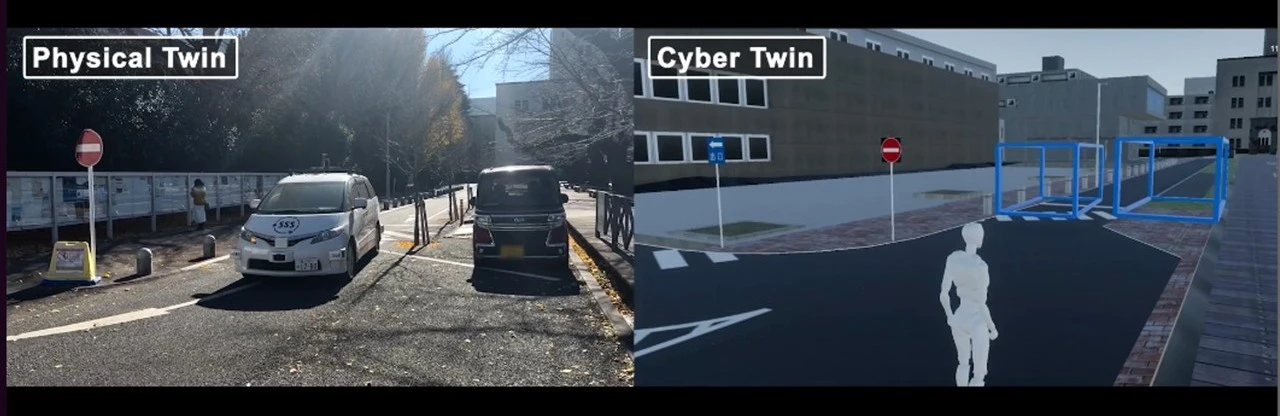
Professor Kei Sakaguchi and his team at Institute of Science Tokyo (Science Tokyo) are working to make this future mobility system a reality. The system is currently being demonstrated on Science Tokyo's Ookayama Campus (Photo 1).
In recent years, a technology called the "digital twin" has attracted growing attention. A digital twin is a system that recreates real-world environments - such as cities or factories - in a digital space. By collecting real-time data, it can visualize what is happening in the real world and even predict future events. Digital twins are already being used in fields such as manufacturing, agriculture, and logistics, and research in transportation has also been progressing rapidly.
Until now, many technologies have been developed to control urban traffic using data, including roadside cameras and sensors, as well as communication systems between vehicles and roads. However, most of these efforts remained limited to just traffic monitoring or computer simulations. Very few systems have successfully connected the full cycle of "sensing, thinking, and acting" in a real city in real time.
Why this matters
Sakaguchi's research has opened the door to a mobility digital twin in which cities and vehicles communicate with each other in real time. The project has three major features.
1. Roadside infrastructure
One of the biggest challenges for autonomous driving is dealing with blind spots.
To compensate for areas that vehicle sensors alone cannot detect, the team installed roadside units at intersections with poor visibility. These units are equipped with laser sensors and cameras that can accurately detect pedestrians and bicycles hidden around corners and share that information with nearby vehicles.
2. A real-time digital twin
Information from the real world is transmitted to the digital space almost instantly.
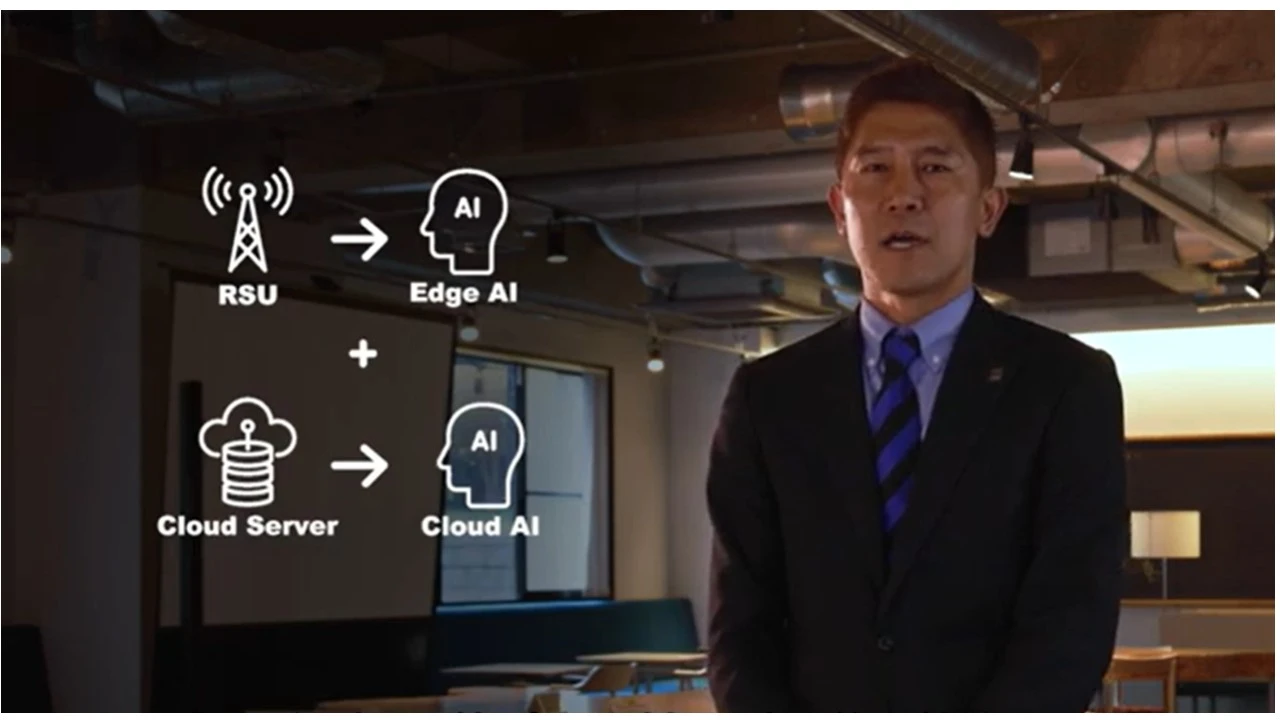
The system processes data around intersections in just 10 milliseconds and citywide information in about 100 milliseconds, synchronizing the digital and physical worlds in real time. This speed allows the system to support immediate actions such as collision avoidance and route optimization.
3. AI-based prediction and control
One of the most important features of a digital twin is its ability not only to reproduce the present, but also to predict the future. Using accumulated data, the system can use AI to predict risks such as pedestrians suddenly entering the road or possible traffic accidents. This concept was already demonstrated in fiscal year 2024. Such capabilities could allow vehicles to adapt their driving behavior to the unique traffic conditions and local rules of each location.
Together, these technologies are bringing mobility digital twins closer to practical use in real urban environments. They are beginning to offer realistic solutions to major traffic challenges such as congestion and accidents.
What's next
Sakaguchi's research continues to evolve. For example, the team is developing technologies that can predict when buildings may block radio signals and automatically switch communication routes before disruptions occur. This could improve the reliability of autonomous driving systems by preventing communication failures.
The potential applications of this technology also extend far beyond mobility. Sakaguchi envisions a future in which digital twins work together with humanoid robots. A single intelligence in the digital space could operate different robots and machines for tasks such as housework, transportation, factory operations, and nursing care. Such systems may eventually help address major social challenges, including labor shortages.
Comment from the researcher
Cars are becoming smarter, but the city itself can also think alongside them. Demonstrating this kind of mobility system in the real world is an important step forward.
(Kei Sakaguchi, Professor, School of Engineering, Institute of Science Tokyo)
Dive deeper
Explore more research in Science for All
Science for All showcases cutting-edge research at Science Tokyo and highlights the ideas, people, and possibilities shaping the future.