
.jpg)
Cosmic detectives are being called on for an interstellar mission to hunt down thousands of invisible black holes lurking in our own back yard.
Space scientists from the University of Southampton need amateur astronomers to search for signs that might locate them.
They know the location of about 70 black holes but reckon there could be thousands more hiding in our galaxy yet to be discovered.
Experts behind the Black Holes Hunters project used a clever AI system to pre-screen millions of possible locations in our Milky Way and pinpoint where they may be hidden.
The system used advanced techniques to examine vast amounts of data, searching in days what used to take years.
The case is now being handed over to citizen scientists to finish the job.
Dr Adam McMaster from Southampton's physics and astronomy department said: "Black holes are famously elusive and trap light, which hide them from telescopes.
"But they often leave clues because of their strong gravity, which can bend light as they orbit around stars creating an effect called gravitational self-lensing.
"Once we detect this, we'll know an invisible black hole exists."
The space data being used in the Black Hole Hunters project is taken from NASA's planet-hunting telescope TESS, or the Transiting Exoplanet Survey Satellite.
It has already struck a chord with amateur astronomers.
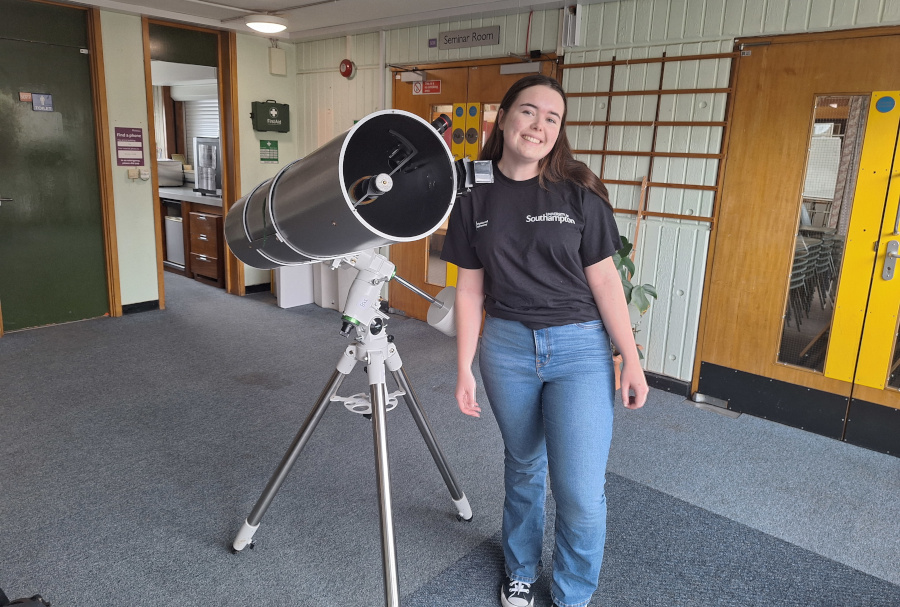
Stargazer Grace Clarke, 20, studies physics with astronomy at the University of Southampton and signed up to the Black Hole Hunters project to "make history".
The undergrad (below) said: "There's still so little we know about black holes so the idea of finding one in our backyard is very exciting.
"This is why the Hunters project's so interesting to me," added Grace, who is also president of the university's astronomy society.
"I can search for black holes on my laptop from my bedroom - and could make a real impact on real space science.
"The data's easy to understand, it's just pattern recognition, and you don't need a degree in astronomy to read it."
The Southampton scientists filtered down huge quantities of data from the NASA telescope and turned them into simple graphs and animations, ready to be searched through by the volunteers.
Dr McMaster added: "We now need people to look at these graphs and flag anything that catches their eye.
"It's a simple task with no expertise required, and we will show volunteers examples of what to look for so all they have to do is recognise the right patterns.
"With potentially thousands of new discoveries, we need all the help we can get.
"You'll be narrowing down precisely where we need to point our telescopes next and you might be the one to discover a black hole."
Have you got what it takes to find a black hole from your bedroom? No posh telescope needed - just a phone, tablet or laptop and a bit of curiosity.
Join the cosmic hunt at zooniverse.org/projects/cobalt-lensing/black-hole-hunters .


