
Climate change is transforming ecosystems and directly influencing the seasonal movements of many animal species.
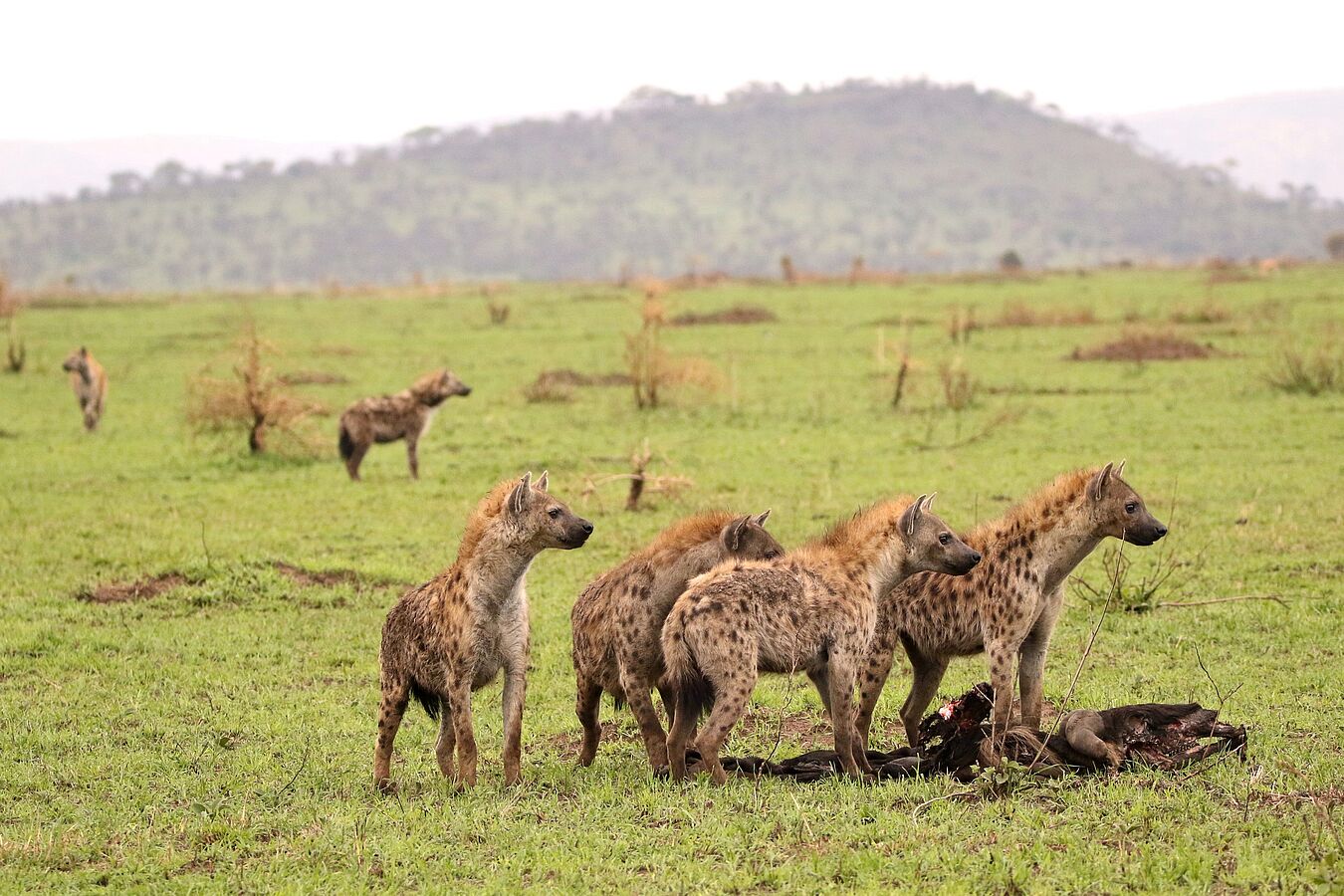
Spotted hyenas in the Serengeti | Photo: Sonja Metzger, IZW
In the Serengeti, changes in the distribution of migratory herbivores can have important consequences for predators that depend on prey such as wildebeest and zebras. A long-term study by scientists from the Leibniz Institute for Zoo and Wildlife Research (Leibniz-IZW) and international collaborators now shows that Serengeti spotted hyenas respond remarkably flexibly to these changes.
Although the main prey of spotted hyenas (Crocuta crocuta), migratory ungulates such as blue wildebeest (Connochaetes taurinus), now spend substantially less time within hyena territories than they did 30 years ago, hyena clans in the central Serengeti have remained largely stable. For this study, scientists used one of the world's longest-running datasets on a large carnivore, spanning three decades and including thousands of individually known hyenas across multiple generations. They investigated how climate-related changes in prey availability within clan territories influence hunting opportunities and, ultimately, the hyena population in Serengeti National Park, Tanzania.
Over recent decades, rainfall has increased across the Serengeti. This change in rainfall is suspected to have influenced the movement patterns and distribution of large herds of migratory prey, as it reduced the time these large prey herds now spend within central spotted hyena clan territories. Whereas between 1990 and 1994 migratory herds were present within clan territories for around 12% of the year, this had consistently declined to only about 7 percent between 2015 and 2019.
How do large carnivores compensate for the reduced availability of their main prey?
Consistent with the decline in the presence of migratory prey within clan territories, the number of observed feeding events also declined over the study period. However, the scientists found that Serengeti hyenas continued to feed predominantly on migratory prey species and have not gradually switched to resident prey species, which occur at much lower densities and would be insufficient to sustain entire clans.
"Spotted hyenas are what ecologists call central-place foragers", explains Dr Mellina Sidous lead author of the study. "They cope with seasonal fluctuations in prey availability by commuting between their clan territory and the areas where migratory herbivores are currently concentrated. These commuting trips are particularly common among females with young cubs, because the cubs remain at the communal den and cannot accompany their mothers."
These foraging trips can last up to a week and involve journeys of up to 150 kilometres. Hyenas undertake these long-distance trips only when migratory prey are absent from their own territories.
Remarkable resilience despite changing prey availability
Despite fewer feeding opportunities within their territories over the past three decades, two of the three study clans actually increased in size. "Our results suggest that spotted hyenas are currently able to buffer the decrease in local prey availability," say the two senior authors Dr Sarah Benhaiem and Dr Sarah Cubaynes, scientists at the Leibniz-IZW and CEFE. "Their behavioural flexibility appears to allow them to compensate for reduced hunting opportunities within their territories", adds Dr Sonja Metzger, co-author of the study. Other factors may also have contributed to the positive population trends, including a potential increase in overall numbers of migratory ungulates across the Serengeti ecosystem or reduced hyena mortality caused by disease, lion predation or snaring. Determining the relative importance of these mechanisms will be an important goal of future research.
Climate change may not be the only factor driving these changes. Increasing human activities within Serengeti National Park, particularly tourism and the associated development of roads, lodges and other infrastructure, may also influence the distribution of migratory herbivores. A recent study by a research team of the University of Glasgow found that wildebeest increasingly avoid highly developed areas in the central Serengeti, suggesting that human disturbance may contribute to the observed redistribution of prey.
The study provides new insights into how large carnivores can respond to changes in prey distribution. These findings extend beyond the Serengeti. Around the world, climate change is altering the movements of migratory species. Understanding how predators respond to these spatial and temporal shifts will be essential for predicting the future impacts of climate change on wildlife populations.
Sidous M, Gicquel M, Metzger S, East ML, Hofer H, Nyahongo JW, Benhaiem S, Cubaynes S (2026):
How did spotted hyaenas respond to decreased prey availability in their clan territories over the last decades? ECOSPHERE 17 (10),
DOI: 10.1002/ecs2.70800


