
Representatives from government, workers' and employers' organizations, digital platform enterprises, the European Union, and the International Labour Organization (ILO) gathered in Beijing on 15 October 2026 for a Technical Seminar on the recently adopted ILO Decent Work in the Platform Economy Convention, 2026 (No. 193). Jointly organized by the ILO and the Ministry of Human Resources and Social Security of China (MOHRSS) in the context of the "Improving China's institutional capacity towards universal social protection (Phase III)", funded by the European Union, the event provided a platform for dialogue on emerging policy responses and practical measures to promote decent work in the rapidly evolving platform economy.
Opening the event, senior representatives from MOHRSS, the European Union Delegation to China, the All-China Federation of Trade Unions (ACFTU), the China Enterprise Confederation (CEC), and the ILO underscored the growing importance of ensuring that technological innovation and new forms of work create opportunities while safeguarding workers' rights and social protection.
ILO C193 is now in place as an international labour standard for ILO Member States and tripartite constituents to guide their forthcoming legal frameworks in further enhancing the labour conditions of workers in the platform economy in key aspects such as fundamental principles and rights at work, occupational safety and health, employment status, remuneration or payment, protection of personal data and privacy, terms and conditions of employment and rights to social security - all elements of decent work.
Mr Mikhail POUCHKIN, Director, ILO Country Office for China and Mongolia
A central focus of the seminar was the presentation of the Decent Work in the Platform Economy Convention, 2026 (No. 193), adopted by the International Labour Conference on 12 June 2026. As the first international labour standard dedicated to improving working conditions in the platform economy, the Convention establishes a framework to guide countries in ensuring that technological innovation and new business models go hand in hand with workers' rights, fair competition, and sustainable economic growth.
Throughout the seminar, participants shared experiences and perspectives on policy and regulatory responses to the opportunities and challenges presented by the platform economy, including labour protection, social protection and platform governance.
The seminar featured a dedicated session on China's experience in promoting decent work in the platform economy. A Chinese expert outlined the evolution of China's approach to protecting platform workers' rights and reviewed recent regulatory developments, while an ILO expert presented plans for a forthcoming China Thematic Report on Decent Work in the Platform Economy. As one of the largest location-based platform companies, Meituan shared its practices to protect riders' rights and interests, including measures related to occupational safety, algorithm management, and social security.
Social protection was a key theme throughout the discussions. ILO highlighted ongoing efforts to extend social protection coverage and strengthen policy frameworks to better respond to the needs of workers engaged in platform-based work arrangements. MOHRSS presented the design and implementation of the occupational injury insurance programme for workers in new forms of employment, which currently covers more than 37 million workers.
Representatives of workers' and employers' organizations exchanged views on practical pathways for realizing decent work in the platform economy. Contributions from ACFTU and CEC emphasized the importance of balanced approaches that support both innovation and the protection of workers' rights and interests.
The seminar further benefited from international experiences shared by experts from the European Commission, Spain, and the Netherlands, who presented recent developments and lessons learned from policy initiatives addressing platform work in Europe, particularly the EU Platform Work Directive and national efforts to transpose the Directive into domestic legislation. While recognizing the importance of regulatory initiatives at international, regional, and national levels, speakers highlighted the need for continuous monitoring and evidence-based research to inform policymaking.
Concluding the event, participants reaffirmed the value of tripartite social dialogue and international cooperation in addressing the opportunities and challenges associated with the platform economy. They highlighted the importance of exchanging experiences and strengthening collaboration to promote decent work, inclusive growth, and effective social protection for platform workers.
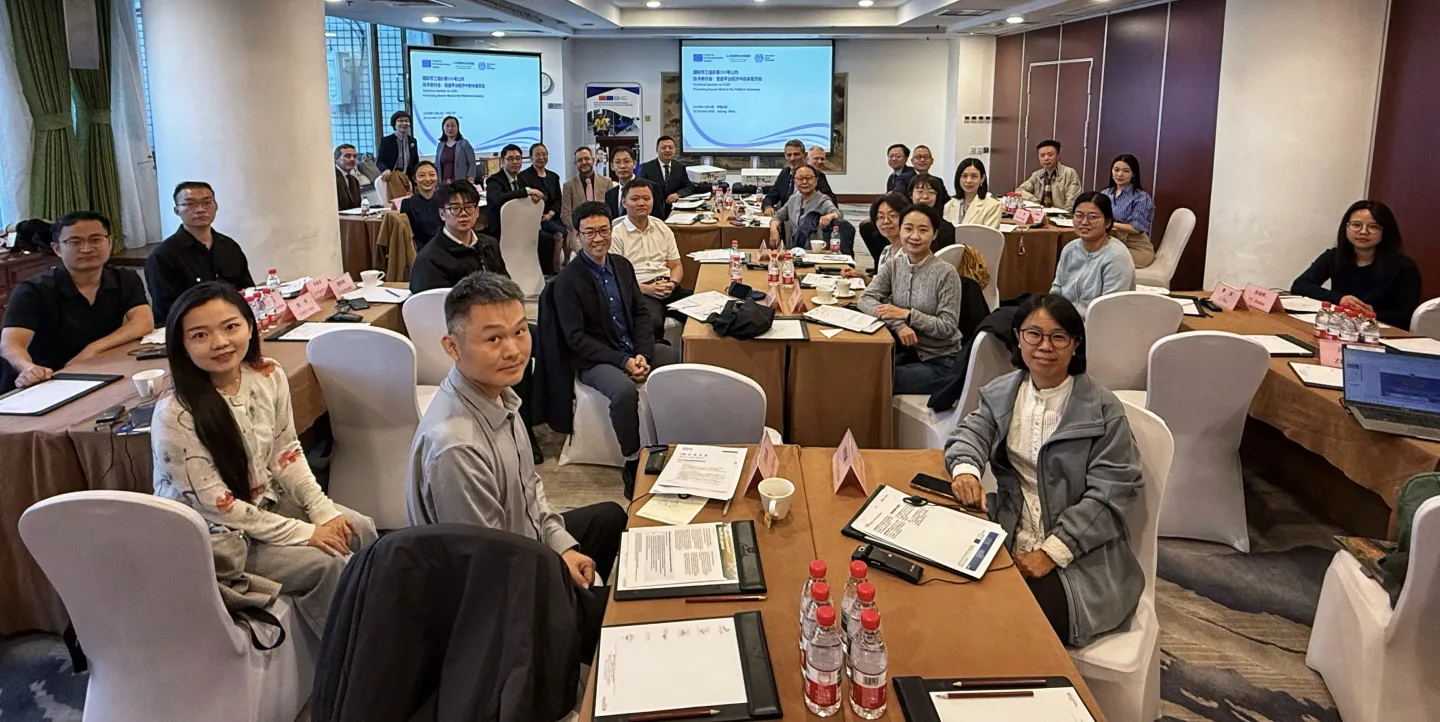
© ILO
Through our Team Europe approach, we seek to bring together this expertise, coordinate our engagement and share good practices and concrete case studies with our partners. While national contexts differ, exchanging experiences can help us better understand what works in practice and inform policy development.
Mr Franck PORTE, Head of Cooperation, Delegation of the European Union to China
China attaches great importance to protecting the rights and interests of workers in new forms of employment and has continued to improve relevant policies and institutions. We welcome international dialogue and cooperation to promote the healthy development of the platform economy and decent work for all.
Mr JIANG Wei, Deputy Director-General, International Cooperation Department, MOHRSS
The ILO Office for China and Mongolia will continue to support China's efforts to enhance the protection of workers in new forms of employment through the EU-funded project "Improving China's institutional capacity towards universal social protection (Phase III)".


