
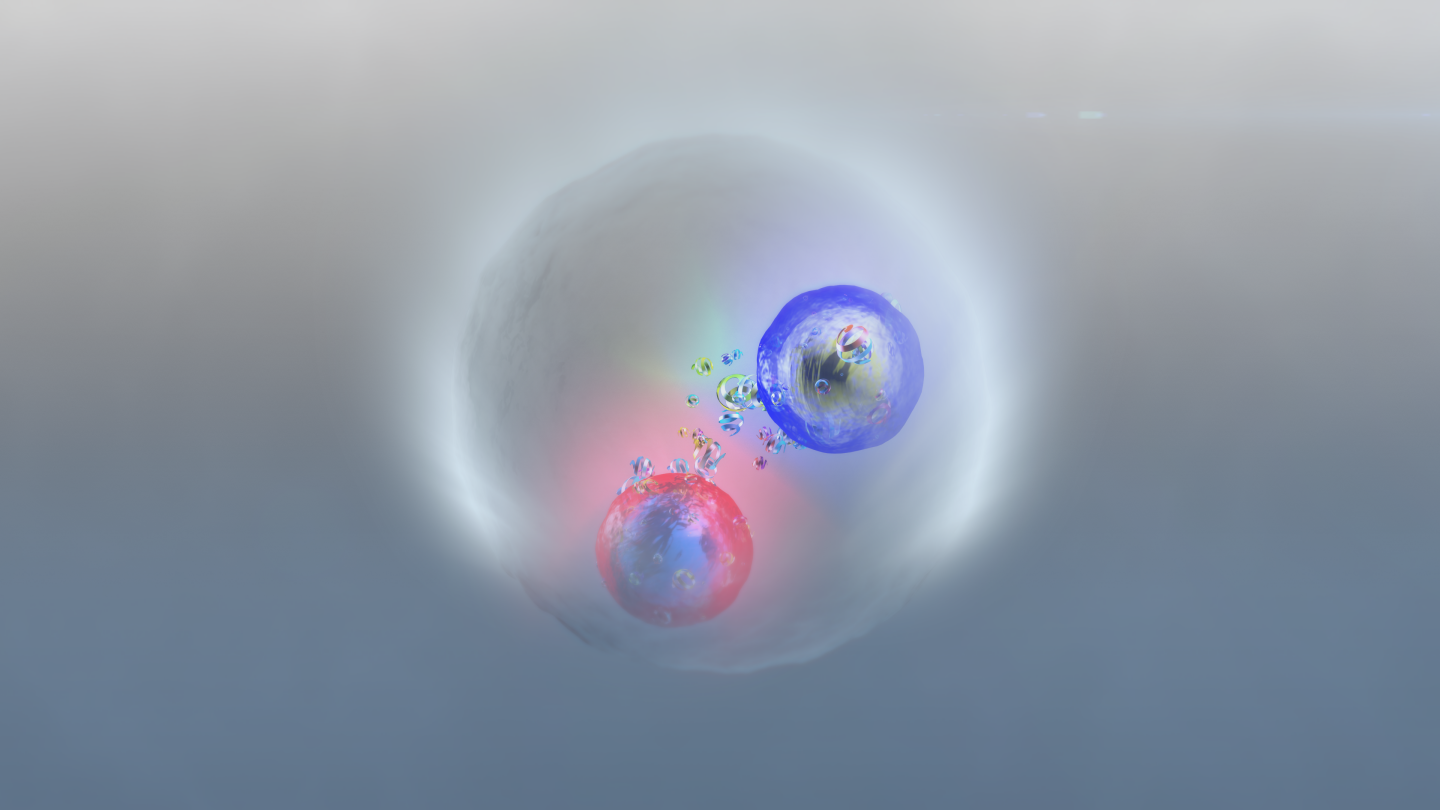
An artist's impression of toponium. (Credit: D. Dominguez/CERN)
The top quark, the heaviest and most short-lived elementary particle known, has long been thought to decay too quickly to form bound states. However, a new result from the CMS Collaboration, presented this week at the Rencontres de Moriond conference, strengthens last year's observation that top quarks may, in fact, briefly pair up with their antimatter counterparts. This fleeting bound state - known as toponium - would be the most massive composite particle ever observed, completing the family of quark-antiquark states bound by the strong nuclear force.
Most matter around us is made of atoms, in which electrons cling to protons through the electromagnetic force. But protons themselves are not elementary. They belong to a broad family of composite particles called hadrons, in which quarks are held together by the strong nuclear force. Among them, the simplest are pairings of a quark with its own antiquark, which provide an especially clean window on the workings of the strong force. For decades, such states have been known for every type of quark but the most elusive: the top.
First discovered more than 30 years ago at the Tevatron accelerator near Chicago, the top quark has been extensively studied ever since, with experiments at the LHC going so far as to measure quantum entanglement between top quarks and antiquarks. Even when produced alongside its antiquark, the top typically decays before any bound state can form. Yet the hundreds of millions of top quark-antiquark pairs produced at the LHC, effectively making it a top-quark factory, provide such an enormous dataset that the rarest phenomena can leave a detectable trace.
The first hints of toponium appeared in searches for heavy Higgs-boson-like particles that could decay into a top quark-antiquark pair. An unexpected excess of collision events was observed at a mass close to twice the mass of the top quark, which is more characteristic of a bound state rather than a new fundamental particle. Detailed studies by the CMS and ATLAS experiments confirmed this excess using events in which both top quarks decay into leptons (electrons or muons).
The new CMS study approaches the problem from a different angle, examining events in which one top quark decays into a bottom quark, a charged lepton and a neutrino while the other decays into quarks that produce sprays, or "jets", of particles. "Isolating the signal in this decay channel was challenging," says Otto Hindrichs, a researcher at the University of Rochester who developed a new AI-assisted technique to reconstruct these collision events.
"Instead of reconstructing the mass of the top quark-antiquark pair directly, we focused on the relative velocity of the top quark and antiquark," explains Yu-Heng Yu, a graduate student involved in the analysis. "If they form a bound state, their relative velocity should be much smaller than when they are produced independently,"
These new techniques proved highly effective. They resulted in the observation of an excess with a statistical significance of more than five standard deviations - the gold standard for a discovery in high-energy physics. The result provides a new, statistically independent confirmation of toponium production.
"Toponium is heavier than the heaviest known atomic nucleus, oganesson, making it the most massive bound state ever observed," says Regina Demina, leader of the CMS group at the University of Rochester. "Its discovery deepens our understanding of the strong nuclear force and its ability to bind the fundamental constituents of matter."


